PSF hardens GitHub Actions; Python migration continues
PSF staff stripped pull_request_target and issue_comment risks from PyPI-related GitHub orgs before GitHub's Dec 2 default block. What to audit.
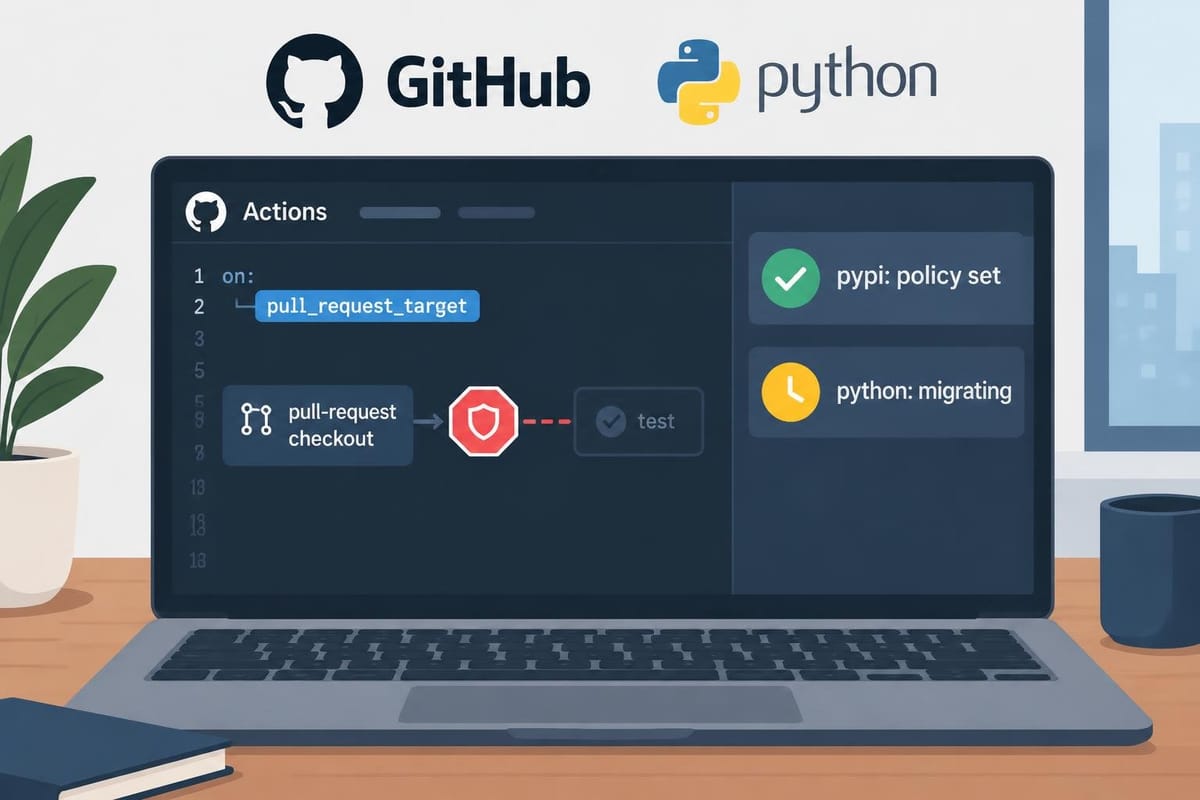
Mike Fiedler, PyPI Safety and Security Engineer, and Seth Larson, Security Developer in Residence, say they have removed dangerous GitHub Actions triggers and applied event policies in the Python Software Foundation's GitHub organizations, though the work is not finished everywhere: Fiedler has set up the policy for the pypi organization, while Larson is still migrating the remaining python repositories before enabling the policy there. That is according to a LavX News report of a PSF blog post dated Nov. 18, 2026. The work covers the psf, python and pypi organizations and comes ahead of a GitHub change on December 2, 2026 that, per LavX, blocks pull_request_target by default in public repositories. Both roles are funded by Alpha-Omega, LavX says.
Status by organization
Per the LavX summary of the PSF post:
- pypi: Fiedler set up the event policy.
- python: Larson is migrating the few repositories that still use insecure triggers, then will enable the event policy.
- psf: covered by the work, but LavX does not describe its current state.
The pair also published guidance for other organizations on the Alpha-Omega blog. The PSF post states that Fiedler set up the event policy for the pypi organization and that Larson is migrating the few remaining repositories in the python organization that use insecure triggers before enabling the event policy there. The exact policy settings and repository counts are not confirmed here.
Why these triggers
GitHub's events documentation notes that pull_request workflows do not run when a pull request has a merge conflict, while pull_request_target workflows do, and warns about the security risks of the latter. LavX's account of the difference: pull_request from a fork runs with a read-only token and no secrets, while pull_request_target runs with a read/write token and access to secrets. The dangerous pattern is checking out the pull request head and executing it:
on: pull_request_target
jobs:
  test:
    runs-on: ubuntu-latest
    steps:
      - uses: actions/checkout@v6
        with:
          ref: ${{ github.event.pull_request.head.sha }}
      - run: make test
That runs a stranger's code with the maintainer's credentials. issue_comment carries a similar risk: comment-triggered CI bots that check out the PR, or workflows that interpolate comment text into a shell command, which allows injection.
LavX lists three incidents cited by the PSF: Ultralytics (December 2024, poisoned build cache leading to malicious PyPI releases, entry point traced to a pull_request_target workflow); LiteLLM and Telnyx (March 2026, releases following a token exposure via an exploited Trivy dependency, itself traced to a pull_request_target workflow); and elementary-data (April 2026, comment text placed in a shell script, leading to a malicious release). These are the PSF's characterizations as relayed by LavX.
What to check in your own repositories
- Find every use. Search
.github/workflowsforpull_request_targetandissue_comment. - Look for checkout of untrusted refs. An
actions/checkoutwithref: ${{ github.event.pull_request.head.* }}in a privileged workflow is a warning sign. The dangerous pattern is executing that code afterward, for example by running tests or builds, in the privileged context. Code that is only read as data is a lower risk. - Look for interpolation. Comment bodies, PR titles and branch names placed directly in
run:scripts should be passed through environment variables instead. - Split labeling from testing. Chores that never touch contributor code can stay privileged; test runs should move to
pull_request. - Plan for December 2. Per a secondary guide on note.com summarizing GitHub's announcement,
pull_request_targetwill be blocked in public repositories unless a policy allows it. Review affected workflows: some may need rewriting topull_request, and workflows you decide to keep can be explicitly allowed by policy, scoped to specific workflow files. Per LavX, organizations on GitHub Team or Enterprise can disable the triggers org-wide with one policy; Free-plan organizations must do it per repository. We have not verified these plan details against GitHub's own announcement. - Remove long-lived publish tokens. If you publish to PyPI, Trusted Publishers avoid storing an API token a compromised workflow could leak. LavX says Ultralytics, LiteLLM and Telnyx adopted them after their incidents.
The PSF's reported sequence is a useful model: configure the policy, check what it would block, then enforce it.
Comments ()