GitHub’s agentic workflows promise less YAML, not less complexity
GitHub’s agentic workflow pitch may speed up Actions authoring, but CI/CD teams still need review, permissions, and rollback discipline.
GitHub’s agentic workflows promise less YAML, not less complexity
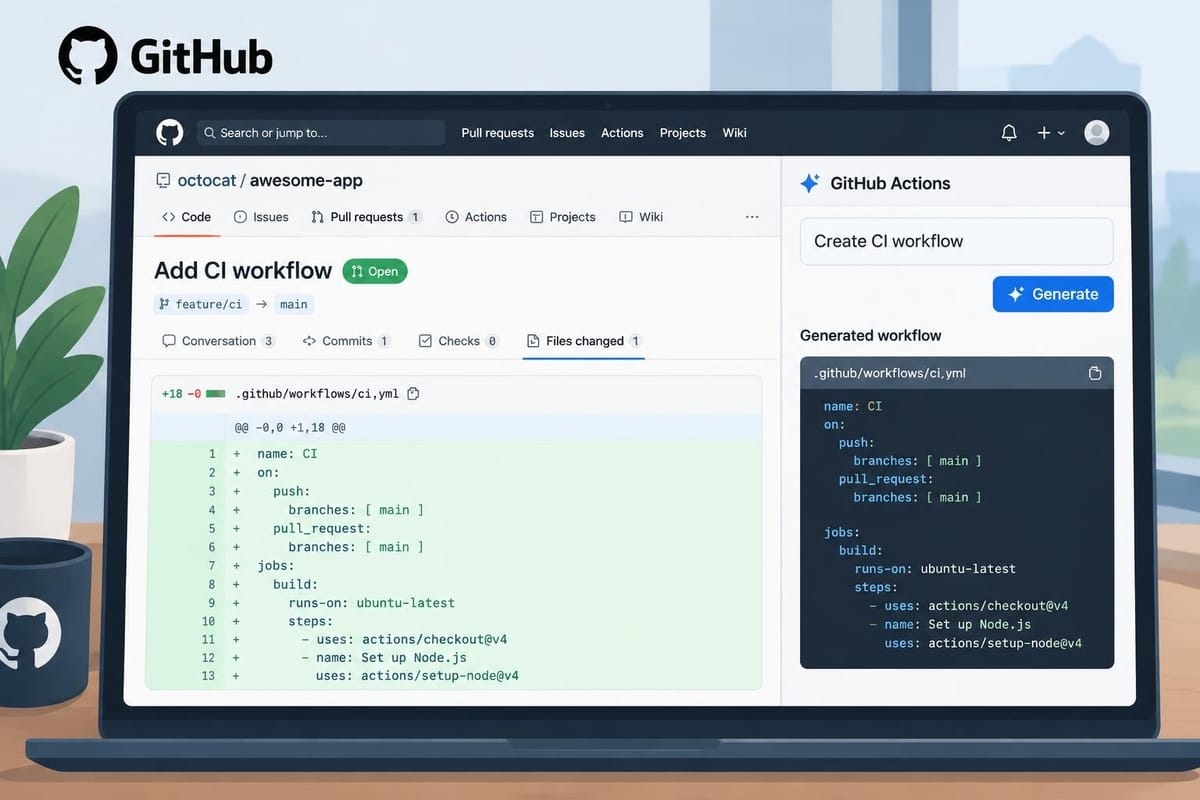
GitHub’s pitch is simple enough to be seductive: describe the workflow you want in plain English, and let the platform help turn that into GitHub Actions automation. That sounds like a shortcut. For CI/CD teams, it might be. But it is also exactly the kind of shortcut that deserves a hard look, because pipeline code is where “helpful” tools tend to hide their real cost.
The reporting record here is thin but telling. Google News surfaced a GitHub Blog item titled “Automate repository tasks with GitHub Agentic Workflows”, and another GitHub Blog lead referenced “GitHub Agentic Workflows are now in technical preview.” Those snippets are enough to establish the direction of travel: GitHub is packaging agentic, natural-language assistance around repository automation and Actions workflows. They do not by themselves prove every implementation detail, and they certainly do not justify pretending the feature is some entirely new CI engine.
That distinction matters. The useful question is not whether the interface is clever. It is whether it changes the hard parts of CI/CD — permissions, review, rollback, and auditability — or merely makes them easier to gloss over.
The best-case reading: less boilerplate, faster setup
If the feature does what the GitHub Blog title suggests, the obvious win is reducing ceremony. A lot of workflow authoring is repetitive: checkout, setup, install, test, build, publish. That is not glamorous engineering; it is repetitive translation from intent into YAML.
A conventional Actions workflow still looks like this:
name: CI
on:
  pull_request:
  push:
    branches: [main]

jobs:
  test:
    runs-on: ubuntu-latest
    permissions:
      contents: read
    steps:
      - uses: actions/checkout@v4
      - uses: actions/setup-node@v4
        with:
          node-version: 20
      - run: npm ci
      - run: npm test
If a natural-language assistant can sketch something like that faster than a human can remember the exact syntax, fine. That is a real productivity gain, especially for small teams and for engineers who only touch pipeline config occasionally.
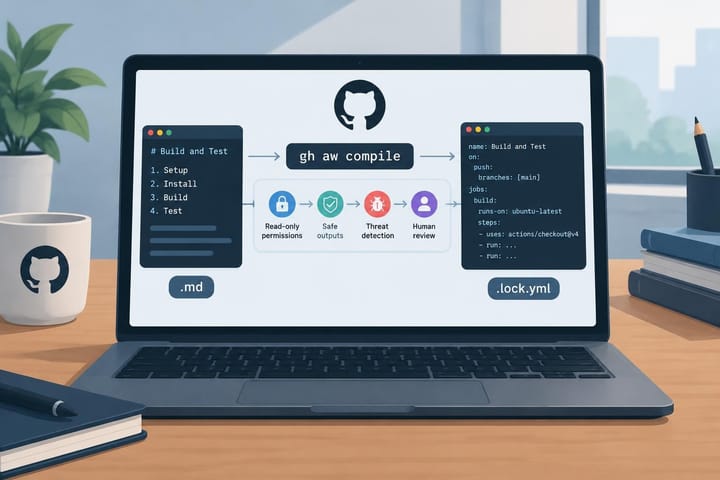
The least controversial use case is scaffolding: generate a draft, inspect the diff, and harden it before it ever reaches production. That is not “AI running CI.” It is a drafting aid for repetitive plumbing.
The catch: CI/CD is judged by the parts people ignore
The problem with automation tools is that they rarely fail on the part users are paying attention to. They fail on the parts users assume are already handled.
In CI/CD, those parts are the entire job:
- workflow permissions
- secret scope
- environment approvals
- branch protections
- action pinning
- rollback behavior
- audit trails
If GitHub Agentic Workflows produces editable Actions YAML that still passes through the same review and policy layers as any other workflow change, that is a healthy design choice. It means the tool is a convenience layer, not a parallel trust model.
If, on the other hand, teams start treating prompt text as the source of truth — or they accept generated YAML without the same scrutiny they would apply to hand-written automation — then the feature becomes a risk multiplier. The danger is not that the assistant invents a bad step. The danger is that it makes a fragile workflow look finished before anyone has really examined it.
That is where the skepticism belongs.
The practical test: can you audit it?
A serious team should not ask, “Can it generate a workflow?” That is the demo question.
The real question is: Can we review it, constrain it, and reverse it cleanly?
That means asking whether the generated output is still just YAML in a repository, subject to the same controls as every other code change. It means checking whether the usual guardrails still hold:
permissionsstay least-privilege by default- deployment jobs still require environment approvals
- secrets do not expand beyond what the workflow actually needs
- the generated file can be inspected in a pull request
- reverting the commit restores the previous behavior
If those things remain true, then the feature is additive. If they do not, then GitHub has not simplified CI/CD — it has hidden some of its complexity behind a nicer prompt.
Why the “interface layer” framing matters
Based on the available reporting, the safest way to describe this launch is as an interface for repository automation, not a replacement for Actions itself. That is the honest read of the evidence we have: the GitHub Blog titles point to task automation and a technical preview of agentic workflows, not to a brand-new execution substrate.
That framing is boring, and boring is usually correct in infrastructure.
It also explains why the feature is interesting without overclaiming. GitHub is not changing what CI/CD is. It is trying to change how people author it. Those are very different products.
A better authoring layer can still matter a lot. Plenty of engineering time is wasted on syntax memory, copy-paste workflow drift, and tiny mistakes that turn into failed builds. But a better authoring layer does not erase the underlying operational burden. Someone still has to own policy, security, and maintenance once the generated file is checked in.
What a cautious rollout would look like
A team evaluating a feature like this should not begin with broad rollout. It should begin with narrow use:
- Generate non-production workflows first.
- Review every diff as if it were hand-written.
- Keep permissions tight and explicit.
- Require the same approvals you already use for workflow changes.
- Measure whether it actually saves time, or just shifts review effort elsewhere.
That is the difference between a useful drafting assistant and a new layer of pipeline sprawl.
And sprawl is the real enemy here. The software industry already has too many systems that are easy to create and annoying to govern. CI/CD does not need another one.
The bottom line
GitHub’s agentic workflow pitch is plausible because it targets a real pain point: workflow authoring is tedious, and plain-English scaffolding can save time. But the evidence available in this reporting packet supports a narrower conclusion than the hype would like.
This is not a new CI platform. It is a way to make GitHub Actions easier to author. That can be useful — even valuable — if the resulting YAML stays reviewable, policy-bound, and easy to roll back.
The warning is equally clear: if teams mistake convenience for trust, they will end up with automation that is faster to create and no easier to manage.
That is the tradeoff, and it is the only one that matters.

Comments ()