jj-musubi live-syncs Jujutsu repos across a person's machines
jj-musubi syncs a Jujutsu repo's op log across your machines over SSH. What it does, how it differs from Git pushes, and its stated limits.
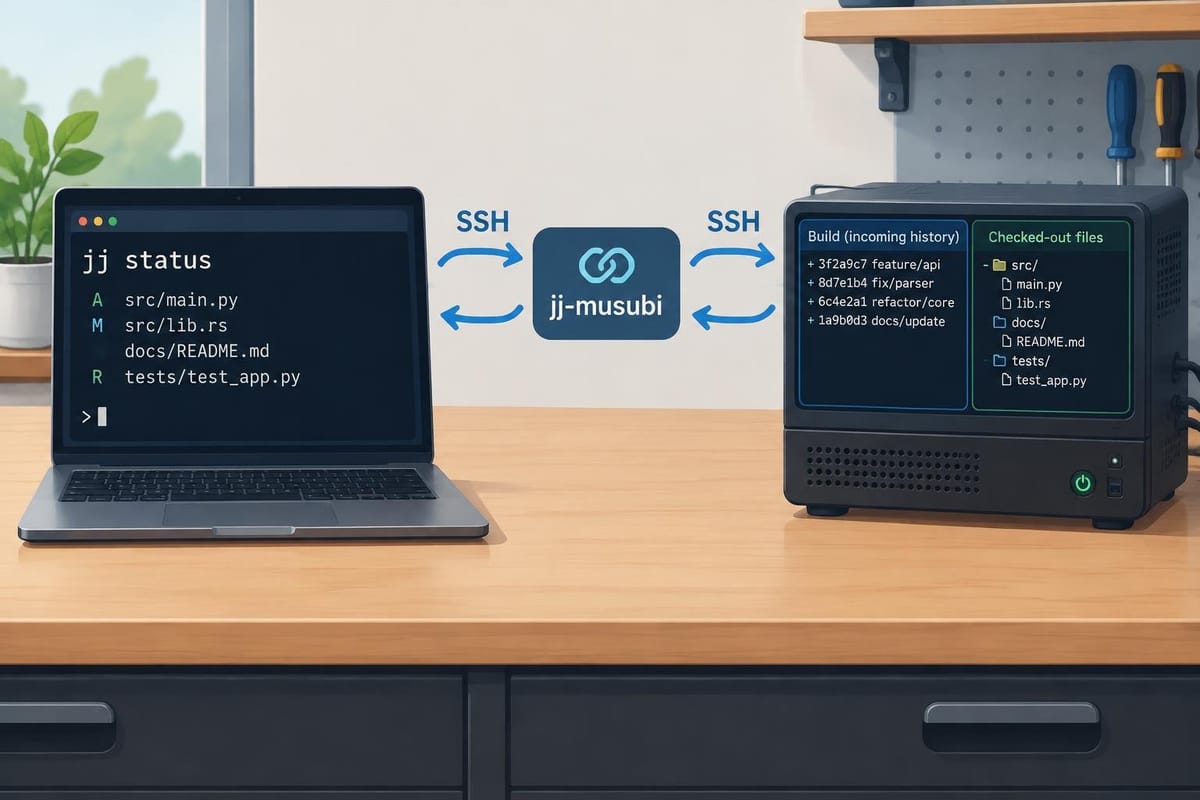
Jujutsu (jj) users who work across several machines now have a tool that keeps their repos in sync without pushing temporary branches. jj-musubi, announced November 20 by its author in a blog post, live-syncs copies of a jj repository: each time jj snapshots the working copy, jj-musubi propagates it to every machine, along with commits, rebases and fetches. The repo is published under the GitHub handle bos; the author says he started the project that became Sapling and Mononoke at Meta.
The difference from jj's usual Git workflow is that nothing has to go through a Git remote. Normally, moving work-in-progress between a laptop and a dev box means pushing a throwaway branch and fetching it. Here, jj-musubi syncs the operation log, so every machine behaves like an extra jj workspace. The author says it never writes to a machine's working copy, so a build in progress is not changed by incoming history. Each machine's workspace is named with a machine prefix, so one can inspect another's work from the laptop with jj diff -r devbox/agent-1@. The author describes the model as similar to Sapling's Commit Cloud.
Setup uses one machine as a hub, with daemons exchanging history over SSH:
cargo install --locked jj-musubi
musubi hub # on the always-on machine; data in ~/musubi-hub
musubi create --hub devbox # in the laptop's repo
musubi join # in devbox's repo
Builds are offered for Linux, macOS and Windows, and a commenter in the Lobsters thread says he contributed illumos support. A repo can lease its place in the sync group (a "hive"), so disposable VMs used by coding agents drop out when the lease expires.
The limits are stated plainly. It is meant for one person across several machines and has no security model beyond that. Concurrent edits to the same change are marked divergent, as with jj workspaces, and a commenter who tried it said resolving them resembles merge-conflict work if you edit one branch in two places. SSH is the only transport, so one commenter whose employer bars SSH servers on laptops could not use a laptop as the hub. The author said in the thread that live snapshot support was added after the announcement but not yet released, and that an XDG-compliant hub directory is coming in a release "in the next few days". A similar tool, jj-mesh, was raised in the thread as an alternative that uses iroh peer-to-peer transport; we have not compared the two.
On correctness, the author says he used Lean to prove key properties of the network protocol and checks the Rust code against that model, plus tests for interrupted syncs and hub restarts. These are his claims; KernelPost has not tested the tool, and its safety guide lists what it does not yet cover. The project is days old, so jj users with a multi-machine or agent-on-VM setup are its audience; teams sharing work should keep using Git remotes.

Comments ()