Red Hat Quay flaw lets anonymous clients replace registry tags
Red Hat's critical Quay flaw lets anonymous clients install a signing key and overwrite tags. What to restrict, which logs to check, and the upstream fix.
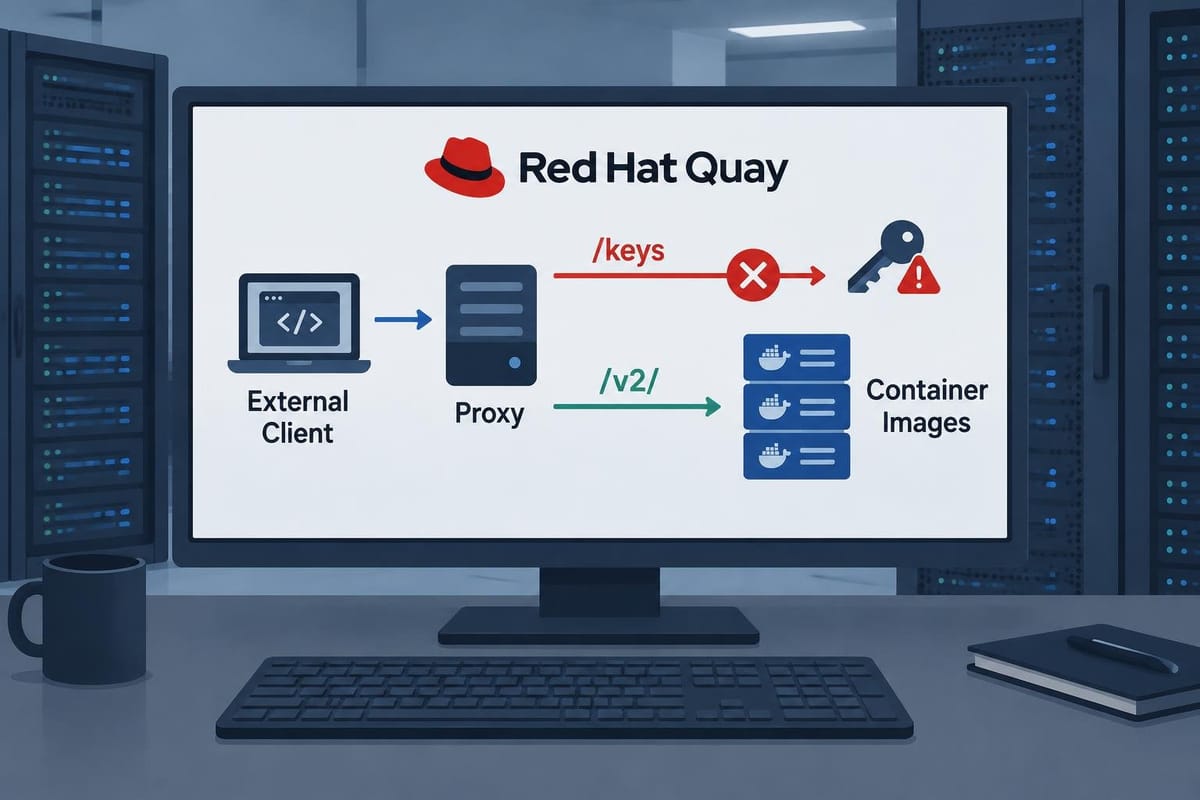
Red Hat has published CVE-2026-123710, a critical flaw in the Quay container registry that lets an unauthenticated client take over registry token signing, then read private images and replace repository tags. Red Hat's CVE page scores it CVSS 3.1 base 9.8 (AV:N/AC:L/PR:N/UI:N) and lists the same score for cve.org; we did not read the cve.org record ourselves. The Hacker News published a report on the issue, but the page body did not load for us, so we rely on Red Hat's advisory and the upstream code change.
For Quay operators this is more than an image-confidentiality problem. A forged signing key lets an attacker overwrite tags that CI/CD pipelines and clusters pull, which makes it a supply-chain integrity problem.
According to Red Hat, an anonymous client can obtain a token from /v2/auth with an audience it controls and present it to the service key rotation endpoint. Rotation only checks that the JWT is signed by an already approved service key with the expected audience and issuer; it does not check that the token is a rotation credential. The attacker installs its own approved key with no expiry, and tokens signed with it are accepted for any repository. Red Hat says deployments where /keys is reachable by untrusted clients are affected. It credits Dave O'Connor of Red Hat and classifies the weakness as CWE-1287.
An upstream quay/quay commit changes this, going by the diff:
- Rotation requires a
key_rotationclaim matching the new key ID. - Key expiry is mandatory and must be in the future.
- When the signing key has an expiry, a new key's expiry is capped at that value.
- Key replace and delete are scoped to the service.
/v2/authignores the client-requested audience.
What to do
- Confirm at the proxy or load balancer who can reach
/keys. If only trusted internal components can, exposure is reduced; verify rather than assume. - If untrusted networks can reach it, block it now. This is Red Hat's stated mitigation.
- Search audit logs for
service_key_rotateandservice_key_deleteevents with a nullexpiration_date, and remove unrecognised approved service keys. That is Red Hat's suggested review; it does not rule out other compromise. - Deleting a rogue key is not durable until a fixed build is deployed, because the anonymous request can install another.
- If a rogue key appears, treat tags changed since then as suspect and check them against build provenance or known digests. The reported flaw forges registry tokens rather than inherently stealing credentials, so decide on robot or user credential rotation from evidence of credential exposure or wider compromise.
Not yet established: the affected and fixed Quay releases, whether quay.io is exposed, and any exploitation. The Bugzilla entry (2568072) and Red Hat's solutions article (7149923) returned no usable content, so check them for fixed builds before scheduling the upgrade.


Comments ()