Inko creator moves to Codeberg but still needs GitHub's registry
Yorick Peterse's account of moving Inko to Codeberg details CI limits, issue-import snags and the quota that keeps some images on GitHub.
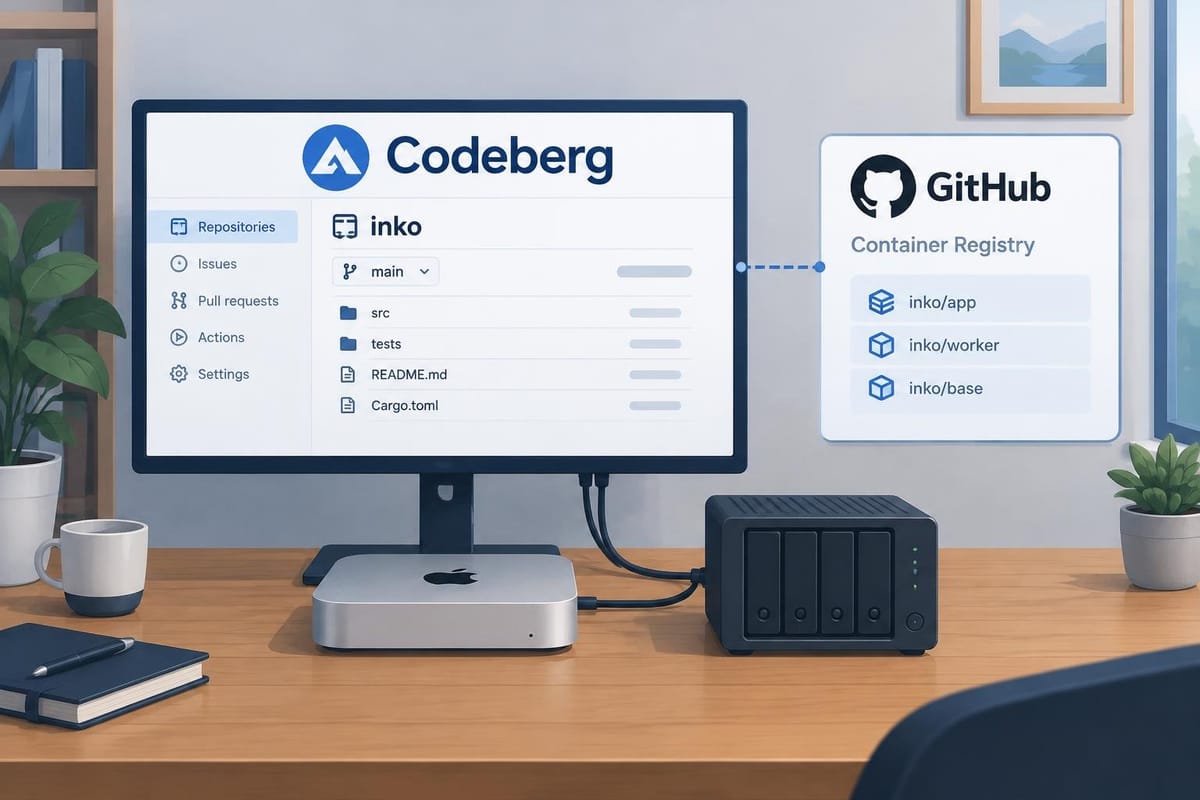
Yorick Peterse, creator of the Inko programming language, has moved his personal projects and the Inko repositories from GitHub to Codeberg, but Inko still stores some container images on GitHub because its Codeberg organization is capped at 1.5 GiB. He lays out the costs in a post on his site. It is undated. It was submitted to Lobsters on Nov. 15, 2026, and he says he began the move "a few weeks ago."
His stated reasons are a rise in low-quality AI-generated pull requests, unease with Microsoft and GitHub, and Codeberg's non-profit structure and stance on AI. This is one developer's experience, not evidence of a wider exodus.
Peterse went through more than 70 repositories but did not migrate all of them. Projects whose development ended years ago were archived on GitHub. He used Forgejo's built-in importer by hand and thinks scripting it would have been faster. The importer gives no notice when it hits a GitHub rate limit. It keeps showing its last status, such as "Migrated 500 issues," until it resumes about an hour later. The issues were still imported. Per the post, imported GitHub identities were not linked to Codeberg accounts, so issues had to be reassigned manually, and GitHub issue types needed equivalent labels to avoid losing that information.
Continuous integration was the largest cost. He chose Forgejo Actions, which he calls a "bootleg version of GitHub Actions," and says subtle differences make porting harder than it looks. Codeberg's shared runners have strict job-time and resource limits and are AMD64 Linux only, so macOS testing is not possible on them. He also reports that the shared runners don't always pull a container image that already exists on the runner, behavior he could not find documented. Tags like alpine:latest are therefore unreliable unless pinned by digest. He now runs his own Forgejo runners on a Mac Mini M1 for ARM64 builds and on a home server.
He reports several Codeberg outages over recent weeks, including a partial one lasting about an hour, most with no communication from Codeberg. He says he gives the project "some slack." His personal account has a 200 GiB asset limit, but the Inko organization's 1.5 GiB is too small for its images. His quota request had not been answered when he wrote.
For private projects he runs his own Forgejo instance. On Lobsters, alexrp pointed to Codeberg's FAQ allowing up to 100 MB of private content for free-software contributors. Peterse replied that he needs about 3-4 GiB. Other commenters were mixed: one said Codeberg's availability has been worse than GitHub's, and another mirrors Codeberg through a private Forgejo instance. Peterse calls Codeberg "a promising alternative" despite the paper cuts.
The post does not say how contributor numbers or issue traffic changed after the move.

Comments ()