Optimizely attack poisoned snippets belonging to 178 organizations
Attackers abused Optimizely's signup flow to inject malicious JavaScript into customer snippets; what operators should check and what is confirmed.
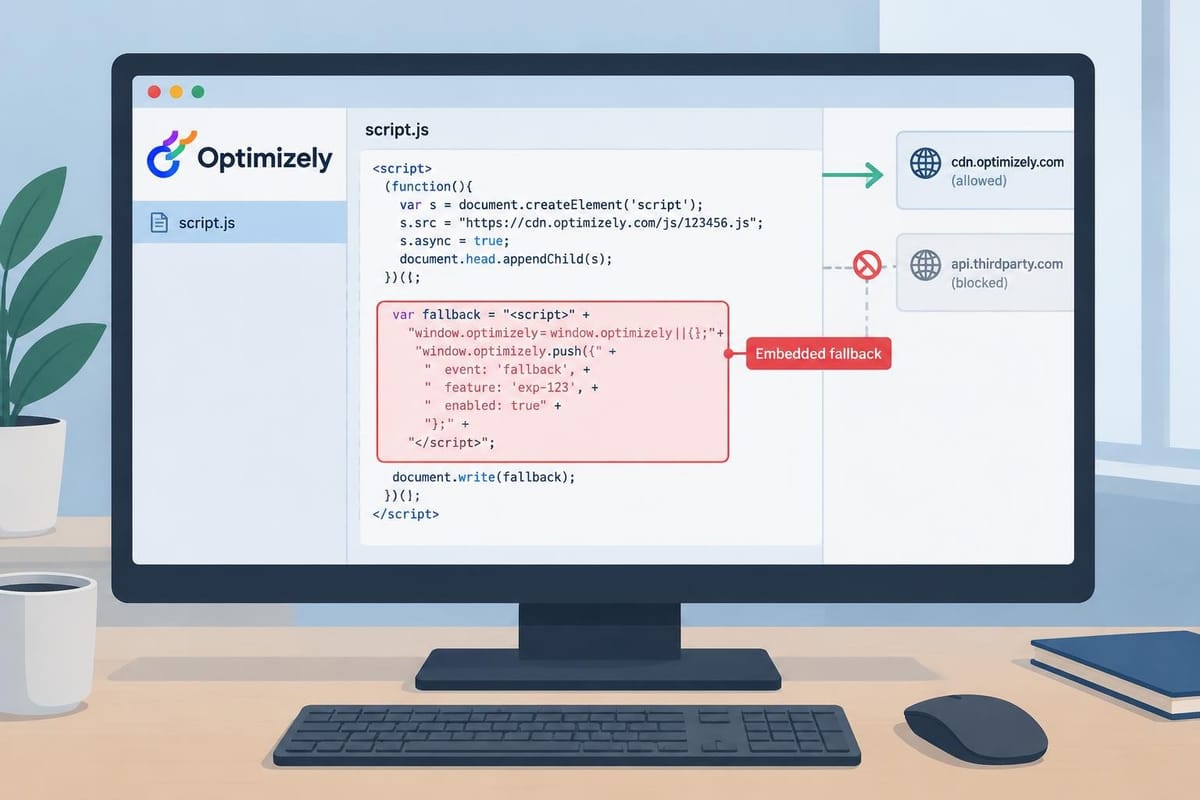
BleepingComputer reported on November 16, 2026 that attackers exploited a vulnerability in Optimizely's Experimentation account signup flow to add malicious JavaScript to some customer projects, so websites serving those projects' snippets delivered malware to visitors. Researcher Scott Helme found 188 infected Optimizely script files belonging to 178 organizations, out of 1,611 scripts he checked.
The consequence for operators is that the compromise sat in a trusted third-party script, not on their own servers. On sites that loaded a compromised snippet, the attacker's code ran with the page's privileges. BleepingComputer says it confirmed through urlscan.io scans that the malicious script loaded, or attempted to load, on Zoom, KLM, GitLab, BBC, CNN and Salesforce, among others. It lists Fox News, Air France and other sites as affected but does not say it confirmed those itself. None of this shows a breach of those organizations' own systems.
The injected code fetched a second-stage script, track.js, from 1688360[.]cc. Some files referenced the URL directly; others hid it with Base64 and atob(). Helme also saw a variant carrying an embedded copy that runs if the remote script is blocked, so blocking that domain alone may not be enough. BleepingComputer and Helme describe the script as built to swap cryptocurrency wallet addresses, capture card numbers, expiry dates and security codes and send them to card.php on the same domain, collect cookies, URLs and screenshots, and load the Coruna and DarkSword iOS exploit kits. Helme says he cannot see how many cards or cookies reached the attacker. Wallets embedded in the script had received about $7,000 as of November 16, but some predate the campaign, so the amount stolen in this incident is unclear.
Optimizely told BleepingComputer it blocked the vulnerable path, deployed a fix, removed injected code from affected projects, ended sessions, revoked tokens, reset access for affected accounts and blocked code delivery in Cloudflare. Its November 17 incident notice, posted at 01:02 UTC and marked Monitoring, says the same for Web Experimentation (Snippet Delivery). Helme found malicious code in only one of the 188 files as of 21:52 UTC on November 16. Salesforce said it was confirming Optimizely scripts are disabled across preview and production.
What operators should check:
- Inspect every Optimizely project's JavaScript and experiment custom code for unfamiliar code, atob() calls or references to 1688360[.]cc.
- Search proxy, DNS and CSP report logs for that domain from November 16.
- Review account users, API tokens and integrations, and rotate credentials.
- Treat cards entered and non-HttpOnly cookies on November 16 as potentially exposed if you served a compromised snippet.
- Disable the snippet where you cannot confirm it is clean.
- Deploy a restrictive script-src and connect-src with reporting. A CSP will report loads that violate its policy, but it will not identify malicious code arriving from a host you allow, such as Optimizely's own CDN.
Not yet known: how long the signup-flow flaw existed and how many visitors were exposed. Helme's earliest observed injection was early on November 16.
Sources: BleepingComputer; Scott Helme, Report URI.

Comments ()