ASN Bank login now requires Google services — and EPI's explanation for why doesn't hold up technically
ASN Bank now requires Google services to log in, locking GrapheneOS users out. EPI says hardware attestation can't verify OS integrity. Engineers say that's wrong.
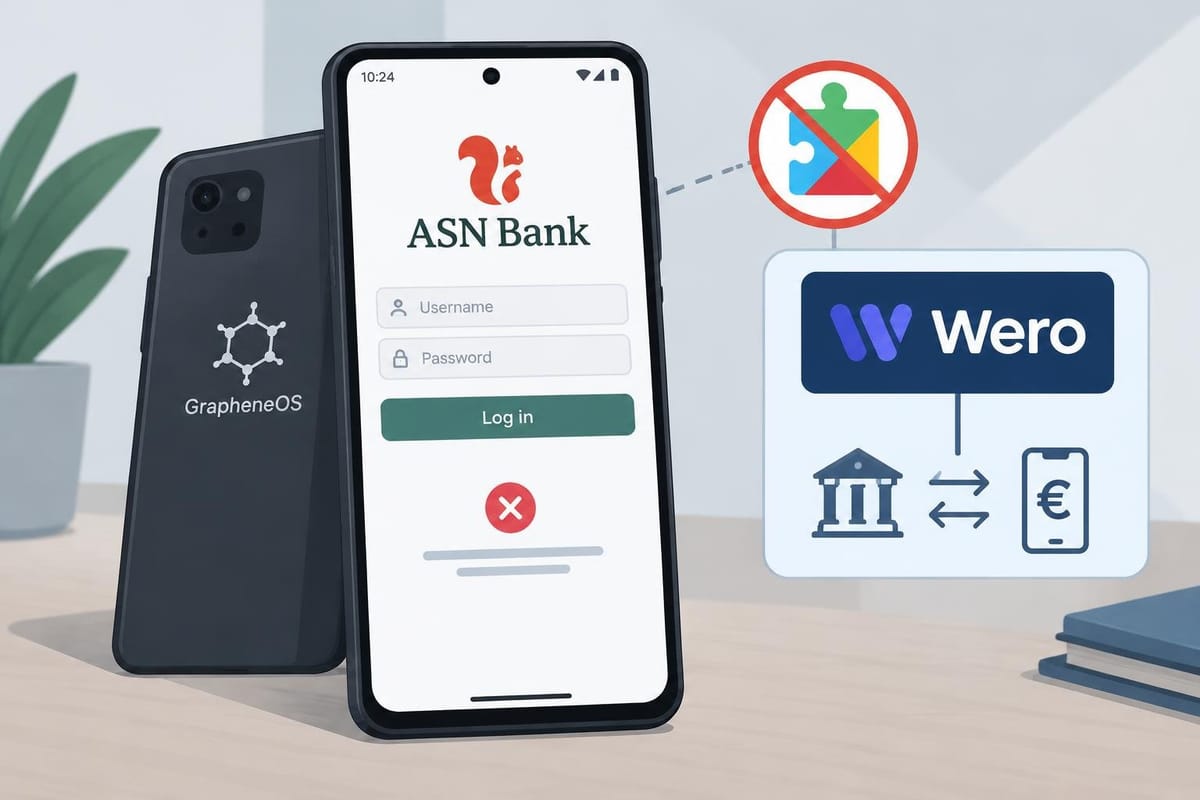
An ethical Dutch bank known for its social values quietly changed how its Android app verifies logins, locking out users who run GrapheneOS and other non-Google Android builds. What looked at first like a routine Play Integrity rejection turns out to have a more specific cause — and a more troubling upstream policy driver.
What changed and when
ASN Bank's Android app (nl.devolksbank.asn.bankieren), version 2.40.2, introduced a hard dependency on Google Mobile Services during the client authentication flow. The original PrivSec-dev banking-app compatibility report filed in July 2022 described the app as fully functional on GrapheneOS without any Google Play services installed — users confirmed they could log in, scan QR codes, and complete transactions on devices from the Pixel 3 through the Pixel 6 Pro series.
That changed. Community testers on the same hardware documented that authentication now fails with an internet-connectivity error when Google Mobile Services is absent. The failure occurs specifically at login, not during ordinary transactions. Without GMS present, the app cannot complete account registration or sign-in at all, even though earlier versions completed those same flows without it.
The secondary app — mobiel betalen, ASN's tap-to-pay utility — had already required Google components for wireless payments. Version 2.40.2 of the primary banking client now mirrors that barrier, but at the login stage.
The failure mode: GMS dependency, not a Play Integrity verdict
This distinction matters. Most banking-app incompatibility with GrapheneOS comes from one of two paths: the app calls the Play Integrity API and receives a verdict that GrapheneOS isn't Google-certified, or it calls a Google Play services component and crashes when it isn't present. The ASN case is the second kind.
The error message users see — a generic internet-connectivity failure — is a symptom of the app treating a missing GMS network hook as a lost connection, according to discussion in the GitHub thread. It is not a device integrity rejection; there is no attestation check passing or failing. The app simply cannot proceed through its authentication pipeline without Google's libraries in the system.
For users who have sandboxed Google Play installed in a separate profile, this may be workable. For those who have deliberately excluded all Google components — many ASN customers chose the bank precisely for its stated ethical values, and chose GrapheneOS for the same reason — it is a lockout.
EPI and Wero are the upstream source
The thread has surfaced a more important actor than ASN itself: the European Payments Initiative, which runs the Wero regional payment network now integrated into ASN's app. When a user pressed EPI directly, the organization replied that it requires Google Play Integrity rather than Android hardware key attestation because, in EPI's framing, hardware key attestation "proves a key was generated in a TEE or StrongBox but not app or OS integrity."
That claim is disputed by engineers in the thread — and the dispute is not close.
What hardware key attestation actually proves
Android hardware key attestation, mandatory on every device launched with Android 8 or later, produces an X.509 certificate chain signed by the device's hardware keystore. That chain carries a RootOfTrust extension containing:
verifiedBootState— whether the OS chain is verified, self-signed, or unverifieddeviceLocked— whether the bootloader is lockedverifiedBootKey— the hash of the key that signed the booted OSattestationApplicationId— the package name and signing certificate digest of the app that created the key
This is exactly OS and app integrity information, signed by the chip and chained to Google's published hardware trust roots. GrapheneOS publishes its verified boot key hashes as a signed JSON file and documents how verifying servers should check the timestamp to prevent downgrade attacks. The attestation guide describes it as "a much stronger form of attestation than the Play Integrity API" because the guarantee is rooted in hardware rather than a remote server call.
One developer participating in the thread who runs both Play Integrity and hardware attestation in their own app was explicit about why they still gate on Play Integrity too: "Not for security: because the easy check was done first, and 'Google said so' is easier to defend in front of an auditor than 'I maintain a list of key hashes.'"
That is an honest description of the tradeoff — but it is an operational convenience argument, not a security one. EPI's stated technical rationale for requiring Play Integrity does not reflect what hardware attestation actually provides.
Play Integrity: what it does and doesn't verify
Google's Play Integrity API works differently. An app calls a client SDK, passes a nonce, and sends the resulting token to its server, which calls Google's server to retrieve a verdict. Google returns structured labels such as MEETS_DEVICE_INTEGRITY or MEETS_STRONG_INTEGRITY. Whether GrapheneOS is in or out of those buckets is decided on Google's side, opaquely, based on whether the device has a Google Mobile Services license.
The GrapheneOS project has described the device integrity verdict as one that "barely does anything more than enforcing licensing Google Mobile Services." A current Pixel running GrapheneOS with a locked bootloader and verified boot fails MEETS_DEVICE_INTEGRITY, while a certified Android device that hasn't received a security patch in two years passes. From a fraud-prevention standpoint, the signal is backwards.
The project's own numbers put the current banking-app compatibility rate at around 90%. Without GrapheneOS's own workarounds for broken anti-tampering code in apps, that figure would drop to roughly 50%; without sandboxed Google Play, to around 20%. Most of the remaining failures are Play Integrity rejections — ASN's current problem is a GMS dependency that sits upstream of any attestation verdict at all.
A dozen banks have already switched to hardware attestation
The GrapheneOS project said it had convinced "around a dozen banks mostly in the EU to use the standard Android key attestation API." The PrivSec.dev banking compatibility list confirms explicit support from several named institutions:
| Bank | Country | Status |
|---|---|---|
| Yuh | Switzerland | Whitelisted via hardware attestation (July 2025) |
| Swissquote | Switzerland | "We now officially support GrapheneOS" (August 2025) |
| UBS / UBS key4 | Switzerland | Officially supports GrapheneOS |
| Triodos Bankieren NL | Netherlands | Added explicit support; flagged broken on Pixel 10 series |
| AmeriCU Credit Union | United States | "This app officially supports GrapheneOS" |
Not all of these switched attestation methods; some simply removed their Play Integrity calls or fixed anti-tampering code. But the ones that added hardware attestation as an alternative demonstrate the path exists and works. They also make EPI's claim that hardware attestation is insufficient harder to sustain — EPI's peer institutions have adopted the same standard EPI says cannot do the job.
Revolut had been working on GrapheneOS support, though a policy change around custom firmware was flagged as unsettled. Curve works, but requires sandboxed Google Play.
What GrapheneOS users can do now
If your bank app is failing, work through these steps in order before concluding it is a deliberate policy block:
1. Install sandboxed Google Play in the profile where the bank app lives. Open the GrapheneOS App Store, find Google Play services, and install. Many apps silently depend on Play for push notifications or the integrity call without disclosing it. The GrapheneOS docs recommend the Owner profile for simplest setup; a separate user or work profile works if you want Google contained.
2. Enable per-app exploit protection compatibility mode. Go to Settings > Apps > [your bank app] > Exploit protection compatibility mode. This swaps hardened_malloc for Android's standard Scudo allocator, reduces the address space from 48-bit to 39-bit, disables memory tagging, and allows ptrace for that app only. It fixes crashes caused by the bank's own broken anti-tampering code, not by GrapheneOS blocking it.
3. Re-enable native code debugging if you've turned it off. Some anti-tampering SDKs break without it. Find the setting under Settings > Security & privacy > Exploit protection.
4. If it still fails, contact the bank directly. A support ticket that says "your app doesn't work on GrapheneOS" is easy to file and easy to close. One that names the specific API, links the GrapheneOS attestation compatibility guide, and identifies banks that have already shipped hardware attestation support has a real chance of reaching a mobile engineer. The project itself noted that user pressure "convinced dozens of apps to drop using attestation."
For ASN users specifically: the GMS dependency appears to be tied to the Wero payment flow. If the bank's standard transaction features worked previously without GMS and only the iDEAL/Wero login path broke, the problem may be upstream of ASN's own engineering team entirely — which means pressure on EPI's technical decision is the more productive path.
The structural question EPI hasn't answered
What the ASN thread has clarified is that the remaining friction for GrapheneOS users isn't all one thing. Some failures are Play Integrity licensing checks. Some are GMS dependencies in authentication pipelines. Some are app-specific quirks like keyboard whitelists or animation-speed checks.
The ASN/Wero case is in a different category: it reflects a payment network's deliberate policy choice to mandate Google's proprietary verification service, and EPI's stated justification for that choice doesn't match what the standard API actually provides. Swissquote, UBS, and Triodos have shown that strict security requirements and GrapheneOS support are not in conflict. EPI's current stance leaves European users of a European payment network dependent on a licensing check run by an American company — an irony the thread participants did not miss.
The PrivSec-dev compatibility tracker remains the most reliable current source for per-app status. App versions, bank policies, and country-specific payment integrations change frequently; check the tracker for your specific bank before switching hardware or filing a support ticket.
Comments ()