GhostAction targets over 30,000 GitHub repos with fake audit workflow
Socket and GitGuardian report a fake security-audit.yml workflow in 30,000+ targeted GitHub repos; here is what it can access and what to check.
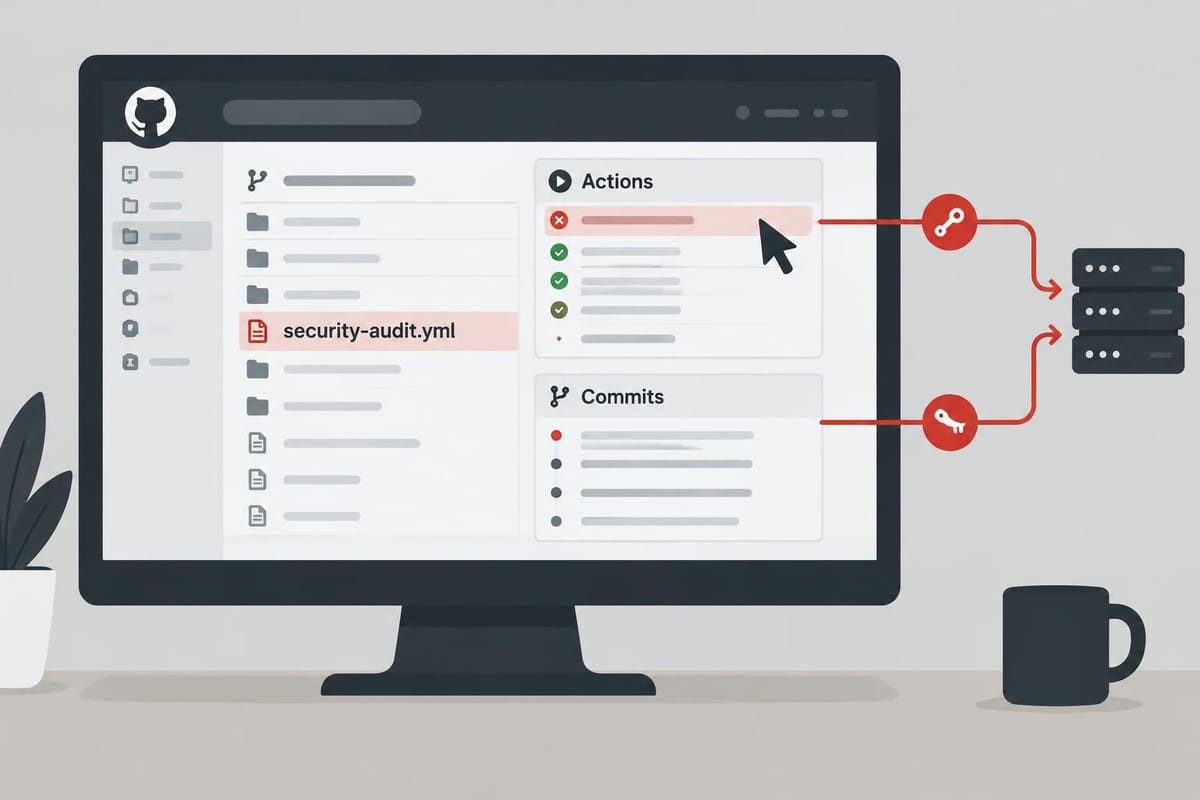
A new burst of the GhostAction campaign pushed a fake security-audit.yml GitHub Actions workflow into tens of thousands of repositories between October 8 and 12, 2026, using hijacked maintainer accounts, according to Socket and GitGuardian. GitGuardian places a batch of roughly 28,000 repositories across October 8–9 and a total of more than 30,000 targeted repositories across October 8–12. Those are counts of targeted repositories, not confirmed successful thefts. The workflow does no auditing. It collects credentials and POSTs them in cleartext to 193.32.204[.]199. Infosecurity Magazine reported on Socket's findings on November 9.
The file's presence alone does not prove theft: the payload only yields secrets if it actually ran. Both firms say it did run in many repositories, until GitHub began blocking it. Maintainers should check for the file, look for completed runs, and, as a precaution, rotate anything the workflow could have read.
How the attack works
Socket describes three stages. First, the operator obtains a working credential for a maintainer account; Socket says it did not observe how. Second, each repository's existing workflows are scanned for the Actions secret names they already use, and those exact names are written into the payload. Third, the workflow is committed with a plausible message, "Add security audit workflow" or "Update security audit workflow."
This matters for scope. GitHub's documentation says Actions can only read a secret that a workflow explicitly includes, so the payload does not automatically receive every configured secret. It attempts to receive the secrets the attacker named, when they are set and available to the workflow. GitHub says an unset secret resolves to an empty string, and environment secrets can require approval. For kitao/pyxel, Socket says the named secrets were CARGO_REGISTRY_TOKEN, PERSONAL_ACCESS_TOKEN, PYPI_PASSWORD and PYPI_USERNAME: publishing credentials for crates.io and PyPI.
The workflow runs on any push to any branch or tag, with no filter, plus manual workflow_dispatch. That means ordinary later commits can trigger it.
What is new in this variant is a second collection path. Socket says it checks out full history (fetch-depth: 0) and uses regular expressions to sweep the working tree and reachable Git history for cloud and AI credentials: AWS key IDs plus surrounding lines to capture the paired secret, Anthropic, OpenAI and OpenRouter keys, and GitHub and GitLab tokens. The analyzed payload caps the history input at 200,000 lines, so a complete sweep of every commit is not established. A key committed years ago and since deleted can still be found if it falls within what the payload reads. GitGuardian counts 11 regexes in its sample of the first payload version; Socket lists 13 patterns in the version it analyzed, so the payload evolved. GitGuardian says it changed over time and that the wave looked "more experimental and manual" than earlier ones.
Who was behind the commits, and how big it was
Socket says two compromised maintainer accounts, henrywoo and kitao, pushed the file into every repository they could write to on October 8: 346 repositories in two automated sweeps, including the 18,420-star kitao/pyxel and Uber's uber/athenadriver, where henrywoo has write access as original author. Socket describes the accounts as compromised, not as complicit.
The two-account figure is the initial example. Socket's later update says it identified more than 500 accounts that committed the workflow to tens of thousands of repositories since October 7, including organization-owned repositories reached through compromised contributors. GitGuardian's October 13 update, from a different dataset, counts more than 30,000 targeted repositories across 3,000 users and organizations, about 1,900 compromised accounts, and 3,174 secrets the actor attempted to extract from public repositories' CI. Its largest batch, roughly 28,000 repositories, landed October 8 to 9. The counts are not directly comparable.
A campaign that did not stop
Infosecurity Magazine frames this as a reappearance. GitGuardian's data says otherwise: it reports an August 2026 wave, and in 92 cases the attacker edited workflows injected in earlier waves, repointing them to new endpoints. GitGuardian concludes GhostAction "never really stopped." It also says many October victims had appeared in the September 2025 and August 2026 waves, suggesting the actors rely partly on secrets never rotated after earlier compromises.
Status
As of October 9, Socket said the file remained on default branches of repositories it checked, including uber/athenadriver and kitao/pyxel, and that the workflow had run successfully in affected repositories. GitGuardian says GitHub began preventing the malicious workflow from running on October 9, so waves on October 10 and 12 (149 commits) could not extract secrets. That is GitGuardian's observation about execution, not confirmation that files were removed. We found no GitHub statement, and The Hacker News article body was unavailable to us. Socket had seen no malicious PyPI or crates.io releases from the activity when it published; Infosecurity notes this does not mean stolen credentials went unused elsewhere.
What maintainers should check
The steps below follow Socket's guidance, which is precautionary: it does not establish that every secret in an affected repository was stolen.
- Look for
.github/workflows/security-audit.ymlon all branches, and for the two commit messages above. - Read the Actions run history for the workflow. Socket says to treat any completed run as successful exfiltration of the secrets named in the file; that is a precaution, not proof of theft in each case.
- Rotate every secret the file names; Socket recommends revoking, not just rotating, a leaked personal access token.
- If the file greps the repository, scan reachable history with
git log -p --alland rotate every credential found, treating anything ever committed as potentially exposed. That command does not cover unreachable objects, so include those in the scan as well. For AWS keys, review CloudTrail for new IAM users, keys and unexpected regions. - Remove the workflow, revert the commit, and treat the pushing account as compromised: revoke sessions, tokens, OAuth grants and SSH keys, and re-enroll with phishing-resistant MFA.
- Search egress logs for 193.32.204[.]199 and review PyPI and crates.io release history for unexpected versions.
GitGuardian also warns that stolen GitHub credentials are traded and reused, so a compromised account may be exploited by unrelated attackers; it found 13 GhostAction victim repositories also used for cryptomining by at least four separate campaigns.
Not yet known
Socket has not said how the accounts were compromised, and neither firm has reconciled its repository counts with the other's. GitHub's own account of the blocking and cleanup was not found.

Comments ()