Blender 5.3 imports and renders Gaussian splats, but can't export them
Blender 5.3 natively imports and renders Gaussian splats in EEVEE, Cycles and Workbench; export and editing remain limited, per the release notes.
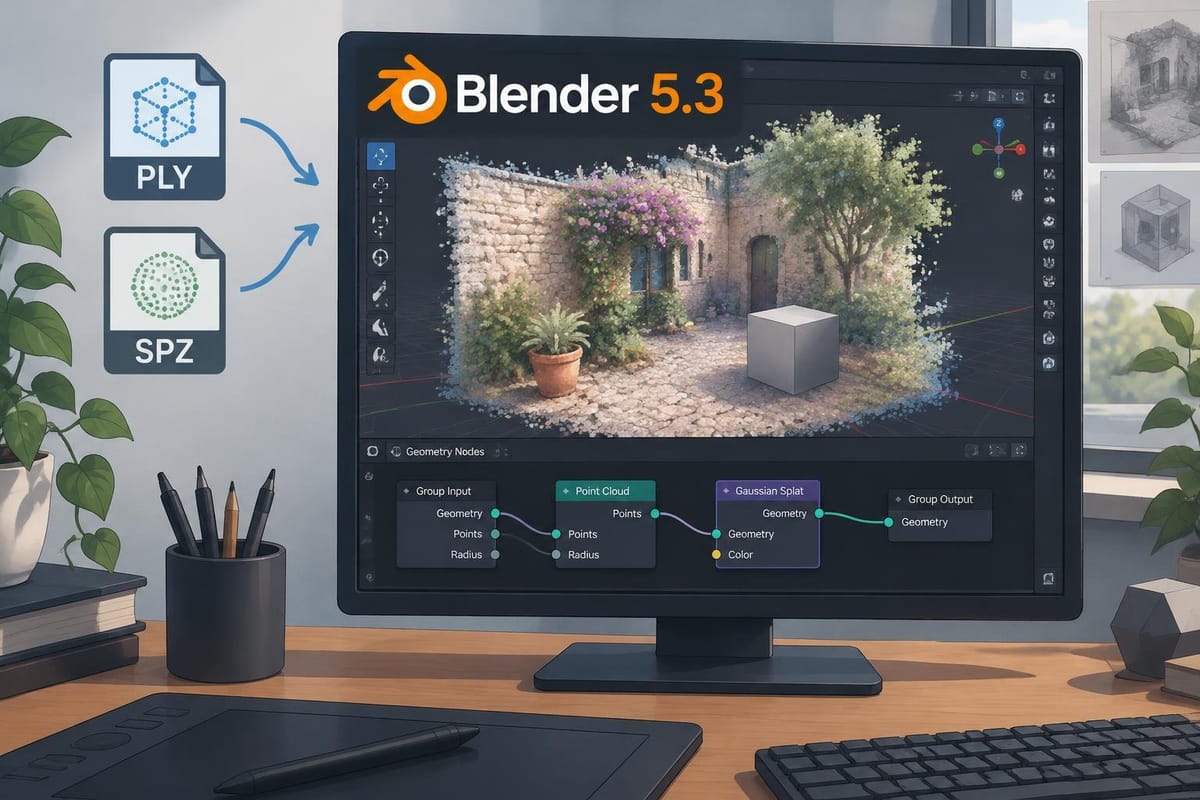
Blender 5.3 shipped on 10 November 2026 with native support for 3D Gaussian splats. Users can import PLY and SPZ files and render them in Workbench, EEVEE and Cycles, according to the Blender 5.3 rendering release notes. The release date comes from trade coverage such as Linuxiac. Blender's own release page returned an error when we tried to read it.
The feature is built in rather than supplied by an addon, but Blender's developers describe it as a first step. The developer blog post by Mark van de Ruit and Sergey Sharybin calls it "initial support". Splats can be imported and rendered, but there is no export, and editing relies on existing point cloud tools.
Splats are stored as point clouds. A new Type option on the PointCloud data-block switches between ordinary points and 3D Gaussian splats. Splat clouds carry extra attributes: scale, rotation (a quaternion) and radiance, which holds spherical-harmonic coefficients for view-dependent colour. Geometry Nodes gets a Set Point Cloud Type node and an Import SPZ node. The Import PLY node now outputs a point cloud when the file is a splat and a mesh otherwise. The notes say the PLY importer detects splats automatically and that SPZ versions up to 4 are supported. USD files can also load splats, per the blog post.
The two render paths differ. EEVEE and Workbench rasterize splats as camera-facing billboards, using dithered transparency that the authors say is noisy enough to warrant higher sample counts. Cycles instead intersects each ray with a splat, and treats opacity as a probability. That lets splats work with reflections and indirect lighting, but the post concedes that most splat data is fitted for rasterized rendering, so the same scene can look different between engines. By default splats render with an emissive shader. Relighting, by swapping in a Diffuse BSDF, is described as rudimentary and estimates normals from each splat's smallest scale axis.
The listed limitations are substantial: performance "is not ideal"; the renderer assumes splats were trained in sRGB, while Cycles and EEVEE work in linear space, so rendering is not fully correct, mainly in low-opacity, high-radiance areas; and Apply Transform doesn't yet handle the new attributes. SPZ files from some software may also need manual axis adjustment.
The authors say editing tools feel "clunky" and list culling, albedo extraction for relighting and performance as future work. A "Gaussian Splatting Improvements" project appears on Blender's fund roadmap.
On the open question, the evidence points to native handling that is usable for viewing, compositing and procedural work on captured scenes. It is not yet a full pipeline: without export, Blender can't send splats back out. Reaction from addon authors and developer discussion was not captured in the sources reviewed.



Comments ()