The Licenses That Tooling Can't Read and Distros Won't Ship
Licenses with ethical restrictions or undefined clauses get rejected from Debian and Fedora main repos and flag as unknown in SPDX-based compliance scanners.
When a License Becomes a Support Ticket: The Bespoke Terms Breaking Package Review
Philosophy turns into a support ticket the moment a package maintainer submits software to a Linux distribution or a CI pipeline tries to classify a dependency. That is exactly what happens with a growing category of principled-but-non-standard licenses — and two named projects illustrate where the friction lands hardest.
In a post that circulated on Lobsters in November 2026, developer dustri traced the downstream consequences of licenses like the Filthy Human Hands (FHH) License and Reticulum's custom terms. The argument was about more than aesthetics: licenses with ethical restrictions or vague exclusion clauses stop being philosophical statements the moment a distro's legal reviewers or a corporate compliance scanner encounter them.
Two Projects, Two Flavors of Friction
Reticulum: Meaningful Restriction, Distribution Dead End
Reticulum is a cryptography-based networking stack built for resilient, decentralized communication. Its custom license includes a clause that sounds straightforward:
"The Software shall not be used in any kind of system which includes amongst its functions the ability to purposefully do harm to human beings."
That sentence is also what makes Reticulum non-free under both the Free Software Definition and the Open Source Definition. Both require that a license permit use "for any purpose" — freedom 0 in the FSF framework; OSD clause 6, "No Discrimination Against Fields of Endeavor."
The practical consequence follows directly from Debian's Free Software Guidelines and Fedora's Licensing Guidelines: packages carrying licenses that restrict use by purpose or user class are categorized as non-free. Under Debian's policy, that means the package lives, at best, in the non-free component — disabled by default and excluded from Debian proper. Under Fedora's policy, it would not be accepted into the main repositories at all.
Reticulum is not in Debian or Fedora. Users who want it must install it outside the distribution's default package graph, which means no distro-managed updates through apt or dnf and no dependency resolution through those same tools. Dustri's post puts it plainly: "Linux distributions usually have strict policies when it comes to what software they package, with non-Free ones being either forbidden, or living in their own not-enabled-by-default dedicated repository."
MRMO-Halftone: Undefined Terms, Unlimited Litigation Surface
For a sharper illustration of machine-unreadable licensing, look at the MRMO-Halftone font, documented in Erik McClure's bad-licenses compendium on GitHub (2,144 stars). The font ships under a two-tiered license — one tier for non-commercial use, one for commercial — but both tiers exclude:
"those relating to or containing non-fungible tokens ('NFT') or blockchain-related projects"
As the bad-licenses analysis puts it: "Git uses a merkle-tree, is that blockchain? Does blockchain only refer to proof-of-work algorithms? What about proof-of-stake? Are furry adoptables NFTs? Without legal clarification this license could be used to sue basically anyone."
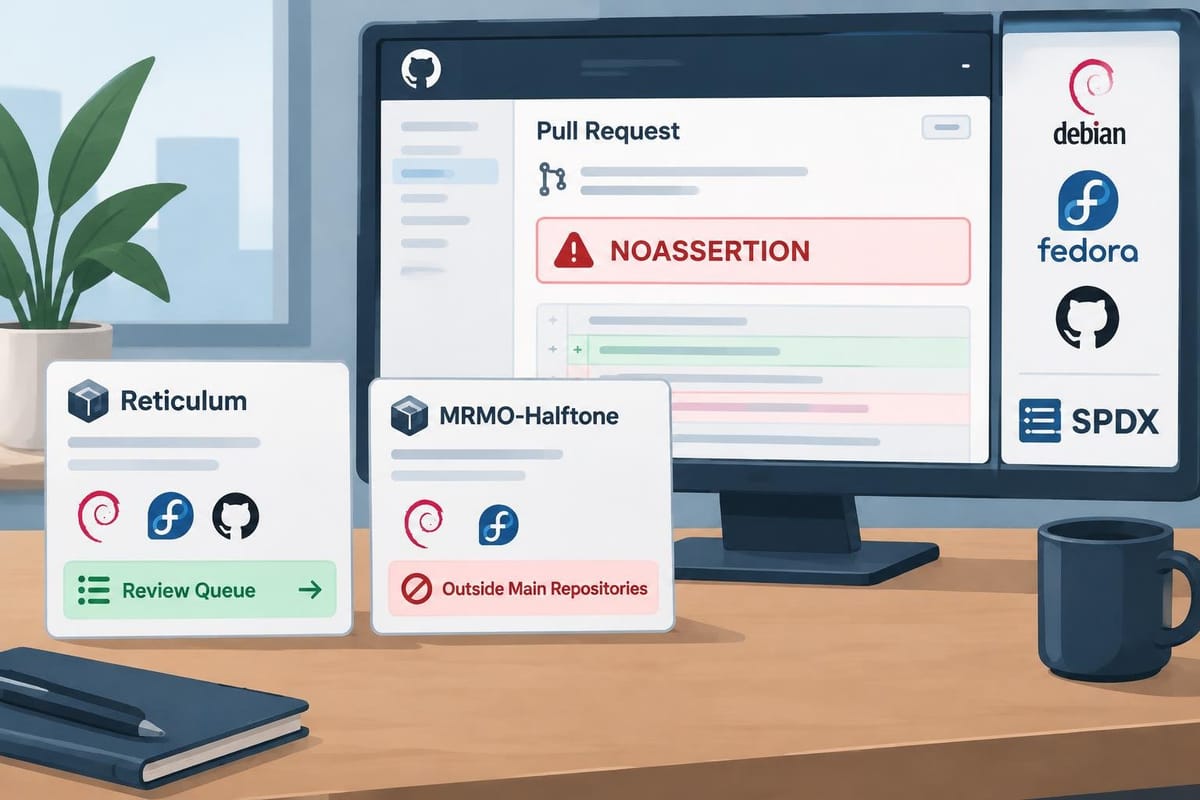
The exclusion clause has no SPDX identifier. SPDX — the Software Package Data Exchange standard maintained by the Linux Foundation — covers hundreds of licenses and is what tools like licensee, FOSSA, Scancode, and GitHub's own dependency graph rely on to classify license risk automatically. When a license lacks an SPDX identifier, those tools surface it as NOASSERTION or LicenseRef-custom, which triggers a manual review flag. Organizations whose policies prefer or require approved license lists will find that an NOASSERTION result commonly pushes the package into a legal review queue rather than receiving automatic clearance.
GitHub's License Compliance feature, which entered public preview in July 2026 and reached general availability in October 2026 (per the GitHub changelog linked from the opentools.ai coverage), can annotate pull requests and route unusual, missing, or disallowed licenses into review. According to Help Net Security's coverage of the launch, "if it finds a license that does not meet those policies, it adds an alert to the pull request identifying the affected package. Developers can remove or replace the dependency if the license is not acceptable." Organizations can configure stricter enforcement from there. For the MRMO-Halftone font, the blockchain exclusion clause means no automated tool can safely approve it for a project that uses Git — which is effectively every software project — without a human reading the full text and forming a legal opinion.
The Mechanism: How Distribution Review Rejects Non-Standard Licenses
Both Debian and Fedora use human review of license text as a gate for package acceptance. Fedora's guidelines explicitly list approved licenses by SPDX identifier; anything not on the list requires a formal review request and a Fedora Legal ruling. The process is documented and open, but it has a default answer for licenses with undefined discriminatory clauses or ethical restrictions: rejection from main repositories.
Debian's DFSG similarly require that a license not restrict who can use the software or for what purposes. Both the Reticulum harm-prevention clause and the FHH License's 50-employee size limit fail this test. The FHH license, quoted in full in dustri's post, also includes:
"No part of a work under this license may be used or reproduced in any manner which promotes bigotry of any kind. This includes but is not limited to fascism, racism, sexism, misogyny, ableism, transphobia..."
Dustri acknowledges this is likely unenforced by design — "it must be taken as a statement" — but that framing only works from the author's perspective. A distro's legal reviewers cannot accept a license on the basis that its author doesn't intend to enforce it. Vague terms are a legal liability in both directions.
Enterprise Compliance: Where 'Unknown' Becomes a Queue Item
For developers working inside larger organizations, the problem is upstream of the distro. Modern dependency scanning tools — FOSSA, Aikido, Snyk's license module, Black Duck — classify licenses against a database of known identifiers. A bespoke license without an SPDX ID either fails to match or matches a permissive template imprecisely, commonly generating a flag that legal must clear manually.
FOSSID's public audit findings describe audits where engineers copied Stack Overflow answers under CC-BY-SA into source code without recognizing it as a copyleft trigger — a known, structured license that tooling can read. Unrecognized bespoke licenses create a harder problem: the tool cannot even tell a reviewer what rights exist, so the reviewer must read the full text, obtain a legal opinion, and document the decision. That work multiplies for every project that depends on the package.
The MRMO-Halftone scenario is illustrative: a designer drops a font into a web project, the package manifest carries a custom license, the CI pipeline flags it as NOASSERTION, and a compliance ticket opens. The blockchain exclusion clause, once a legal team reads it, produces an opinion along the lines of "we cannot confirm this does not apply to our infrastructure." The font gets swapped for one with an MIT or OFL identifier. The original project loses a potential adopter.
The Distro Proposal That Won't Happen (Yet)
Dustri ends the post with a genuinely interesting idea: a "weird-license repository" in Linux distributions — a curated, opt-in collection of software under principled non-free licenses, discoverable and installable but not part of the default trust graph. It is a thoughtful response to the commons problem the post also diagnoses: maintainers burning out while cloud providers extract value, AI generating unreviewed pull requests, and copyleft proving insufficient.
The structural problem is that the distro mechanism for non-free software already exists (Debian's non-free, Fedora's alternatives), and those repositories carry the same search and install paths — they are just not enabled by default. What is missing is not a new repository concept; it is curation and discoverability for principled-non-free software specifically, as distinct from the proprietary drivers and firmware blobs that dominate existing non-free repos today.
Whether distributions would invest curation effort in a "weird-but-principled" category is an editorial question for each project's governance. Neither Debian nor Fedora has announced such an initiative.
What This Means for Package Maintainers
If you are packaging software for a Linux distribution or submitting a project where license compatibility matters, the practical checklist from the available evidence is short:
- Does your license have an SPDX identifier? Check the SPDX License List. If it does not, automated tooling will commonly surface it as unknown, and distros will require a manual legal review before the package can enter main repositories.
- Does your license restrict use by purpose or user class? Under DFSG and the OSD, any such restriction means the license is non-free, and the package will be rejected from Debian main and Fedora main repositories.
- Are your restriction terms defined? The MRMO-Halftone blockchain clause shows that undefined discriminatory terms do not just fail the OSD — they generate legal uncertainty for every downstream user who tries to assess whether the restriction applies to their infrastructure.
The licenses dustri describes are not all jokes. Some of them carry genuine values their authors care about. But the downstream infrastructure that moves software from a repository into a data center was not built to adjudicate ethics — it was built to pattern-match identifiers. When a license sidesteps that infrastructure, the cost lands on the next developer who tries to use the software professionally.
Sources: dustri.org; ErikMcClure/bad-licenses; Debian DFSG; Fedora Licensing Guidelines; Help Net Security on GitHub License Compliance; SPDX License List; MRMO-Halftone on itch.io; FOSSID audit findings.

Comments ()