Gliver, a Guile Wayland window manager, is not yet in Guix
Christine Lemmer-Webber says Gliver completes the Guix desktop, but it is unpackaged, pre-0.0.5, and has missing features. What to know before trying it.
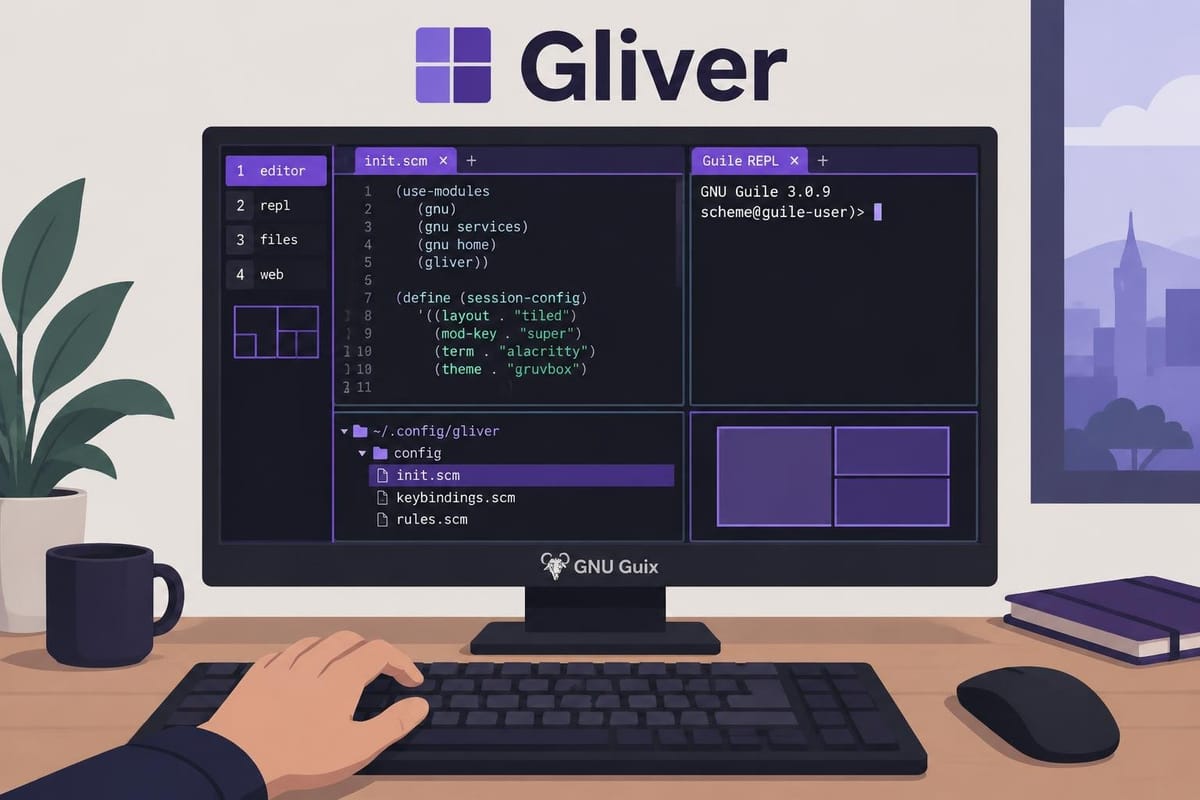
Christine Lemmer-Webber wrote on 22 November 2026 that Gliver, a Guile Scheme tiling window manager for Wayland, "completes the Guix desktop". The claim is hers, and her post says it is aspirational: Gliver is not yet packaged in Guix, and an open pull request is waiting on an upcoming 0.0.5 release that she says will fix many bugs. This is a progress report from an early user, not a release announcement.
For Guix desktop users, the practical point is that the install route today is a git checkout, not guix install. Lemmer-Webber says she runs Gliver from a checkout of the project's repository on Codeberg, following the README's approach of a loop around make run. Her variant first kills the Cow window manager she was using:
killall -q cow; while true; do (killall -q gliver || true) && make run || sleep 3; done
She says getting it running needed some help from another early adopter because it is unpackaged. The post does not state a minimum Guix version, and we have not seen the pull request's contents or the repository README, so check both before relying on it.
What it is. Gliver is styled after StumpWM and Emacs. It is built on River, a Wayland compositor designed as a base for window managers, and draws its own interface through FFI bindings to Cairo and Pango rather than a GUI toolkit. It supports manual tiling, with panes (called containers) holding tabbed windows, and keybindings to move windows between workspaces and containers. Lemmer-Webber says it also has other tiling modes, which she does not use.
Why Guix users might care. Gliver is configured and extended in Guile, the same language as Guix. By default it opens a Unix socket at ~/.local/state/gliver/repl.sock, which a REPL client such as Geiser can connect to. Users can run commands, inspect state, jump to definitions with M-., and evaluate changes live, then move them into init.scm. Its describe-key command maps keys to commands and the reverse.
Limitations she lists. There are bugs, and she expects users to file issues. The #:interactive (string) prompt is not implemented, so commands such as shell-process-spawn-detached and workspace-create do nothing when bound to a key; she creates workspaces at the REPL. She says the maintainer, ebeem, is refactoring the GUI system, inspired by Flutter, and expects that to fix some of these. The post gives no release date.
She also says she moved from GNOME after custom application launcher shortcuts stopped working following an upgrade. Her prediction that most of the Guix community will switch once it is packaged is opinion.
The concrete step for a Guix desktop user is to wait for the 0.0.5 release and the merged Guix package, or run from a checkout and expect to use the REPL for missing features.
Comments ()