When a cheaper AI model is worth choosing over its sibling
Compare model price, quality, access and latency using OpenAI's GPT-6.2 Sol and Astra as a worked example.
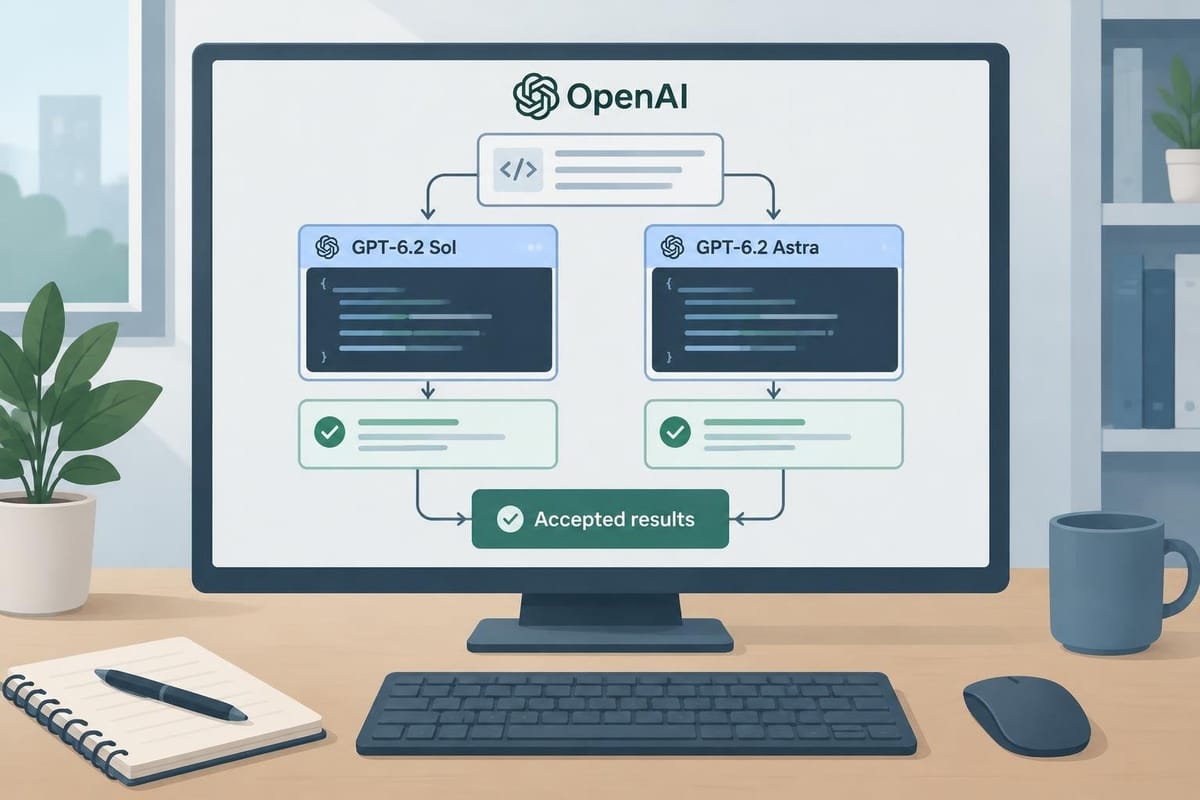
Choose the cheaper model for a high-volume, bounded task when its error rate and end-to-end latency meet your requirements. Choose its more expensive sibling when the improvement on difficult cases is worth the extra cost, or when the cheaper model lacks a required feature. For mixed workloads, a cheaper-first route with escalation can save money—but only if it catches enough failures.
A useful substitute for the proposed Inkling example is OpenAI’s GPT-6.2 Sol and GPT-6.2 Astra: OpenAI positions Sol as its more efficient everyday model and Astra for harder work. Sol is not named a mini, and the comparison does not establish their parameter counts. It does show the buying decision: as of November 21, 2026, Astra’s standard input and output token rates are four times Sol’s. The Inkling provider and its terms are not established, so this article does not assign specifications to that family.
Worked comparison: GPT-6.2 Sol and Astra
OpenAI introduced the two models on November 17, 2026. Its model catalog lists both for the Responses API and client SDKs, with text and image input and text output. Its announcement supplies pricing and a same-benchmark comparison.
| Criterion | GPT-6.2 Sol | GPT-6.2 Astra |
|---|---|---|
| Position | Efficient model for everyday work and agents | Flagship for complex reasoning and coding |
| API model ID | gpt-6.2-sol |
gpt-6.2-astra |
| Standard API price per million tokens | $2 input, $0.10 cached input, $10 output | $8 input, $0.40 cached input, $40 output |
| Context and output | 1.05 million-token context window; 128,000 maximum output tokens | 1.05 million-token context window; 128,000 maximum output tokens |
| Inputs and tools | Text and image input; function calling, web search, file search and computer use | Same listed inputs and tools |
| Quality evidence | OpenAI says Sol came within 0.5 points of Astra on Cognition’s FrontierCode 2.0 at about one-fifth the cost, both at maximum reasoning | The same OpenAI-reported comparison puts Astra ahead; its cost in that evaluation was about five times Sol’s |
| Access and ecosystem | OpenAI API, Responses API and SDKs; also available in eligible ChatGPT Work and Codex plans | Same access routes; workspace-admin enablement applies to eligible Enterprise and Edu users |
| Latency | No comparable measured latency established for this pair | No comparable measured latency established for this pair |
| Operations and lock-in | Hosted API integration; account for service limits, retries and provider-specific interfaces | Same considerations, with higher per-token rates |
Rates are OpenAI’s standard API rates as of November 21, 2026; cached-input prices apply only to eligible cached tokens. ChatGPT subscription access is distinct from API pricing. OpenAI’s catalog documents hosted access, not a self-hosting license for these two models; check applicable service and data terms before sending production data. Comparable independent quality and latency measurements for the pair are not established here.
The listed context windows and tools remove some obvious feature differences, but they do not guarantee identical performance. For example, OpenAI says both models have tighter safeguards for higher-risk cybersecurity assistance that can restrict legitimate vulnerability research and security testing. A team doing that work should evaluate refusals in its actual workflow, rather than assuming that a listed tool makes the model suitable.
What one request costs
Take a text request with 10,000 uncached input tokens and 1,000 output tokens, no tool charges, retries or other discounts. At the rates above:
- Sol: 10,000 × $2 / 1,000,000, plus 1,000 × $10 / 1,000,000 = $0.03.
- Astra: 10,000 × $8 / 1,000,000, plus 1,000 × $40 / 1,000,000 = $0.12.
At those identical token counts, Astra costs $0.09 more per request, or $90 more per 1,000 requests. Actual outputs can differ in length, and reasoning, caching, tools and retries can change the bill. OpenAI recommends keeping prompt prefixes unchanged and appending new instructions to improve cache reuse; check the eligible cached-token count rather than assuming every repeated input receives the discount.
The extra $0.09 could be worthwhile for a complex code change if Astra produces enough additional acceptable results to reduce expensive review or rework. It is harder to justify for a high-volume classification task if Sol already meets the error target. The relevant comparison is cost per accepted result, including retries and human review, not token price alone.
Read the benchmark in context
OpenAI’s FrontierCode 2.0 comparison is useful because it compares the two siblings on the same coding evaluation and reports both the quality gap and cost. FrontierCode 2.0 evaluates whether changes to real codebases meet maintainers’ standards for merging. OpenAI reports the result; the benchmark was created by Cognition. The reported one-fifth cost is a cost per task in that evaluation, not a universal discount for any request.
That result does not establish performance on invoice classification, internal document extraction or a particular repository. Nor does a small aggregate gap say whether the models fail on the same issues. For a coding agent, a failure that introduces a security flaw can matter more than an answer that merely needs formatting cleanup.
OpenAI also reports that Astra led the models it tested on its internal GDPval v2, which measures longer professional workflows. That is a reason to evaluate Astra on difficult knowledge-work tasks, not a direct estimate of its improvement over Sol on any one business process. Keep the benchmark runner, model version, reasoning setting, scoring method and test date with any score you use.
Start with the feature gate
List what the application sends and expects back. A classification service may need text input and a small structured response. A document workflow may require images, long context, tool calls and reliably formatted output. A cheaper model that is adequate at classification is not automatically a substitute for its sibling in the document workflow.
Compare context limits with the whole request: instructions, conversation history, retrieved documents, tool results and space for the response. Check whether a provider’s documented maximum applies to input alone or to input and output together. A large advertised window does not establish that the model will retrieve the right detail from every long document.
For an agent, inspect the interface as well as the model: available tools, parallel calls, structured output and behavior when a call fails. If the cheaper option does not expose a required interface, its lower token price is irrelevant unless the team is willing to redesign the workflow.
Price the completed job and the escalation path
For a text-only API comparison, multiply input and output tokens by their respective rates, using the unit in the price list. Add separately priced features where applicable. Record the conditions for cached input, batch processing and other discounts.
Then account for retries and escalation. In a hypothetical example, suppose a cheaper request costs one unit and a larger-model request costs four units. If every job first goes to the cheaper model and one in four then goes to the larger model, model calls cost two units per job on average: one for the first call plus one-quarter of four for escalation. That is half the cost of sending every job directly to the larger model, before retries, routing overhead or other charges.
The arithmetic does not establish quality. Measure how often the larger model fixes an escalated case and how many bad cheaper-model responses were never escalated. A routing rule that misses confident wrong answers can make the average bill look good while allowing costly failures through.
Measure latency at the application boundary
A cheaper model is not guaranteed to produce a faster finished answer. Time to first token, output generation, request queueing, tool calls and retries all contribute to the user’s wait. Long prompts can also change the comparison from one seen with short inputs.
Measure both candidates with representative prompt and response lengths, the same region and similar concurrency. Record time to first token and time to complete; for an agent, also record time until the final usable result. Compare median and tail latency rather than relying on a single response. Measure a cheaper-to-larger escalation path separately: the user may wait for both calls.
Check operations and exit cost
A smaller model name does not establish open-weight availability or permission to run it locally. For each candidate, check whether access is through a hosted API, downloadable weights or both; read the applicable license or service terms for commercial use, data handling and redistribution. If local deployment is required, include hardware, memory, serving software, maintenance and utilization rather than treating weights as free inference.
For hosted models, check account eligibility, regional availability, rate limits and any published retirement or snapshot policy. Ask whether the application depends on provider-specific tool formats or features that would make a switch costly. A common interface can reduce integration work, but it does not make prompts, outputs or safety behavior interchangeable.
Build a held-out set from the actual task, including difficult and ordinary examples. Score both models with the same rubric, separate recoverable formatting errors from incorrect answers, and keep model charges and human-review costs separate in the estimate. Repeat the evaluation when the model snapshot or application changes.
Choose by use case
- Choose Sol, or another cheaper model, if the task is high-volume and bounded, its measured errors are acceptable, and its complete-job cost and latency meet the target.
- Choose Astra, or the more expensive sibling, if difficult cases materially benefit from it, a required capability is absent from the cheaper option, or avoiding an error is worth more than the additional inference cost.
- Choose cheaper-first escalation if a measurable routing rule catches enough failures and the combined latency and cost meet the target.
- Choose neither yet if licensing, data handling, availability or a required feature cannot be established from the provider’s documentation.


Comments ()