Researcher claims unpatched Windows 11 Narrator lock-screen bypass
A researcher claims an unpatched Narrator lock-screen bypass on Windows 11 26H2. Here is what the repo and reports establish and what is missing.
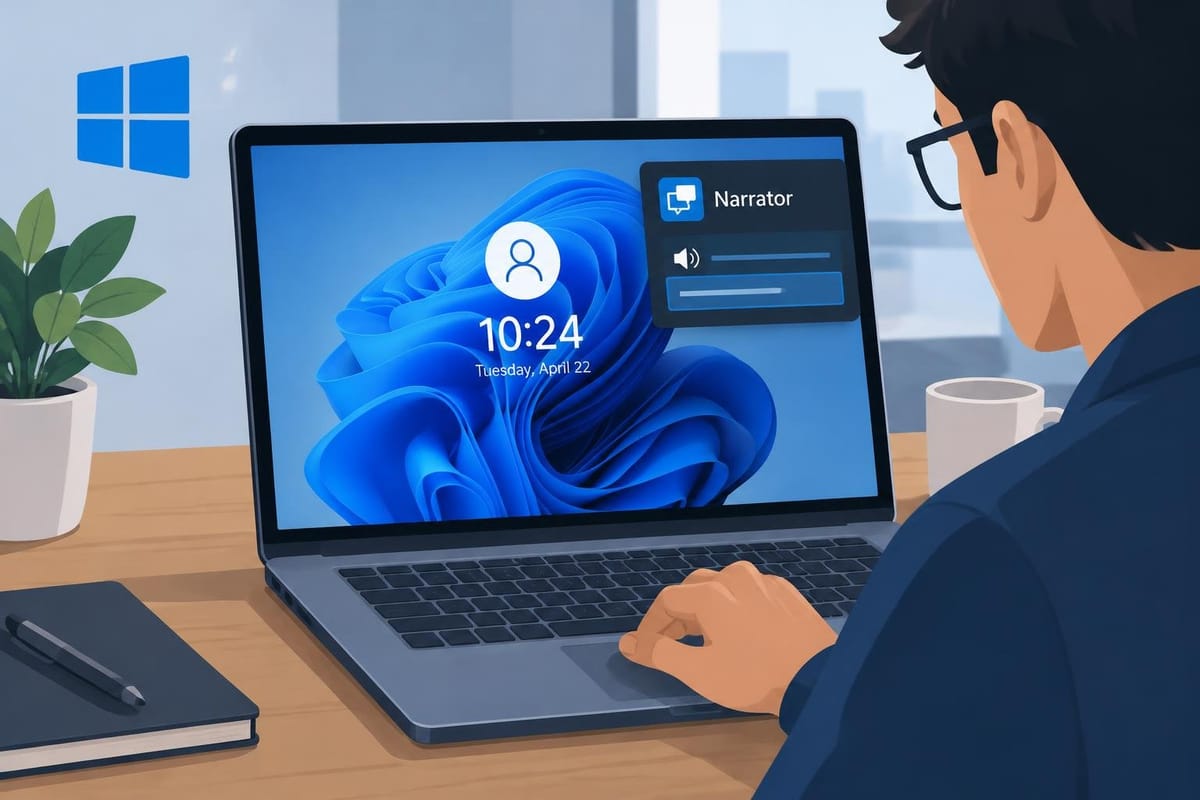
A researcher who publishes as Chaotic Eclipse, Nightmare-Eclipse and MSNightmare posted a GitHub repository called FastUnlock on November 19, 2026. It claims a "0day" in Windows Narrator that lets someone with physical access run code from the lock screen on a BitLocker-encrypted Windows 11 26H2 machine with the November 2026 updates installed. Coverage we reviewed comes from Security Affairs and Cyber Security News. Cyber Security News reported that, as of November 20, available reporting did not identify a Microsoft advisory, a CVE or a fix for the Narrator flaw. We have not independently checked MSRC, CVE or CISA KEV records.
The repository was created on November 19 and last pushed on November 21, according to GitHub metadata. The README says the flaw is in how Narrator's redesigned interface behaves in a locked account context, and that code runs as "WsiAccount", the account used at the lock screen. The author says the attack needs physical access and at least one account linked to a Microsoft account. He says he tested only Windows 11 26H2 and does not know whether Windows 10 is affected. He also reports that the attack took about five minutes from discovery to compromise. That is a single self-reported test, not a measured attack time. We do not reproduce the README's steps here.
The boundary matters. Cyber Security News reports that the bypass does not break BitLocker encryption or show that a powered-off drive can be decrypted. It targets a running machine whose system drive is already unlocked, a stage at which, per Cyber Security News, the lock screen and Windows account permissions govern what people can access. That differs from the earlier YellowKey flaw, which the outlet says attacked BitLocker before Windows fully loaded. Cyber Security News says ThreatLocker tested FastUnlock and got code running as WsiAccount, which is not an administrator. That confirms code execution without sign-in. It does not establish takeover of a signed-in session, administrator rights or access to all files. We could not see ThreatLocker's own write-up, so that confirmation is secondhand. The README itself does not show a full code-execution demo; the author says he added a USB test afterward and that it worked.
The BitLocker CVEs from November Patch Tuesday, CVE-2026-97015 and CVE-2026-119832, are separate and, per Cyber Security News, are not a FastUnlock fix. Cyber Security News says no in-the-wild attacks had been publicly reported. The same outlet cites Microsoft's BitLocker guidance in saying a TPM plus startup PIN protects shut-down or hibernated devices and does not address Narrator on a drive that is already unlocked. Neither source documents a fix or workaround for the Narrator mechanism itself.
The researcher has a record of publishing Microsoft zero-day exploits after disputes with the vendor, and Security Affairs notes some were later exploited. Microsoft has not publicly responded in the sources reviewed. We will update if it issues an advisory or CVE.

Comments ()