NGINX fixes critical HTTP/2 RCE flaws; upgrade to 1.30.7 or 1.31.9
Two critical NGINX HTTP/2 RCE flaws are fixed in 1.30.7 and 1.31.9; see affected versions, NGINX Plus releases and what to check.

F5 released NGINX security updates on November 18, 2026, fixing two critical unauthenticated remote code execution flaws in HTTP/2 handling, CVE-2026-123007 and CVE-2026-123633. Wiz scored each CVSS 4.0 9.2. Fixed open source releases are 1.30.7 (stable) and 1.31.9 (mainline). As of November 19, 2026, none of the sources we read reported exploitation in the wild, though those sources do not rule it out.
November 18 is the coordinated disclosure date, not the discovery date. Wiz's timeline says it reported the first flaw to F5 on October 21 and the second on November 16, and that Ikotas Labs, Metnir, Rapid7 and Xint found the bugs independently. We did not capture F5's own advisory or the CVE.org records, so the version and fix data below comes from the Wiz and Xint write-ups. Check it against F5's advisory before closing tickets.
Who is affected
Both bugs need HTTP/2 enabled. Per Wiz (the ranges below are Wiz's published ranges; stable 1.30.7 is listed separately as a fixed release and is not affected):
| CVE | Flaw | Condition | Affected (OSS) |
|---|---|---|---|
| CVE-2026-123007 | Memory corruption in HTTP/2 flow control | Default configuration with HTTP/2 enabled | 1.9.5 to 1.31.8, excluding fixed stable 1.30.7 |
| CVE-2026-123633 | Use-after-free in HTTP/2 | Configured with HTTP/2 as a proxy server | 1.19.7 to 1.31.8, excluding fixed stable 1.30.7 |
The vulnerable code behind CVE-2026-123007 has been in official NGINX releases since HTTP/2 first shipped in 1.9.5 in 2015, so official releases through 1.31.8 with HTTP/2 enabled are in scope, except the fixed stable release 1.30.7. That statement covers official upstream builds only. Distribution packages may carry backported fixes. Wiz says it demonstrated code execution against NGINX serving ordinary static files, with no backend or third-party modules.
Fixed releases listed by Wiz:
- NGINX open source: 1.30.7 stable and 1.31.9 mainline, for both CVEs.
- NGINX Plus, CVE-2026-123633: R33 and 37.0.0 are first affected; fixed in 37.0.7.1 and 37.2.0.1.
- NGINX Plus, CVE-2026-123007: fixed in 37.0.8.1 and 37.3.0.1.
Xint gives examples of distribution package versions, but neither write-up identifies which distribution packages or Kubernetes ingress controller builds carry fixes for these flaws. Check your vendor's advisory for backported fixes rather than comparing upstream version numbers.
nginx2root overlaps with Wiz's report but is broader
Xint's nginx2root research overlaps with Wiz's on two flaws, CVE-2026-123007 and CVE-2026-123633, and Wiz describes Xint as one of the teams in the coordinated disclosure. nginx2root also covers three further nginx bugs: CVE-2026-123634 (use-after-free in the DNS resolver, reached in Xint's test through the mirror directive, with other subrequest features such as SSI possibly reaching it), CVE-2026-121810 (HTTP/3 with upstream forwarding, from 1.25.0) and CVE-2026-113425 (mail proxy with auth_http). Wiz's table lists the same three as fixed in this release.
The sixth item is a separate Linux kernel flaw in SCTP, which Xint says is unpatched and whose details it is withholding until a fix exists. Per Xint, all five nginx bugs give an unauthenticated attacker code execution with nginx worker privileges. Xint demonstrated escalation to host root by chaining the SCTP bug with an nginx bug, including from a Docker container. Xint does not claim this is the only route to root, and neither do we.
Xint says disabling HTTP/2 addresses only CVE-2026-123007 and CVE-2026-123633. The other three need separate configuration changes, and patching is the fix for all five.
What to do
- Inventory every NGINX instance, including container images and ingress controllers, and note whether HTTP/2 is enabled (an
http2parameter onlisten, orhttp2 on;). - Upgrade to 1.30.7 or 1.31.9, or to your distribution's patched package. NGINX Plus operators need a release that contains the fixes for both CVEs on their branch; Wiz lists different fixed Plus releases for each CVE (37.0.7.1 and 37.2.0.1 for CVE-2026-123633, 37.0.8.1 and 37.3.0.1 for CVE-2026-123007), so confirm the right release for your branch in F5's advisory.
- After upgrading, restart NGINX or complete a supported live binary upgrade. Xint notes that a configuration reload does not replace the running executable, so a reload alone leaves the vulnerable binary in memory.
- Hunt for signs of compromise: unexpected worker crashes and any program launched by an nginx worker. Xint suggests an auditd execve rule on the worker UID, which records only from installation onward, so an empty result does not rule out earlier compromise. Wiz calls these general warning signs, not confirmed indicators.
Both researchers also describe a temporary HTTP/2 shutoff for operators who cannot upgrade. We did not find an F5 statement endorsing it, so we are not recommending it here. Operators considering it should check F5's advisory first and test compatibility, since it would affect gRPC and other HTTP/2-only clients.
Exploitation status
Wiz says it built working exploits in lab settings, including an ASLR bypass on official 1.31.7 and 1.31.8 builds, and is not releasing them. Xint says its CVE-2026-123007 exploit worked on AWS, GCP and Azure, including over a public HTTPS endpoint and under concurrent normal traffic. Wiz notes that CDNs or WAFs terminating HTTP/2 in front of NGINX may block parts of an exploit, and that attackers need direct communication with the server.
A Hacker News commenter said a fix reached the public repository about a week before release, with a commit message crediting Xint. We did not verify that, but it is a reason not to delay patching.
Where the bugs sit
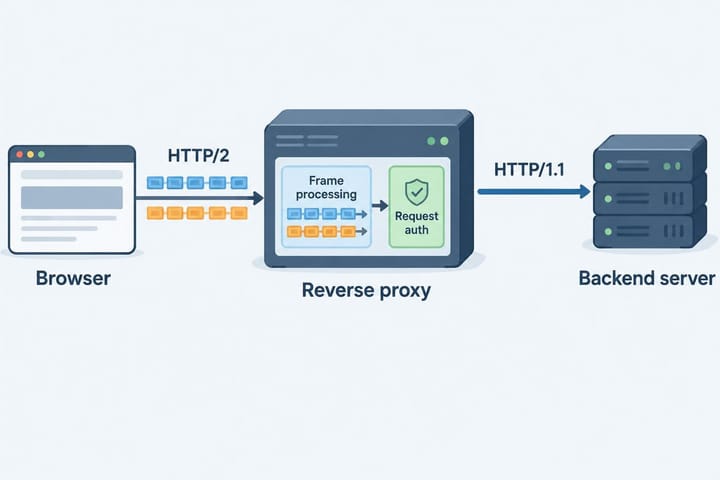
Both core bugs are in how HTTP/2 connection state meets NGINX's own bookkeeping. Wiz describes CVE-2026-123633 as a connection that stays on NGINX's reusable-connection list after a request starts on it, so NGINX may reclaim a connection still in use. CVE-2026-123007 involves flow-control arithmetic: an integer underflow yields a malformed buffer and an out-of-bounds copy in the TLS send path. Terminating HTTP/2 at a CDN and speaking HTTP/1.1 to the origin can reduce exposure, but only if the origin is not also reachable over HTTP/2.
Not yet known: whether F5's advisory endorses an HTTP/2 workaround, which distribution and ingress builds carry backported fixes, and when a kernel patch for the SCTP bug will ship.



Comments ()