TeamViewer RCE (CVE-2026-111585): The Machine You're Helping Can Attack You Back
TeamViewer CVE-2026-111585 (CVSS 8.8) lets a malicious host run code on the connecting viewer. No exploitation confirmed. Update Full Client, Portable, and Android app to 15.83.
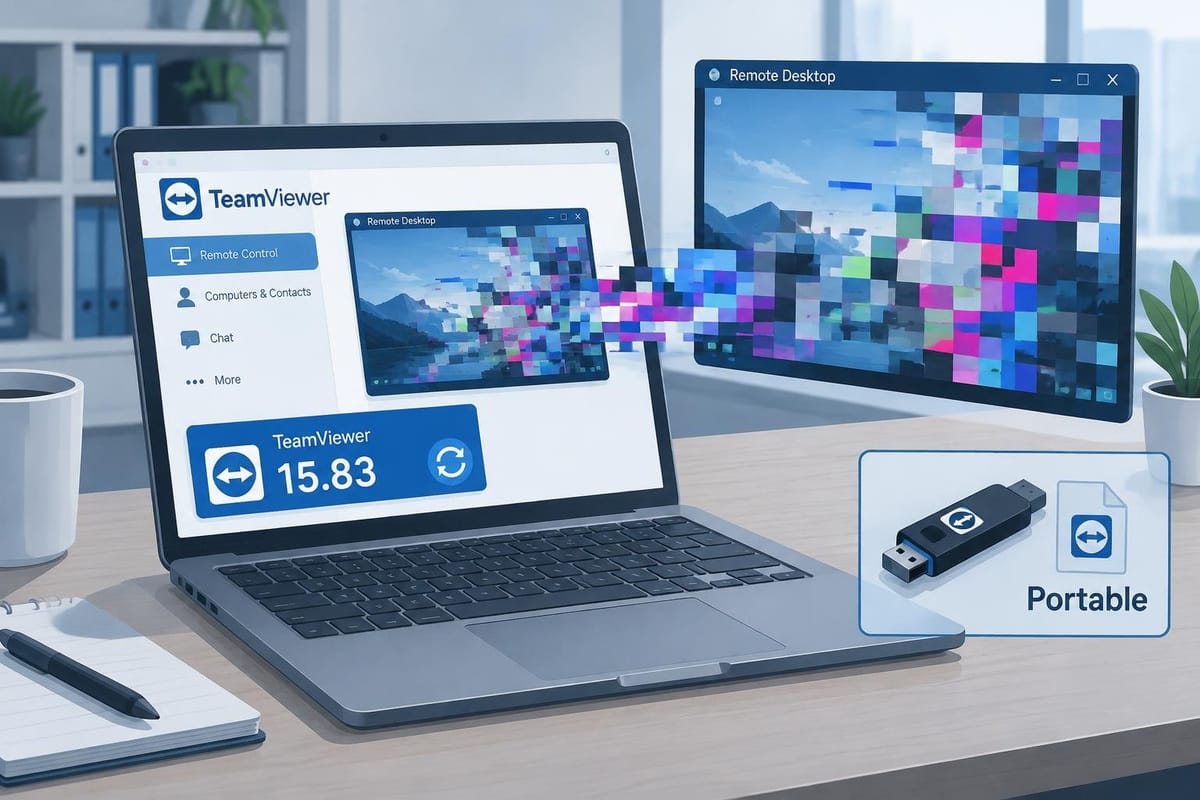
IT support technicians and managed service providers face an uncomfortable reversal of the usual threat model in a vulnerability patched by TeamViewer on October 27, 2026: the remote machine you connect to help can attack your workstation. The flaw, CVE-2026-111585, carries a CVSS 3.1 score of 8.8 (High) and affects TeamViewer clients on Windows, Linux, macOS, and Android before version 15.83. No exploitation in the wild has been confirmed. The fix is available now, with no workaround.
What the vulnerability is and how it works
The flaw is an integer overflow in the code that processes remote screen data during a TeamViewer session—specifically, in the path used to decompress incoming screen updates when no hardware video decoder is negotiated for the session.
Researcher Omri Dar of Remedio, who reported the issue to TeamViewer on August 14, 2026, describes the core problem clearly: when a TeamViewer session begins, the host announces the width, height, and color depth of its screen. The viewer uses those declared dimensions, with no enforced upper bound, to allocate an in-memory pixel buffer for drawing screen updates. The size calculation runs in 32-bit arithmetic, so sufficiently large declared dimensions—Remedio gives 32,768 by 32,768 pixels at 32 bits per pixel as an example—wrap around and produce a buffer far smaller than the host claims. Subsequent bounds checks compare each update against the declared dimensions rather than the real buffer size, allowing a malicious host to write past the end of the allocation.
According to SecurityWeek, reporting Remedio's findings, the corrupted surface object contains a function pointer in its first field, so overwriting that pointer with controlled data redirects the viewer's next call. Remedio says it bypassed Control Flow Guard and DEP on a fully updated Windows system and ran a program of its choosing on the viewer. Remedio notes that one step in its proof-of-concept—heap grooming—used a host-side hook rather than a pure network payload, a limitation the researchers disclose.
Critically, a malicious host can refuse to negotiate video codecs during session setup, forcing the viewer onto this vulnerable decode path. The host controls both the declared screen dimensions and the stream of screen updates. No special viewer configuration or permissions are needed beyond an ordinary accepted remote-control session.
TeamViewer's advisory (TV-2026-1011) describes the worst-case outcome as "denial of service or, depending on the platform, potentially execute arbitrary code with the privileges of the viewer process"—meaning the logged-in technician's account. The CVE record (CWE-190, integer overflow leading to heap-based buffer overflow) was published at 17:19 on October 27 and reached NVD at 18:17. NVD lists the record as awaiting its own analysis and has not issued an independent score.
A third-party proof of concept appeared on GitHub on October 31 (googlesky/CVE-2026-111585), according to ThreatDefence's advisory. It is not from Remedio, runs against Linux builds, and demonstrates a viewer crash rather than code execution. It injects screen data inside the viewer process rather than delivering it from a fake host over the network, so it is not a ready-made attack tool, but it does publish the root cause and fix in detail.
Who is at risk
The direction of attack is what makes this flaw especially relevant to helpdesks and MSPs. Conventional TeamViewer security concerns focus on a hostile operator taking control of a customer's machine. Here the exposure runs the other way: a technician connecting to a machine the attacker controls or has already compromised. Any organization whose staff regularly initiates remote-control sessions to systems outside their direct control sits in the risk zone.
The CVSS vector—AV:N/AC:L/PR:N/UI:R/S:U/C:H/I:H/A:H—reflects that user interaction is required (the victim must open the session), but attack complexity is low and no special privileges on the attacker's side are needed. Code would run with viewer-process rights, so whatever the technician's account can reach—saved credentials, customer environments, internal systems—is in scope.
Note that CVE-2026-111585 specifically affects Full Client, Portable, and the Android Remote Control app—the viewer-side components. The companion CVEs in the same bulletin (described below) separately affect Host components on Linux and macOS. Administrators should not assume that updating Host alone addresses CVE-2026-111585.
Affected products and fixed versions
Per TV-2026-1011 and the CVE record, the components affected by CVE-2026-111585 are:
| Product | Affected | Fixed |
|---|---|---|
| Full Client (Windows, Linux, macOS) | Before 15.83 | 15.83 |
| Portable (Windows) | Before 15.83 | 15.83 |
| Remote Control app (Android) | Before 15.83 | 15.83 |
| Legacy Full Client & Portable 15.64 (Windows 7/8) | Before 15.64.10 | 15.64.10 |
| Legacy Full Client 14.7 (Windows, Linux, macOS) | Before 14.7.48868 | 14.7.48868 |
| Legacy Full Client 13.2 | Before 13.2.36231 (Win) / 13.2.154008 (Linux) / 13.2.154007 (macOS) | Those builds |
One important operational note: 15.82 is not sufficient. TeamViewer issued security bulletin TV-2026-1010 in late September, patching five separate client flaws in version 15.82. Teams that updated to 15.82 at that time are still exposed to CVE-2026-111585. Remedio confirmed the vulnerable code was still present in 15.82.
TeamViewer Portable deserves particular attention: because it runs without installation, it can be easy to miss in software inventories and patch management tools. Organizations should audit for Portable instances explicitly—including copies in shared drives, download folders, and USB toolkits.
Two companion flaws in the same bulletin
TV-2026-1011 also fixes two additional vulnerabilities, both CVSS 8.8 or above:
- CVE-2026-92372 (CWE-123, out-of-bounds write in screen-image decoder): Affects Linux and macOS Full Clients and Host. Can be triggered by crafted screen-image data during a session, or by opening a specially crafted TeamViewer session recording (
.tvsfile). Worst case per vendor is code execution. Organizations should not open.tvsrecordings from untrusted sources on unpatched systems. - CVE-2026-92374 (CWE-367, TOCTOU race condition with improper symlink handling in a privileged helper): Affects macOS Full Client and Host only. A local user with low privileges could exploit the race to install a malicious package and gain root. CVSS 7.8 High.
SecurityWeek's reporting also notes that TeamViewer separately patched six high-severity local privilege escalation vulnerabilities in the TeamViewer Remote Management add-ons in companion bulletin TV-2026-1012. Organizations using Remote Management components should review that bulletin independently.
Exploitation status and CISA KEV
TeamViewer stated in its advisory that it was "not aware of any active exploitation in the wild" at publication. CERT Santé (France's health-sector CERT, which issued an alert on October 28) listed no active exploitation and no public proof of concept. The Canadian Centre for Cyber Security issued alert AV26-1093 on the same date.
As of the November 4, 2026 catalog release, none of the three CVEs—CVE-2026-111585, CVE-2026-92372, or CVE-2026-92374—appear in CISA's Known Exploited Vulnerabilities catalog. According to ThreatDefence, CISA added its own assessment to all three CVE records on November 4, rating exploitation as "none" and technical impact as total—but did not add them to KEV. NVD still lists all three as awaiting analysis. According to ThreatDefence, FIRST's EPSS scores as of November 4 were low: 0.29% for CVE-2026-111585, 0.43% for CVE-2026-92372, and 0.09% for CVE-2026-92374.
Remedio published a detailed technical write-up on October 29, one day after the patch. The write-up describes the technique but does not, per SecurityWeek's reporting and Rescana's review, include ready-to-deploy exploit code.
Disclosure timeline
| Date | Event |
|---|---|
| August 14, 2026 | Remedio reports the flaw to TeamViewer |
| September 29, 2026 | TV-2026-1010 ships version 15.82—vulnerable code still present |
| October 22, 2026 | TeamViewer accepts the finding, assigns CVE-2026-111585 |
| October 27, 2026 | TV-2026-1011 published; version 15.83 released; CVE record published 17:19 |
| October 28, 2026 | TeamViewer updates the bulletin; CERT Santé and Canadian CCCS issue alerts |
| October 29, 2026 | Remedio publishes technical write-up |
| October 31, 2026 | Third-party PoC appears on GitHub (crash only, not code execution) |
| November 4, 2026 | CISA assessment added to CVE records (per ThreatDefence); not added to KEV |
What to do now
TeamViewer lists no workaround. The fix is the update.
Based on the exposure model this vulnerability establishes, the following priorities apply:
- Update all viewer clients to 15.83, or to the fixed legacy builds listed above. Full Client, Portable, and the Android Remote Control app all require updates. Do not stop at 15.82.
- Hunt for Portable installs. Run a file-system search for
TeamViewerPortable.exeand audit USB-based or manually placed copies that may not appear in package managers or MDM inventories—portable copies do not self-update and require manual replacement. - Prioritize support-desk workstations. Helpdesk technicians, MSP operators, and anyone who connects to external machines daily face the most direct exposure. They should be first in the update queue.
- Update macOS and Linux clients for the companion CVEs. Don't open
.tvssession recording files from untrusted sources on unpatched systems (CVE-2026-92372). macOS users should also update Host for CVE-2026-92374. - Limit what technician workstations can reach. Given that a successful exploit runs with viewer-process privileges, keeping privileged credentials off support workstations—separate accounts, no stored customer credentials on that endpoint—narrows the blast radius during the update window.
- Treat unexpected connection requests with extra skepticism. A "please connect to me" request from an unfamiliar TeamViewer ID is a potential lure consistent with this attack model. Confirm the requester through a separate channel until every viewer is updated.
For organizations using suppliers who provide remote support over TeamViewer, this is a reasonable moment to ask those suppliers which TeamViewer versions their staff run and whether Portable is covered by their patch process.
Sources: TeamViewer security bulletin TV-2026-1011; Remedio researcher disclosure; SecurityWeek reporting by Ionut Arghire; Rescana CVE analysis; ThreatDefence SOC advisory; CISA KEV catalog; NVD CVE-2026-111585.

Comments ()