Report: Lovable apps exposed passport data and private messages
A German firm says Lovable apps on Supabase left passport data and 200,000+ messages open without login; figures are unverified and fix status unknown.
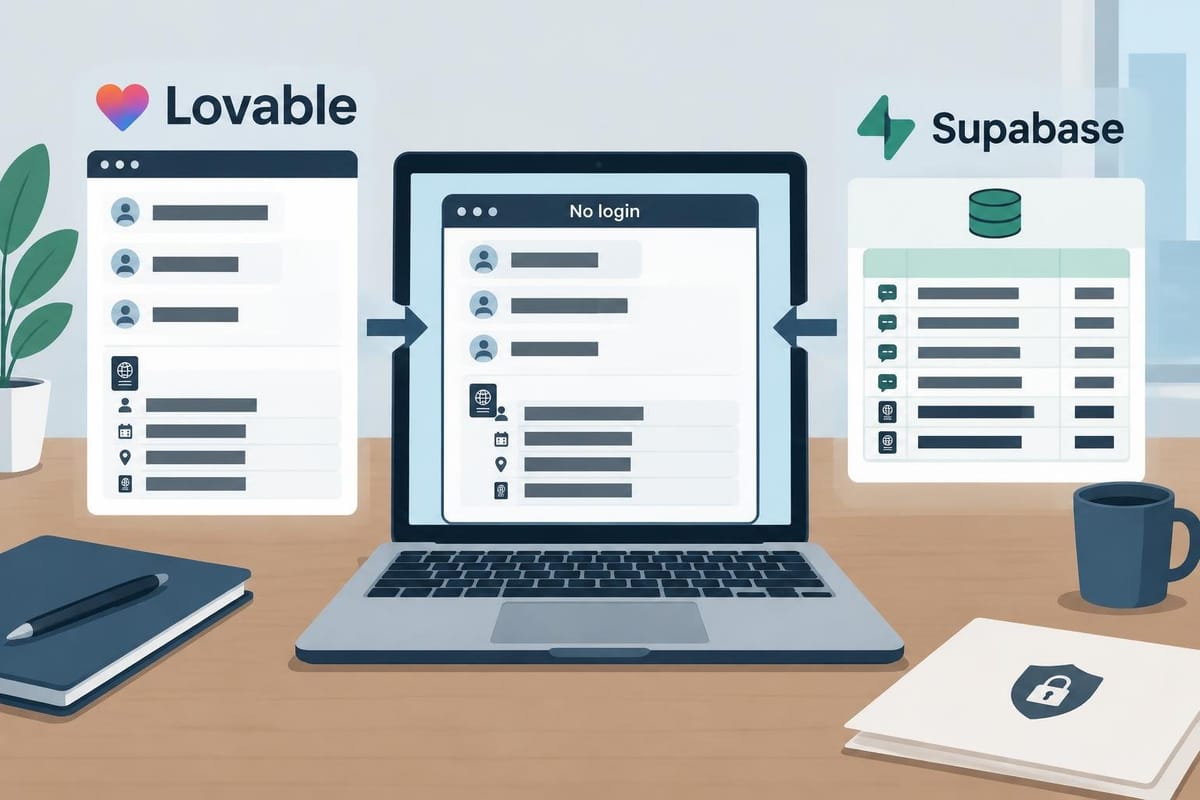
A German security firm, Crissyfield, says many web apps built on the AI platform Lovable left sensitive data readable without a login. Its report covers 159,041 Lovable projects. In one case a German lifestyle forum exposed more than 200,000 chat messages. In another, a service provider exposed more than 1,000 records with passport numbers, expiry dates and nationalities. All figures are the researcher's own and have not been independently verified.
Lovable's head of security, writing in the Hacker News discussion, attributed the root cause to insufficient row-level security. The report points to a recurring access-control pattern in apps connected to the Supabase database service rather than a single bug. Neither source establishes that the affected apps have since been secured.
What was reachable, and how
Crissyfield used the open web archive Common Crawl to identify Lovable projects built between December 2025 and September 2026. Of the 159,041, it says 34,545 used Supabase. It focused on Supabase because it believes it is the most widely used database among Lovable projects and its integration is relatively easy to analyze. Lovable's own database features, introduced in late 2025, were not examined.
Of the Supabase sites, 24,664 sent database records to the browser as soon as the page loaded, with no login. The report says this alone is not a flaw, since some data is meant to be public. The researchers then made additional read-only requests with the same API key the sites already exposed. They found records containing email addresses in 10,560 tables across 7,403 of those 24,664 sites (30%).
The report warns against reading that 30% as a leak rate. Email addresses can be public contact details or test data, and the method misses personal records without emails. The figure applies only to the 24,664 sites examined more closely, and the Common Crawl sample is not representative of all Lovable apps. Only parts of the datasets were downloaded, so the affected tables may hold more than the reported counts. The researchers are withholding access details.
In the Hacker News thread, the author, posting as neathack, added a figure not in the report. He said a decision model run on each dataset, with an 85% confidence threshold, flagged nearly 4,000 sites as leaking privacy-sensitive information. He described it as 15.9% of Lovable sites using Supabase, but that denominator conflicts with the reported counts, since 34,545 sites used Supabase, and the thread does not make clear which sites the model assessed. A commenter calculated roughly 2.5% of all 159,041 sites. The model's method is unpublished, so treat these numbers as unverified.
Other examples in the report
The report lists several cases. A property management company exposed AI-generated summaries of internal emails containing sensitive information about tenants, property owners and business partners. Event organizers and restaurants exposed tens of thousands of ticket and food-sales records. The forum case also included more than 80,000 profiles with names, emails, dates of birth and gender.
Separately, the researchers say other accessible content included tens of thousands of contracts and invoices, personal photo albums and internal WhatsApp communications. In one case, 280,000 emails sent to a provider's customers were accessible. The report does not attribute those items to the property manager. The researchers say they could not establish whether any data was misused.
Disclosure and responses
The report says it was produced with the newspaper Handelsblatt, whose reporter Lina Knees covered the findings on November 2, 2026. The report says it contains a more recent analysis and updated figures than that article. The Handelsblatt page returned no text when we retrieved it, so its contents, including any Lovable statement, were not checked.
In the thread, the author said Lovable was told weeks before publication, gave an official statement confirming the findings that appears in the Handelsblatt article, and never asked to delay publication or threatened legal action. He said he sent Lovable's head of security website names, table names, record counts and an LLM-generated privacy sensitivity score, but no actual records. Another commenter said the news article refers to attempts to report going back to August. The author also said he first submitted the report to Hacker News two weeks before the thread.
A commenter identifying himself as Igor, Lovable's head of security, said the root cause in these apps was insufficient row-level security, which he said Lovable's scanning is built to catch. He said every app is scanned automatically before publishing, a deeper SAST scan is offered, both free, and users can select Fix or enable auto-fix, and can block publishing when there are critical findings. He also said Lovable is training auto-fix to avoid breaking changes and hopes to turn it on by default. This is his account in a public forum; we could not verify it, and it does not show the exposed apps are fixed. Several commenters criticized the response as shifting responsibility to users.
Commenters also pointed to a Supabase discussion about changed defaults for new tables, and one said tables created before the change keep the older, more open defaults. We did not review that discussion.
The author said no personal data from the apps ended up in Common Crawl, which does not store the database responses, and that data fetched during the research was deleted. He acknowledged readers must take that on trust. Commenters debated the legal risks of probing and downloading records.
What builders can do
The report advises reviewing access permissions, interfaces and separation between user accounts before an app handles real customer data, repeating the review after significant changes, and not treating automated checks as a substitute for professional assessment. In Supabase terms, that generally means enabling row-level security on tables holding personal data and writing policies that match who is actually authorized to see each row. That framing is our summary; we did not capture Supabase's official documentation.
What is not known
It is not established how many affected sites have been fixed or whether anyone else copied the data. Lovable's statement to Handelsblatt was not reviewed. The report does not establish when its English version was published.

Comments ()