GreyNoise reports Check Point management breaches at 22 organizations
GreyNoise says actor GT13 compromised Check Point Security Management servers at 22+ organizations; here is what is documented and what admins should check.
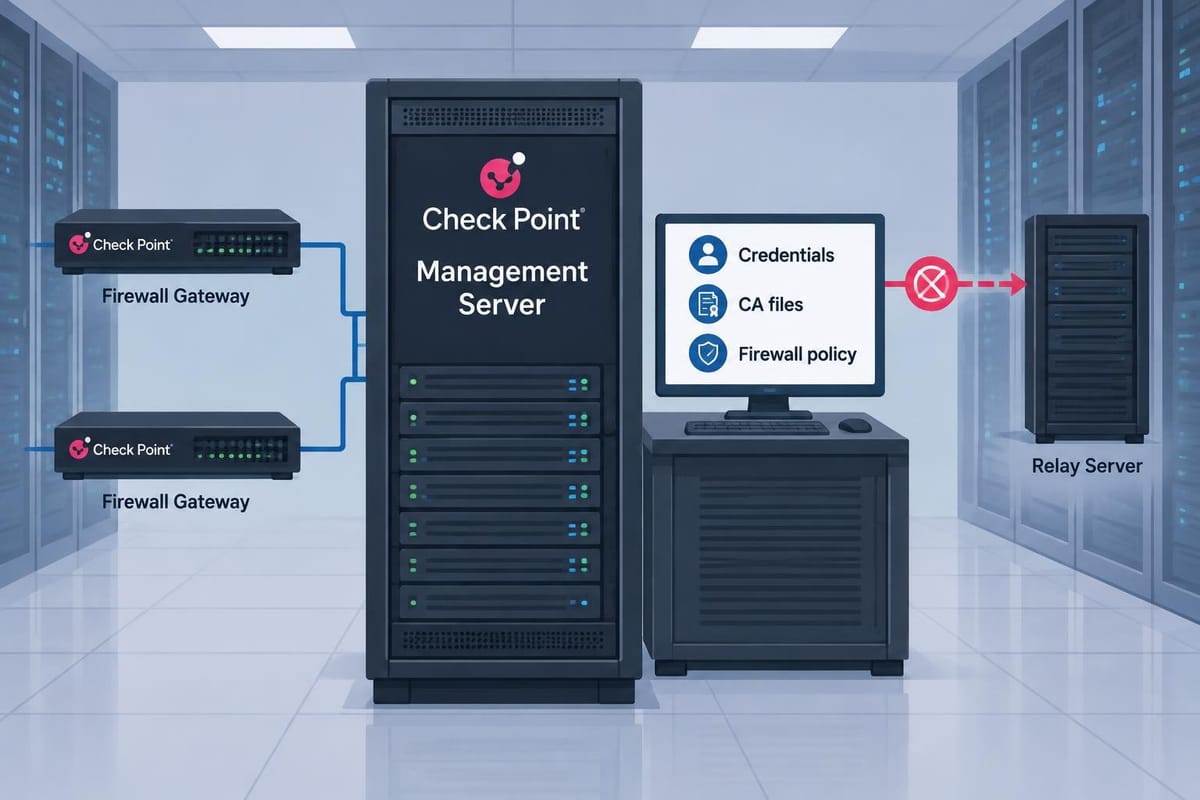
GreyNoise reported on November 23, 2026 that an unattributed actor, tracked as GreyNoise Threat 13 (GT13), compromised Check Point Security Management servers at at least 22 organizations, with confirmed activity between October 17 and November 2, 2026. The GreyNoise report says the victims span financial services, energy, government, transportation, mining, engineering and manufacturing, with assets in the UK, Ireland, France, Germany, India, Australia, the US and other countries.
The target is the management plane, not the gateways: these servers hold firewall policy, stored credentials and the internal certificate authority. GreyNoise says the relay host stored command results and data stolen from 24 distinct Check Point Security Management Servers, and that it watched one victim (Victim A) in detail and later observed bulk actions on 21 other victim Check Point devices. The report does not establish that those 21 devices belong to 21 separate additional organizations. The count is of victim organizations GreyNoise identified from its observation of the actor's infrastructure, not a vendor-confirmed tally.
The documented tool for command execution is CVE-2026-16232, which GreyNoise describes as a SmartConsole authentication bypass leading to Run Script. It says the actor used a script purportedly adapted from a Metasploit module for it. Through that route the actor harvested credentials, CA files and firewall configuration, and tried certificate minting; GreyNoise says those attempts failed. Cybersecurity News, summarizing the report, adds that the actor tried to unload security policies. That detail is not in the GreyNoise passages we reviewed.
How the actor first reached the management servers is not known. GreyNoise says access predated the compromise of a Rejetto HFS server (CVE-2026-61500) that the actor turned into a relay, and it could not determine when or how. The actor also used or tried CVEs against Citrix NetScaler, Ivanti, Windows NetLogon and Linux (CVE-2026-98432), plus Nmap, Chisel, Impacket and Paramiko. GreyNoise believes LLM-driven automation was involved and expects the campaign to continue because the actor retains access. It says it notified many victims directly or through government partners.
This is not described as a new vulnerability. Separately, Cybersecurity Dive via Yahoo reports a distinct PHP2Shell campaign against Check Point Security Gateways, starting October 30; GreyNoise confirmed the overlapping dates but said the campaigns are unrelated. Check Point had not commented at the time of that report, and we have not seen a Check Point advisory tying a fix to GT13.
What administrators can do: check Check Point's security advisories for guidance and available updates covering CVE-2026-16232. We have not seen a vendor advisory that identifies fixed releases for it. As general precautions, restrict which addresses can reach the management servers and review them for unexpected certificates, scheduled tasks, policy changes, and SSH keys. GreyNoise flags a preload entry for /usr/lib/.libproc.so in /etc/ld.so.preload as a possible implant on one device. Treat credentials and CA material on any suspect server as exposed. GreyNoise's report lists domains, user agents and ExpressVPN-hosted IPs for hunting; use its published indicators instead of copies.



Comments ()