Anthropic's S-1: The Compute Margin Reversal, $637 Billion in Infrastructure Bets, and the Governance Architecture No Shareholder Can Override
Anthropic's S-1 reveals a Delaware public benefit corporation controlled in part by an independent Long-Term Benefit Trust — an unusual governance structure for a Nasdaq listing.
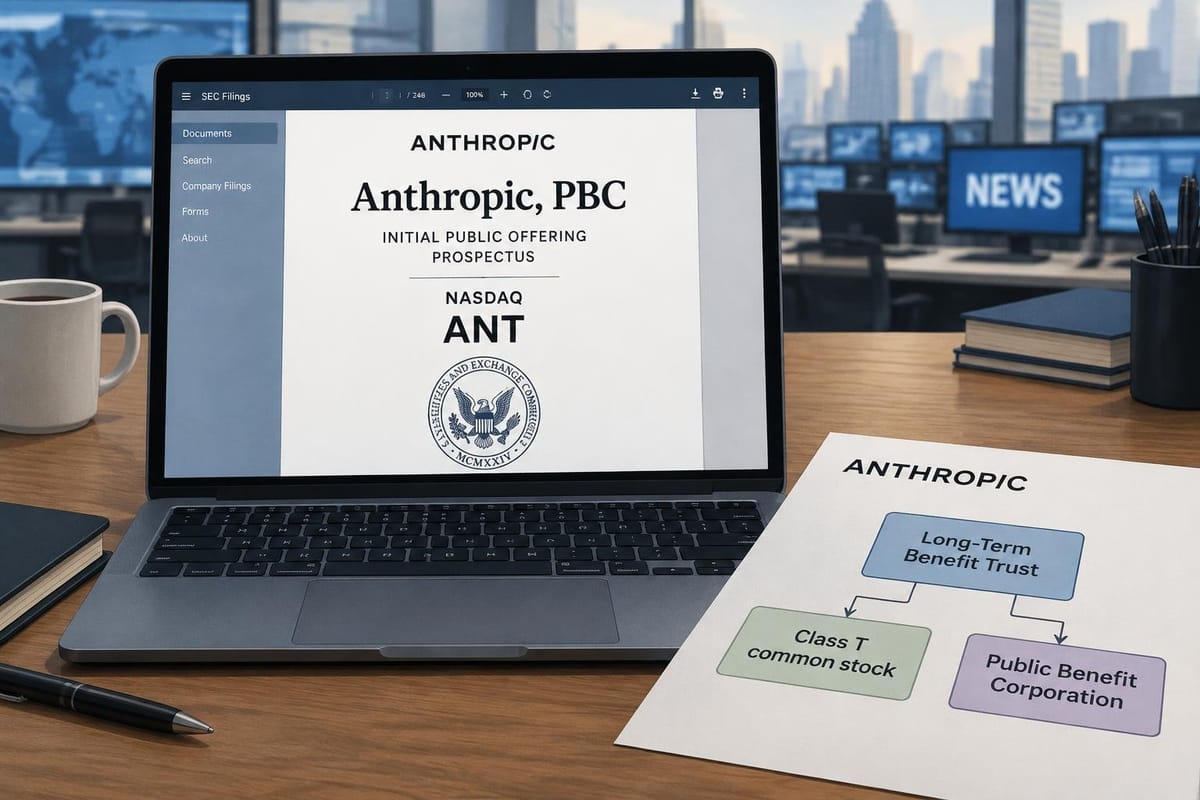
Anthropic's S-1: The Compute Margin Reversal, Infrastructure Commitments, and the Governance Architecture No Shareholder Can Override
On October 26, 2026, Anthropic, PBC filed its S-1 registration statement with the Securities and Exchange Commission, becoming the first frontier AI laboratory to seek a public listing. The full filing is available on EDGAR. Read straight through, it is three things simultaneously: a credible account of a business that turned a corner on unit economics in the first half of 2026, a frank disclosure of infrastructure bets so large they dwarf anything a software company has attempted before, and a governance document that encodes safety constraints into the legal structure of the corporation in ways that survive the IPO itself.
The announcement coverage got the top-line numbers. The details that matter for builders, buyers, and anyone watching what frontier AI actually costs are deeper in.
The Compute Economics Reversal
The most consequential financial claim in public commentary on the filing concerns the shift in compute-and-infrastructure economics between FY 2025 and the first half of 2026. A commenter in the Hacker News discussion of the S-1 — citing figures from the prospectus's financial tables — described the relationship this way: in FY 2025, Anthropic spent $7.3 billion on compute and infrastructure against $4.6 billion in revenue, a ratio of roughly -176%, meaning compute costs substantially exceeded revenue. By H1 2026, the relationship had reportedly inverted: $8.9 billion in C&I against approximately $16 billion in revenue, yielding a positive gross compute margin for the first time.
These figures come from the Hacker News thread, where a commenter identified as JumpCrisscross wrote: "HY1 2026 revenue less compute and infrastructure turned positive (45% gross compute margin; $8.9bn C&I to turn $16bn revenue) for the first time; it was -176% in FY 2025 with $7.3bn C&I on $4.6bn revenue." That is a Hacker News comment quoting the prospectus, not a directly captured passage from the filing itself. The direction of the shift is consistent with independent reporting: CTech reported the H1 2026 revenue figure as $16.3 billion in its coverage of the filing, and Bloomberg reported Anthropic as the first frontier AI lab to go public.
The SEC filing text captured directly does confirm the company's $112.4 billion in cash and cash equivalents and $19.3 billion in short-term investments as of June 30, 2026 — a liquidity position reflecting the scale of investment Anthropic has received from Amazon and Google. It also confirms that long-term compute is contracted under multi-year commitments procured 12 to 18 months in advance of availability, and that short-term compute — purchased when customer demand or research needs exceed the contracted base — "typically carries a higher cost per unit" and that Anthropic "expect[s] our use of short-term compute to increase in the near term and to in turn compress our operating margin."
If the compute margin figures from the HN thread accurately reflect the filing's tables, going from deeply underwater on compute to generating meaningful gross margin in a single year — while revenue nearly tripled — is the economic story Anthropic is telling public markets. Whether that margin is durable, or whether it reflects a temporary window before the next wave of infrastructure spending compresses it again, is exactly what quarterly reports following the IPO will reveal.
Seven Counterparties and the Infrastructure Commitment Table
The infrastructure commitment disclosure is where the filing departs most sharply from anything in software's history. The Hacker News discussion, drawing on the prospectus's contractual obligations table, produced a commenter breakdown identifying seven named counterparties and their time horizons:
- Broadcom: $161.2 billion, 2026–2031
- SpaceX: $120.5 billion, 2026–2029
- Google: $114.5 billion, 2026–2033
- Amazon: $110.0 billion, 2026–2036
- Microsoft: $44.9 billion, 2026–2033
- Nscale: $44.6 billion, 2026–2033
- Lambda: $41.3 billion, 2026–2034
The commenter noted these average approximately $63.7 billion per year across their respective terms. Fortune reported the total as "up to $567 billion" in compute spend. These figures originate from commenter readings of the filing's contractual obligations table; the directly captured SEC filing text confirms the existence of the commitment disclosure and the character of the Broadcom relationship, but the captured passage renders the total dollar amounts with a placeholder ("approximately $ expected to be incurred before December 31, 2030"), meaning the specific counterparty figures above are sourced to the HN thread rather than directly verified in the captured text.
What the filing text does establish directly and in full detail is the structure of the Broadcom arrangement. Anthropic entered "Lease Arrangements" with Broadcom through two special-purpose subsidiaries, with obligations guaranteed by Anthropic, PBC and secured by the leased equipment. The arrangements are non-cancelable during the applicable lease period except in the case of default. Anthropic deposited cash into a restricted account for Broadcom's benefit and may be required to deposit additional cash under certain circumstances. Anthropic agreed to customary events of default, including cross-defaults, upon which obligations may be accelerated. It may, if needed, finance a certain amount of its quarterly rent payments through the issuance of convertible promissory notes. In the second quarter of 2026, Broadcom assigned a portion of its rights under one of the master equipment leases to an unnamed third party.
The filing also describes in captured text how the prospectus summary qualifies the commitment figures: the filing notes that substantially all of the remainder beyond 2030 is expected to be incurred between 2031 and 2045, and that a specific portion is due in the next 12 months — both dollar amounts rendered as placeholders in the captured version, suggesting they appear in a financial table not yet fully retrieved.
The SpaceX commitment — if the thread's reading is accurate at $120.5 billion over three years, the shortest horizon of any counterparty — is striking because SpaceX is a launch and satellite company, not a traditional cloud or chip provider. The nature of that relationship is not explained in the captured filing text.
Fortune separately reported that the prospectus describes plans to build Anthropic's own data centers rather than remain solely a cloud tenant — a structural transition from paying for access to owning capacity.
Competitor-Vendors and Structural Conflicts
The filing's risk factors, captured directly, address a conflict that runs through Anthropic's entire supply chain. The filing states: "Certain of the CSPs and chip partners on which we rely provide us capital or credit support, serve as our infrastructure vendors, and develop and offer AI models and services that compete with ours. These relationships could give rise to conflicts of interest that affect our access to compute, its cost, the prioritization of our workloads, or the terms on which such capital or credit support is provided."
Amazon and Google are both in that category based on Anthropic's funding history. Amazon Web Services hosts Claude via Bedrock, has invested heavily in Anthropic's pre-IPO rounds, and operates competing AI services. Google Cloud similarly distributes Claude via Vertex AI while developing Gemini. The filing does not describe any mechanism for managing these conflicts; it characterizes them as a risk that investors should weigh.
The filing also discloses the structural pressure toward vertical integration in captured text: "Our future competitiveness may depend in part on our ability to successfully develop vertically integrated compute infrastructure on competitive terms and timelines, and there can be no assurance that we will be able to do so. Our competitors may be better positioned, or may invest greater efforts, to vertically integrate across the compute supply chain."
That is a direct acknowledgment that the race for frontier AI may increasingly be a race for hardware, not just algorithms — and that Anthropic is starting from a position of dependency on the same companies it needs to outcompete.
International Infrastructure Concentration Risk
The filing identifies a risk that is easy to overlook amid the headline compute numbers. The captured filing text states directly: "Our ability to enter into definitive agreements for data center capacity and operations in non-U.S. jurisdictions depends on the timely formation, registration, and receipt of governmental approval of local subsidiaries, as well as the establishment of local banking arrangements, and any delay or failure in completing these steps could delay or prevent us from mitigating our infrastructure concentration risks, executing our international growth strategy, securing planned compute capacity, or could result in substantial additional taxes, penalties, or other liabilities. In addition, regulatory, legal, and other constraints in many jurisdictions may limit the locations in which we can practically site or contract for data center capacity, which could constrain our ability to diversify our infrastructure footprint as quickly or as broadly as we currently intend."
For enterprise customers outside the United States — particularly in jurisdictions sensitive to dependence on U.S. cloud infrastructure — this is a vendor risk disclosure that matters operationally. The Hacker News discussion surfaced this dimension organically: several non-U.S. commenters described export controls on Claude models as a factor pushing them toward provider diversity, with one noting that "international relations between the US and its allies have deteriorated to the point yet another critical dependency Washington can turn off for geopolitical reasons isn't a very attractive idea."
The Governance Architecture: What Public Investors Do Not Get
The most structurally unusual disclosure in the filing is not the compute spend. It is the share structure, which the S-1 establishes directly in the captured filing text.
Anthropic has authorized five classes of common stock:
Class A — sold in the IPO; one vote per share; full economic rights. The only class available to outside investors.
Class N — held by strategic business partners; no voting rights; converts to Class A upon transfer to an unaffiliated third party.
Class E — issued to employees excluding co-founders upon IPO completion; votes only on certain limited matters; no economic rights.
Class F — a single share issued immediately before the IPO closes to the "Founder LLC," whose initial members are CEO Dario Amodei, President Daniela Amodei, and five other co-founders. Class F carries 50.1% of total voting power on all matters submitted to stockholders generally, including director elections other than the Class T directors. It has no economic rights.
Class T — held by the Long-Term Benefit Trust (LTBT), described as "an independent body of financially disinterested trustees with expertise in AI safety, national security, public policy, and social enterprise." Through Class T, the LTBT "generally has the authority to elect and remove the Class T directors, who together will constitute a majority of the authorized members" of the board. Class T does not vote on matters submitted to stockholders generally and has no economic rights.
The combined effect is layered control: the LTBT controls board composition through Class T (since Class T directors constitute a board majority), and the seven co-founders control all general stockholder votes through a single Class F share carrying 50.1% of total voting power. Public investors purchasing Class A shares acquire economic exposure and one vote per share — but they cannot outvote the founders on any general stockholder matter, and they cannot change the board majority without the LTBT's consent.
The filing confirms Anthropic qualifies as a controlled company under Nasdaq's corporate governance requirements because of the founders' Class F voting power, and that Anthropic intends to use the controlled company exemption — at least initially — to opt out of requiring a majority of independent directors on its board.
This is deliberate architecture, not an oversight. The LTBT structure means the safety mission is not a policy preference subject to shareholder pressure; it is encoded into who controls the boardroom. A shareholder who believes Anthropic is being too cautious about a commercially valuable capability has no governance mechanism to force a change.
For enterprise buyers building long-term dependencies on Claude APIs, that structure cuts in two directions. It provides assurance that no activist investor or strategic partner can force capability decisions that compromise safety review. It also means that if the LTBT or the founders determine a constraint is necessary, there is no shareholder lever available to buyers. Fortune separately reported that the filing's risk factors include human extinction, the Pentagon, and CEO Dario Amodei's personal reputation as material risks — an unusual trifecta that reflects the range of obligations a public benefit corporation with this governance structure must disclose.
What Quarterly Reporting Will Force Into the Open
Bloomberg reported Anthropic as the first frontier AI lab to list publicly. OpenAI remains private. Google DeepMind is a subsidiary. Meta AI is a division. That means Anthropic will carry quarterly public disclosure obligations that no frontier lab has ever had to meet: training costs, inference economics, capital allocation, headcount trends, and material risks — on a schedule set by SEC rules, not by the company's communications team.
The captured filing text puts the strategic vision plainly: Anthropic believes that "Powerful AI" — defined as cognitive capabilities matching or exceeding top human experts across most professional and scientific disciplines, with the ability to navigate all human interfaces and reason autonomously over extended periods — will become widely available within a few years. Every number in this prospectus is calibrated to that belief being correct.
If it is correct, the infrastructure commitments are rational bets. If it is not, the non-cancelable leases, the Broadcom cross-defaults, and the quarterly reporting cycle that now governs the company will make the resulting adjustment very public.
The H1 2026 compute margin improvement, if the figures cited in the HN thread accurately reflect the filing's financial tables, is the first data point in that public series. Whether the Broadcom lease terms compress margins as equipment depreciates, whether the SpaceX relationship delivers the capacity it promises on the stated timeline, whether short-term compute costs spike as the company races to meet demand beyond its contracted base — all of that will enter the public record quarter by quarter.
Primary source: Anthropic, PBC S-1, SEC EDGAR, filed October 26, 2026. Governance architecture (share classes, LTBT, controlled-company status), Broadcom lease structure, international concentration risk, vertical-integration risk language, and the cash/investment position are drawn directly from captured filing text. The counterparty commitment table (Broadcom, SpaceX, Google, Amazon, Microsoft, Nscale, Lambda) and compute margin figures (FY 2025 and H1 2026) are sourced to the Hacker News discussion thread, where commenters quoted the prospectus's contractual obligations and financial tables; these figures have not been independently verified against the raw filing text. The $16.3 billion H1 2026 revenue figure is reported by CTech. Fortune reported the $567 billion compute spend total and the data center build-out plans, and separately reported the risk-factor disclosures including human extinction and Dario Amodei's reputation. Bloomberg reported Anthropic as the first frontier AI lab to list publicly.
Comments ()