GitHub’s new agentic workflows still live and die by YAML guardrails
GitHub’s new agentic workflows compile natural language into Actions YAML, but permissions, safe outputs and review gates still do the real control work.
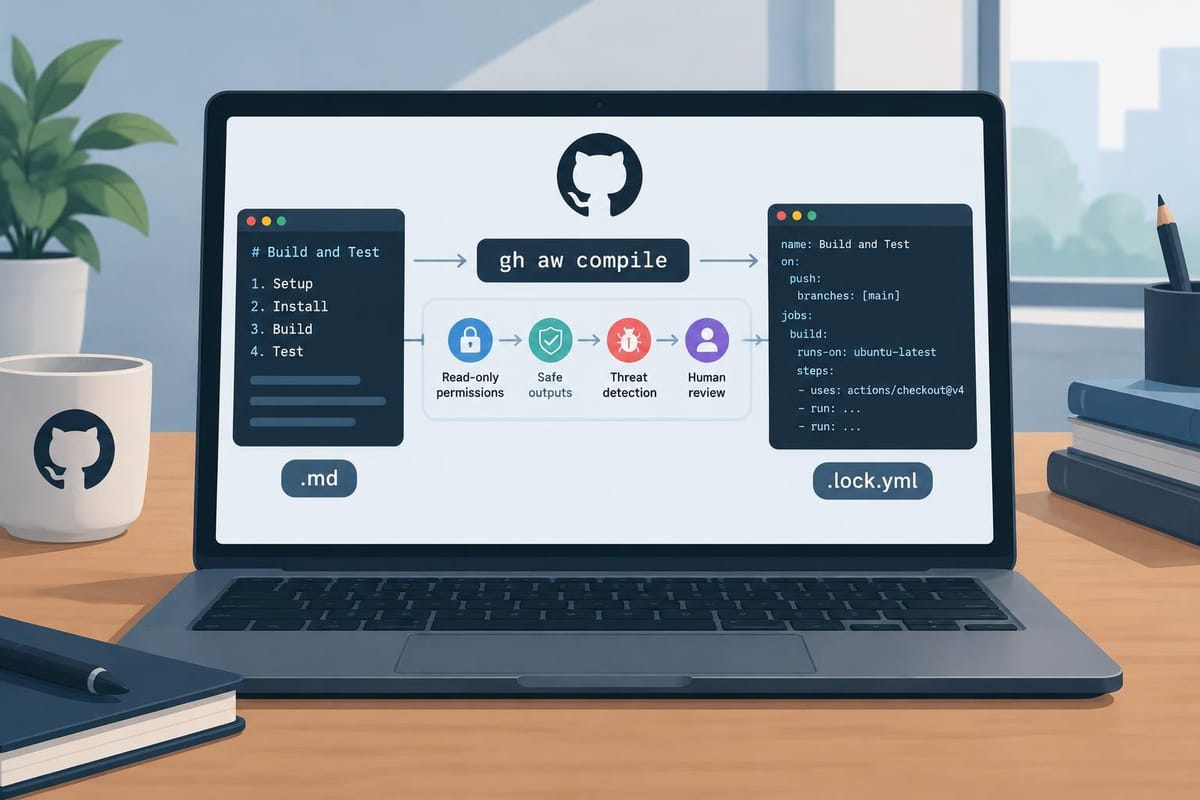
GitHub’s Agentic Workflows has gone generally available, but the headline feature is not that workflows became autonomous. It is that GitHub has wrapped a natural-language authoring layer around a fairly strict Actions control plane — and the strict part still does most of the important work.
GitHub says the product is now generally available on github.com for Free, Team and Enterprise users. Its pitch is simple: describe a repository task in plain Markdown, compile it into a hardened GitHub Actions workflow, then let a chosen coding agent run inside GitHub Actions with guardrails, permissions and review points already in place. GitHub’s own workflow page says the system can use Copilot, Claude, Codex, Antigravity and other engines, and that gh aw compile turns the draft into a “pinned, validated GitHub Actions YAML” file.https://github.blog/changelog/2026-10-28-github-agentic-workflows-generally-available/ https://github.github.com/gh-aw/
That is the practical takeaway for teams already living in Actions: the natural-language layer does not replace workflow definition, it generates it. GitHub’s docs show the flow explicitly:
Prompt your coding agent to create a workflow -> GitHub compiles it into an Actions workflow -> run the chosen agent in GitHub Actions -> apply approved outputs
The generated workflow still has to declare what happens, where it runs, and what outputs are allowed. GitHub’s documentation repeatedly frames the agent as a reasoner, not a free hand: “The agent reasons about your repository. It does not hold the authority to change it.” Safe outputs are the mechanism that turns agent suggestions into writes, and those writes are applied by a separate job with its own permissions.https://github.github.com/gh-aw/
That separation matters because it marks the boundary between what the agent can infer and what the workflow author must still decide. GitHub’s examples show the user specifying the job goal in Markdown, but the compiled workflow still contains the operational constraints: trigger type, sandboxing, read-only tools, allowlisted network access, staged writes, and the safe outputs that map to GitHub operations such as creating a pull request or adding a comment. In other words, the agent can draft intent; the YAML still carries the security model.https://github.github.com/gh-aw/
GitHub’s community discussion from the technical preview makes the same point from another angle. The team described agentic workflows as “automated, intent-driven repository workflows” that run in GitHub Actions, authored in plain Markdown and executed with coding agents. But it also stressed that the workflows run with read-only access by default and rely on safe outputs for GitHub operations, and that pull requests are never merged automatically. Humans must review and approve.https://github.com/orgs/community/discussions/186451
That means the real control surfaces are still boring, which is exactly why they matter. The workflow author decides the trigger, the repository permissions, the allowlist, the budget cap, and the approved write actions. GitHub’s homepage for the product shows examples such as daily issue summaries, CI doctors, test improvers and documentation updaters, but all of them are framed as scheduled or event-driven automations that sit inside Actions rather than replacing it.https://github.github.com/gh-aw/
The guardrails are not cosmetic. GitHub documents a layered execution model with an agent sandbox, isolated inputs, read-only GitHub tools, allowlisted network access, staged artifacts, and a separate “safe outputs” job. It also lists cost controls: max-ai-credits and max-turns can stop a run, while max-daily-ai-credits can skip a workflow once it exceeds the daily budget.https://github.github.com/gh-aw/
That design answers one of the biggest questions around agentic automation: what happens when the model gets creative in the wrong direction? GitHub’s answer is not “trust the model more.” It is to make the dangerous parts hard to do in the first place. On the public site, the company says suspicious outputs can be blocked by a separate threat-detection job, and only declared writes are applied. In the preview discussion, GitHub also said the workflow markdown should be treated as code and reviewed carefully.https://github.github.com/gh-aw/ https://github.com/orgs/community/discussions/186451
The upside is obvious: teams can describe recurring repository chores in natural language instead of hand-authoring every step of a workflow. The downside is equally practical: the more you rely on the compiler, the more you need to know which parts are generated and which parts remain explicit policy. GitHub’s docs suggest the compiled YAML is “hardened” and “pinned,” but the human still has to decide the trust boundary: when to let the agent run, what it may write, what it may reach on the network, and whether a result should be staged, previewed or applied.https://github.github.com/gh-aw/
That is why the GA announcement should be read as a workflow-control story, not a leap to autonomy. The product is useful precisely because it does not ask teams to abandon Actions discipline. It adds a higher-level authoring layer on top of the same permissioning model that already governs GitHub automation.
For practitioners, the question is not whether Agentic Workflows can “do the task.” GitHub has already shown examples of issue triage, CI investigation, test improvement and documentation upkeep. The better question is whether the task can be safely expressed as: read-only by default, writes only through declared safe outputs, and review before merge. If the answer is no, the YAML is still where the real work starts.
And that is the part the GA label does not change.

Comments ()