Anthropic's S-1 makes the AI business legible: $67B in revenue, $141B raised, and hundreds of billions in compute commitments
Anthropic's S-1 reveals $67B annual revenue, $141B raised, and multi-year compute commitments that define the economics of frontier AI — and the platform risk for builders.
Anthropic's S-1 makes the AI business legible: $67B in revenue, $141B raised, and hundreds of billions in compute commitments
When Anthropic filed its S-1 with the SEC on October 26, 2026, it handed the developer community something it had never had before: audited-quality specifics about what it actually costs to build and operate a frontier AI company at scale. The filing on SEC EDGAR is not a product announcement. It is a legal disclosure obligation — which makes it the most reliable window into Anthropic's economics that has ever been opened.
The headline numbers are striking, but for builders choosing platforms, integrating Claude into production workloads, or trying to model the market structure around them, the risk factors and financial model sections are the more important read.
The revenue picture
The S-1 discloses that revenue grew 1,368% year-over-year for the three months ended June 30, 2026, compared to compute and infrastructure expenses that grew 300% during the same period. The company frames this spread as evidence of compute efficiency — it extracts more billable intelligence per dollar of training and inference cost than its approach did a year earlier.
Operating efficiency shows up just as sharply in the employee productivity metric. The filing discloses TTM revenue per employee of over $6.6 million as of September 30, 2026, up from $1.4 million as of September 30, 2025 — roughly a 4.7× improvement in a single year. A Hacker News discussion of the filing (1,703 points, 1,675 comments) identifies the disclosed annual revenue figure as approximately $67.2 billion, which is consistent with the scale implied by those per-employee figures.
As of June 30, 2026, Anthropic had raised an aggregate of $141.1 billion in capital, held $112.4 billion in cash and cash equivalents, and $19.3 billion in short-term investments — all directly stated in the filing.
The compute commitment structure
The most consequential section of the S-1 for anyone thinking about Anthropic as a platform dependency is the compute risk disclosure. The filing states plainly that the company must make binding financial commitments for compute months or years in advance because chip manufacturers, cloud service providers, and data center developers require forward commitments to allocate production capacity and manage their own supply chains. The company acknowledges it must forecast demand "well in advance of deployment" and commit capital "often with limited ability to adjust commitments if our needs change."
The filing does not present a single consolidated commitment table in the captured sections, but HN commenter dyslexit, analyzing the filing, reconstructed the following counterparty breakdown from the document:
| Counterparty | Commitment | Period |
|---|---|---|
| Broadcom | $161.2B | 2026–2031 |
| SpaceX | $120.5B | 2026–2029 |
| $114.5B | 2026–2033 | |
| Amazon (AWS) | $110.0B | 2026–2036 |
| Microsoft Azure | $44.9B | 2026–2033 |
| Nscale | $44.6B | 2026–2033 |
| Lambda | $41.3B | 2026–2034 |
This table is reconstructed from the HN thread, not a direct quote from the filing's captured sections. Treat the individual figures as practitioner analysis pending independent confirmation from the full document.
HN commenter Maxatar contextualized the math usefully: these are not annual figures. Most of the commitments amount to roughly ten-year arrangements. Spread across their contract periods, commenter dyslexit estimated the aggregate at approximately $63.7 billion per year — a figure that sits uncomfortably close to the disclosed annual revenue run rate of roughly $67 billion.
Commenter trjordan framed the structural logic directly: "They've got to commit hard or end up with a frontier model and 50% of the capacity, getting eviscerated on either availability or last-minute datacenter leases." That is not editorializing — it restates the risk factor language in the filing itself, which warns that "even a brief period without access to sufficient compute could cause us to fall behind quickly" and that "the gap between frontier models and those one or two versions behind can be significant in terms of capability, performance, and commercial applicability."
Cloud distribution and the three-platform dependency
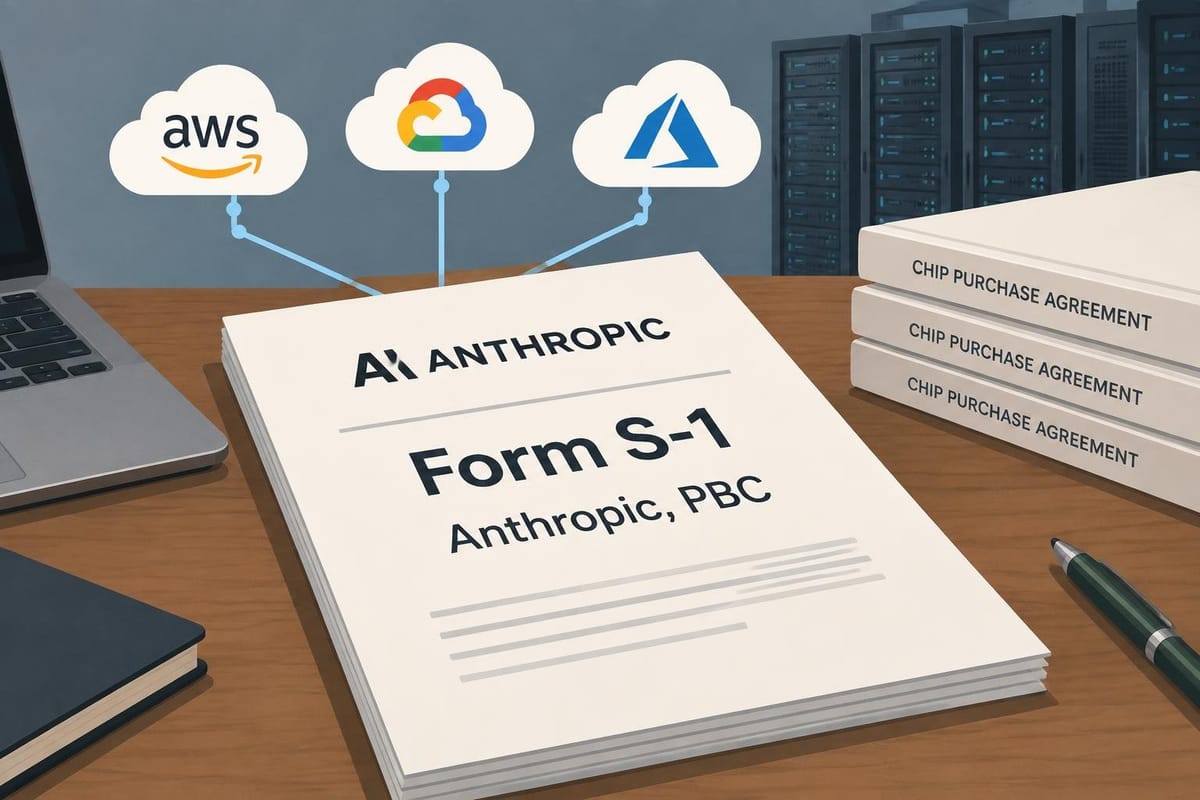
The S-1 discloses that Claude is accessible on all three major cloud platforms — AWS, Google Cloud Platform, and Microsoft Azure — under a structure where Anthropic establishes direct contractual relationships with customers but pays a fee to each cloud service provider. The filing frames this as beneficial because it avoids channel conflict, allows Anthropic to set its own pricing, and lets the company capture the financial benefit of compute efficiency improvements directly.
For builders, this structure has a specific implication: when you consume Claude through AWS Bedrock, Google Vertex AI, or Azure AI Studio, you are in a three-party arrangement. Anthropic holds the customer relationship and pricing lever; the cloud provider receives a distribution fee and supplies infrastructure; you get a contractual relationship with Anthropic through the cloud's procurement layer.
The filing names Accenture, Deloitte, KPMG, and PwC as system integrator partners, and Salesforce and Snowflake as data platform partners. A new vehicle — Ode with Anthropic, described as an AI services company launched in partnership with leading private equity firms — targets mid-sized companies, building solutions on the Claude Platform for customers who want managed deployment rather than direct API integration.
The overlap between compute partners and equity investors is notable. Amazon and Google are both major shareholders and infrastructure suppliers — a structure that can accelerate distribution but also means the compute risk section of this S-1 is inseparable from the health of those three-party relationships.
What the risk factors actually say
The risk section is where S-1 filings do their most useful work, and Anthropic's is unusually direct. The filing enumerates the following as material risks:
Compute forecast error. If actual compute requirements differ materially from projections, Anthropic may be committed to excess compute that remains underutilized — or, conversely, unable to meet demand. Both scenarios create financial exposure, and the filing acknowledges the company "often" has limited ability to adjust commitments once made. HN commenter ml-anon pushed further, arguing that equity-funded compute means losses don't show up as cash losses in the traditional sense — a framing that drew pushback in the thread but surfaced a real accounting question about how to read the profitability signals in the filing.
Talent concentration. Success depends on retaining co-founders, senior management, and key technical employees. The filing notes that researchers may leave if they lack access to adequate compute or if Anthropic is not perceived as operating at the frontier — creating a feedback loop where compute access affects talent retention, which affects model quality, which affects compute access.
Frontier position fragility. Losing frontier model status is identified as potentially difficult to recover from. Customers and developers who shift to a competitor with superior capabilities may not return, and the brand cost of falling behind is framed as compounding.
Capital access. The filing is explicit that continued access to capital is a requirement for the current investment trajectory, and that this access depends on continued revenue growth. The IPO is partly a mechanism to widen the capital base beyond the private investors who have funded operations to date.
Capital structure and governance
Co-founders Dario Amodei (CEO) and Daniela Amodei (President) are named as agents of service in the filing. Wilson Sonsini Goodrich & Rosati and Freshfields US LLP are listed as legal counsel.
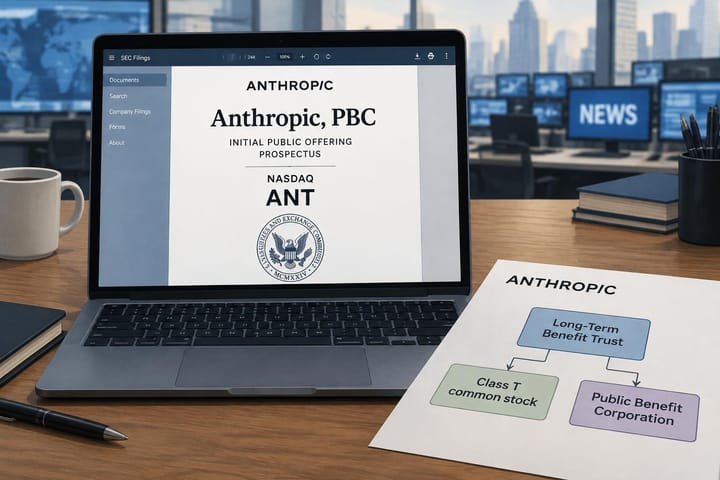
The filing confirms Anthropic is a Delaware public benefit corporation (PBC), which constrains certain governance decisions. The PBC designation is disclosed as a material fact to investors: the board weighs fiduciary duties against stated public benefit obligations, not solely against shareholder returns. For builders relying on the platform, this is a genuine governance constraint, not marketing language — the filing presents it as a risk factor for investors, which is the clearest signal that it carries real legal weight.
What the filing makes legible for builders
For a developer or engineering organization deciding how deeply to integrate Claude, several facts from this filing are worth internalizing:
Anthropic is structurally committed to staying at the frontier. The compute commitments are not optional infrastructure hedges; they are the cost of the business model. A company that falls one model generation behind risks customer attrition, talent flight, and a deteriorating cost basis simultaneously. This creates strong incentive to keep investing — but it also means the financial picture depends on demand forecasts that the filing itself acknowledges are inherently uncertain.
The revenue efficiency trajectory is real but recent. The jump from $1.4 million to $6.6 million in TTM revenue per employee between September 2025 and September 2026 is dramatic. Whether it reflects genuine model-deployment leverage or a favorable period of rapid enterprise contract expansion — followed by a harder efficiency curve — is not something the S-1 can resolve. It is a data point, not a trend line.
The compute commitment scale is multi-year, not annual. The practitioner discussion flagged clearly that presenting aggregate commitment figures without contract periods is misleading. A $161 billion Broadcom commitment spread over six years is categorically different from a $161 billion annual obligation. The filing's own risk language is calibrated around this: the danger is not the aggregate number but the inflexibility of the commitments relative to demand uncertainty.
The PBC structure is not a formality. Builders relying on the platform are relying on an institution that has legally committed to balancing profit against stated public benefit obligations. Whether that is a feature or a risk depends on your perspective — but the filing makes clear it shapes how the board will weigh hard tradeoffs.
The practitioner discussion at Hacker News drew over 1,700 points and 1,600+ comments within three days of the filing, reflecting genuine uncertainty about whether the demand growth that makes these commitments rational will materialize at the scale and duration required. That uncertainty is not unique to the commentary — it is the central tension the filing itself acknowledges, in legally required language, across multiple risk sections. For anyone building on Claude or watching the AI platform market structure, the S-1 is the most useful primary source that has existed about this company. Reading the risk factors, not the business overview, is where that usefulness concentrates.

Comments ()