Mistral’s Large 4 open weights help teams self-host a frontier model — but not cheaply
Mistral’s Large 4 weights can now be downloaded and self-hosted, but the license is not open source and frontier costs remain high.
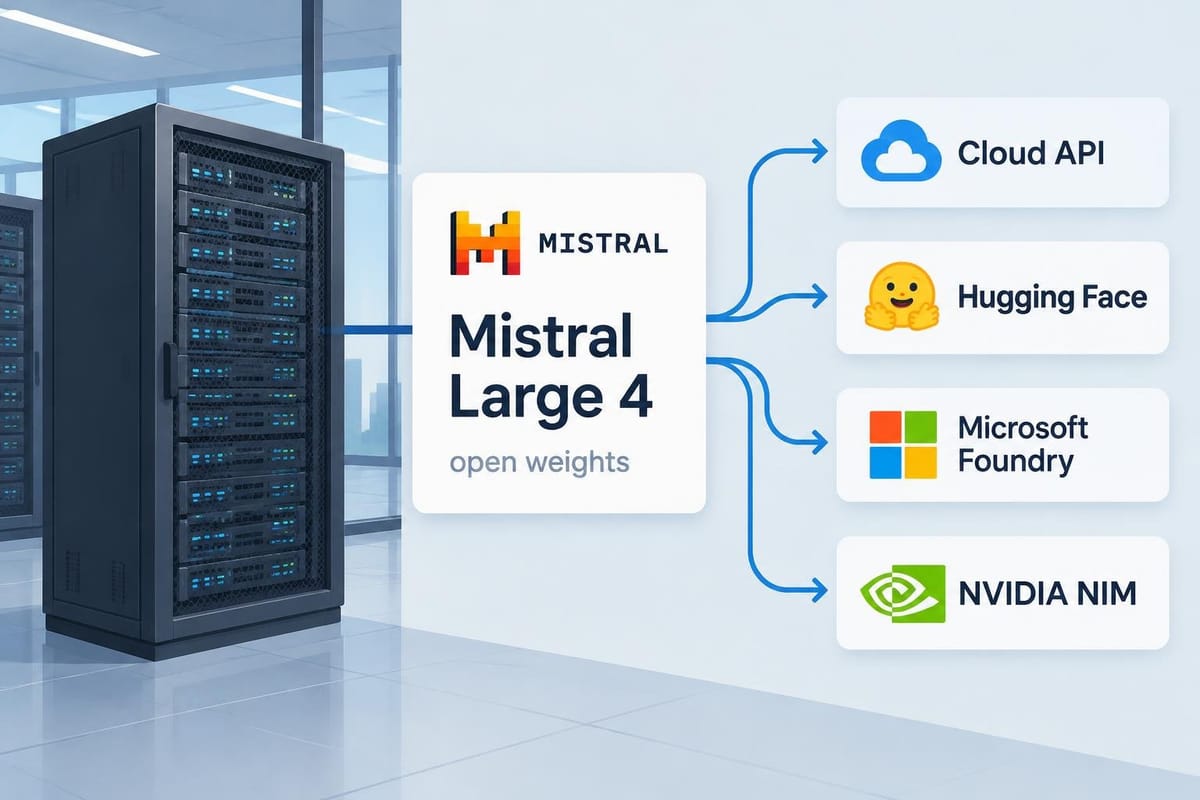
Mistral’s release of Mistral Large 4 (Le Chonk) changes who can run the model more than what the model is. On Oct. 29, the company said it was releasing the weights for the 1-trillion-parameter, natively multimodal model, letting teams download it and deploy it on their own infrastructure with vLLM or SGLang. That is a meaningful shift for organizations that want more control over where the model runs and who can access it. It is not the same thing as open source in the software-licensing sense. Mistral’s own page talks about “open weights,” a model card, and a license — not an OSI-style open-source release. Source: https://mistral.ai/news/mistral-large-4-oss/.
That distinction matters because the practical benefits and the legal rights are not identical. Mistral says: “We release the weights of Le Chonk,” and later: “For full control, download the open weights from Hugging Face and deploy on your own infrastructure with vLLM or SGLang. The model card and license have everything you need to get started.” In other words, the company is making the model portable and self-hostable, while keeping the licensing terms attached to how it can be used commercially. Source: https://mistral.ai/news/mistral-large-4-oss/.
The release widens access across a lot of channels at once. Mistral says Large 4 is available through Mistral Studio, the Mistral API, OpenRouter, Hugging Face, Microsoft Foundry, and NVIDIA-hosted endpoints. For teams that want to run it themselves, the company points to self-hosting with vLLM or SGLang. That gives buyers a clearer path than an API-only launch: they can stay on a managed service, move to a private enterprise deployment, or take on the infrastructure themselves. Source: https://mistral.ai/news/mistral-large-4-oss/.
The benchmark story is where Mistral is trying to sell the model as more than just “open.” The company says Large 4 leads FrontierCode 2.0 with a score of 19.7%. It also says the model reaches 48% on the Artificial Analysis Coding Agent Index while using 47% fewer tokens per task on average, and scores 41% on Terminal-Bench 4.0, up 13 percentage points from the public preview, while reducing output tokens by 30%. On the B3 Agent Security Benchmark, Mistral says the model resists 97.1% of attacks, versus 93.3% in preview. Those are strong claims, but they are still the company’s selected benchmarks, and Mistral says a full technical report is still coming. Source: https://mistral.ai/news/mistral-large-4-oss/.
The release also shows Mistral leaning hard into the “sovereign AI” pitch. The company says the model was trained on European infrastructure and frames Large 4 as something enterprises and institutions can “own, customize, and control.” That message will resonate most with teams that have compliance, privacy, or data-residency requirements. It also matches the broader appeal of open weights: not just model quality, but the ability to inspect, adapt, and deploy on your own terms. Source: https://mistral.ai/news/mistral-large-4-oss/.
But the economics still set a floor under how useful self-hosting really is. A 1-trillion-parameter frontier model is not something most teams casually spin up on spare capacity. Even with open weights, the bill moves from Mistral’s API to your own GPUs, ops team, latency tuning, quantization work, and security controls. Mistral’s own framing makes that tradeoff explicit: the point is control, not smallness. For organizations that already have the infrastructure and people to run large models, that can be enough. For smaller teams, the managed options remain the more realistic route. Source: https://mistral.ai/news/mistral-large-4-oss/.
Pricing is the murkiest part of the public conversation around the launch. In the Hacker News thread, commenters said Mistral had “slashed pricing,” citing figures of $0.70 per million input tokens and $2.10 per million output tokens, compared with $1.36 per million input tokens and $4.18 per million output tokens. Other commenters pushed back on that comparison and said the model still felt expensive and slow for their use case. That discussion is useful as a read on practitioner reaction, but it is not the same as newsroom-verified pricing history. Source: https://news.ycombinator.com/item?id=50289418.
That debate points to the real takeaway: open weights change deployment choices, not physics. Teams can now pull the model down, run it in their own environment, and avoid depending on a single hosted service. They cannot, however, make a frontier model cheap by declaration. The model is more portable and more governable, but it is still a frontier-scale system with frontier-scale costs.
What changes for teams
Before: mostly a hosted or preview-first experience
Now: downloadable weights, self-hosting, private deployment, and multiple managed endpoints
For large enterprises, regulated industries, and teams with serious infrastructure already in place, that is a meaningful expansion of choice. For everyone else, the release mostly narrows the gap between “we can use this” and “we can operate this ourselves.” It does not erase the cost or complexity of doing the latter.

Comments ()