PHP’s Emergency Security Release Puts Web Operators on Patch Alert
PHP shipped emergency fixes for two critical runtime flaws. Here’s why operators must patch the runtime beneath their apps, not just application code.
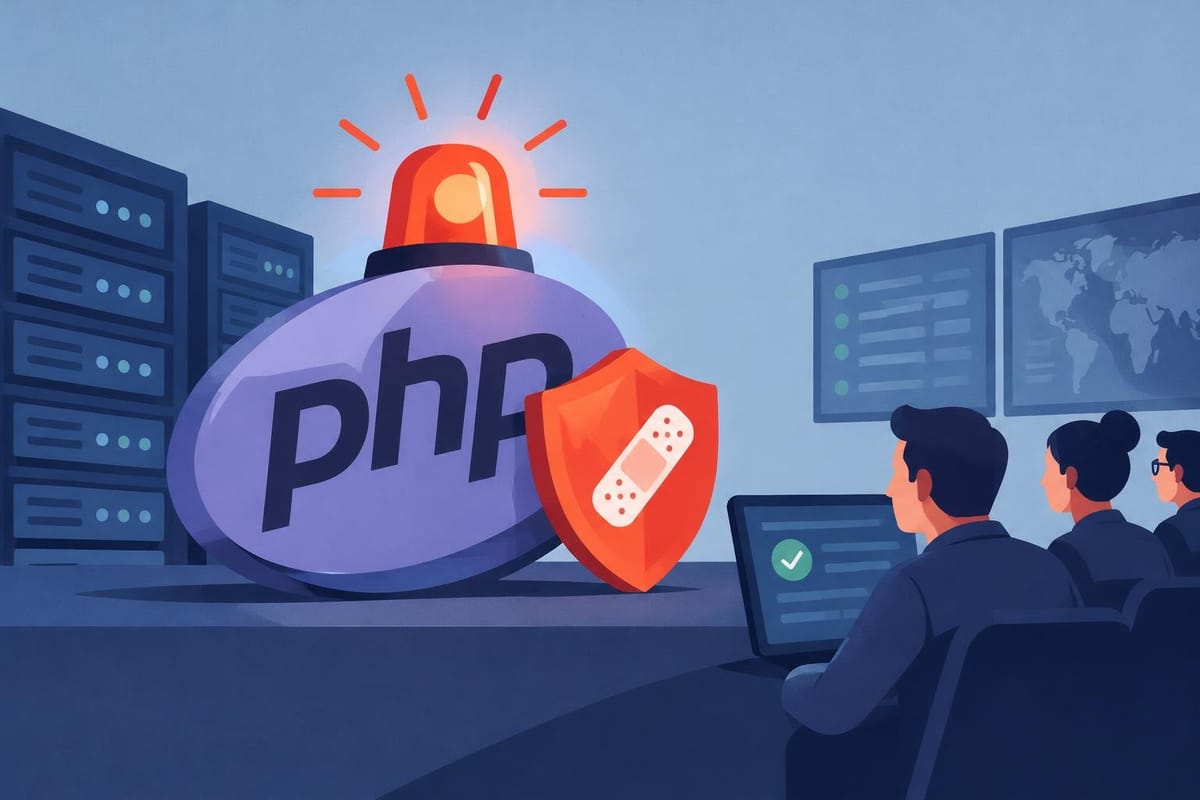
PHP has shipped emergency security updates for two critical flaws in the language runtime, forcing web operators to patch the engine underneath their apps rather than just application code.
The Hacker News reported that PHP released fixes on Oct. 21 in versions 8.5.12, 8.4.27, 8.3.36 and 8.2.35 for the issues, which security researchers and publishers have labeled PHP2Shell. The flaws sit in PHP itself, not in WordPress, Laravel or any other app layered on top, so a site can be exposed even if its own code is clean. The Hacker News said the highest risk is on Apache mod_php deployments, where an exploit can trigger before application code runs.
NBC News reported that OpenAI said it helped discover the vulnerability and notified PHP before wider abuse. NBC also reported that some sites temporarily went offline while administrators rushed to patch, and that U.S., European and British authorities urged sites to consider going offline until the fixes were in place.
The operational problem is simple, but not always easy: updating an application does not update the runtime beneath it. PHP’s patching guidance, as relayed by The Hacker News, says administrators need to update the PHP runtime serving web requests and then restart Apache, PHP-FPM or any long-running workers. For hosted environments, that often means coordinating with a distro maintainer, cloud image provider or platform team — not just pushing a package in one repo.
The currently reported fixed versions are:
- PHP 8.5.12
- PHP 8.4.27
- PHP 8.3.36
- PHP 8.2.35
The reporting also says PHP 7.4, 8.0 and 8.1 received source backports, while older branches are out of support from the PHP project. That makes the release a classic runtime-security event: broad exposure, fast patch window, and a long tail of environments that may not be able to upgrade cleanly.
What this changes for developers is less about a new feature and more about the boundary of responsibility. If PHP is the execution layer, then the security fix lives below the framework, below the app, and often below the team that owns the codebase. In practice, it is a reminder that runtime versioning is part of the security posture, not just a compatibility choice.
Sources: The Hacker News, "PHP Issues Emergency Patches for Two Critical PHP2Shell RCE Flaws as Exploit Attempts Emerge" — https://thehackernews.com/2026/10/php-issues-emergency-patches-for-two.html ; NBC News, "Critical vulnerabilities in commonly used web code spark rush to update systems" — https://www.nbcnews.com/tech/security/critical-vulnerabilities-php-update-systems-rcna604751
Comments ()