Any long password unlocks Alpine SSH accounts — and the musl bug behind it reaches OpenWrt, Buildroot, and Yocto too
CVE-2026-123158 lets attackers into key-only SSH accounts on Alpine, OpenWrt, and other musl systems by sending a 257-byte password. Patch now with OpenSSH 10.6p2.
Update, 9 November 2026: CISA has added CVE-2026-123158 to its Known Exploited Vulnerabilities catalog, its designation for flaws with evidence of active exploitation. Systems not yet on OpenSSH 10.6p2 or Alpine's backported packages should be treated as exposed.
CVE-2026-123158 | Affected: Alpine Linux 3.16–3.24 and edge, OpenWrt, Buildroot, Yocto (musl + no-PAM configs) | Fix: OpenSSH 10.6p2 / Alpine backports | Exploitation: no authentication required, one connection | Actively exploited: added to CISA KEV on 9 Nov 2026
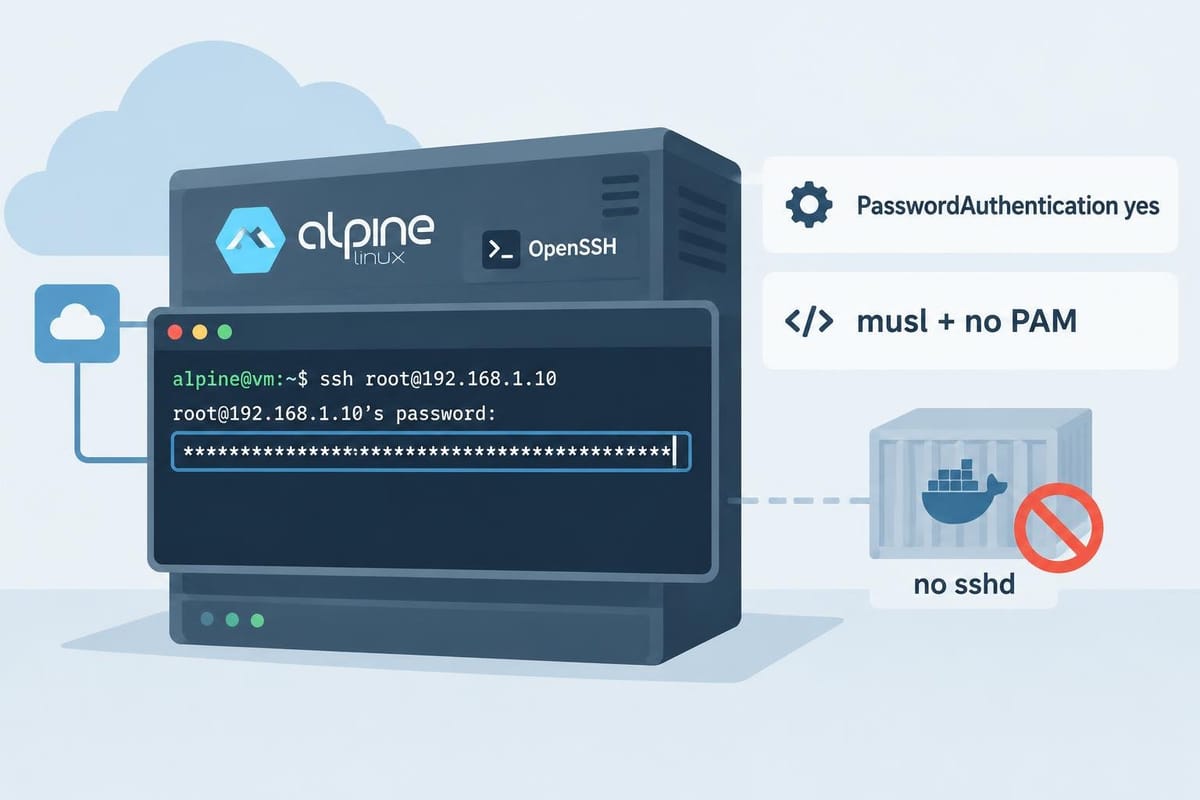
Alpine Linux published an emergency security advisory on November 5, 2026, disclosing that any attacker who can reach an exposed SSH port can log in to certain accounts without knowing their password — by sending a string of 257 to 1,024 bytes as the password field. The vulnerability, tracked as CVE-2026-123158 and nicknamed sshole by the researcher who found it, was fixed the same day in OpenSSH 10.6p2 and in backported Alpine packages covering every supported and recently end-of-life branch.
The story does not stop at Alpine. The underlying mechanics involve musl libc's crypt() function and OpenSSH's non-PAM password-checking path — a combination shared by OpenWrt, Buildroot, Yocto, and any other embedded or minimal Linux system that links musl and runs sshd without the Pluggable Authentication Module interface. Damien Miller of the OpenSSH project stated that non-Linux systems, Linux systems built on glibc, and systems that check passwords through PAM are not affected, according to The Hacker News.
What the bug actually does
When sshd is built without PAM, it verifies a password by calling crypt() on the submitted credential and comparing the result to the stored hash in /etc/shadow. For accounts whose shadow field is * — the conventional marker for "no password, use a key" — there is no salt to give crypt(). In that situation sshd borrows the salt from another account that does have a hash.
Here is where musl diverges from glibc. When a password input exceeds 256 bytes, musl's crypt() returns the literal string * as an error indicator rather than a hashed value. That return value happens to be identical to the stored field for every password-less account. The comparison succeeds, and sshd grants access. The attack works every time, requires only one connection, and needs no retries, according to Alpine's advisory.
The preconditions, as Alpine states them:
- OpenSSH running without PAM — Alpine's default
openssh-serverpackage; oropenssh-server-pamwithUsePAM no. PasswordAuthentication yes— the OpenSSH default, unless explicitly changed.- A target account whose
/etc/shadowfield is*— this includesrootas shipped since Alpine 3.16, any key-only user created withadduserwithout a password, and directory-service users whose credentials flow through musl-nscd (nslcd, winbind, sssd). - At least one local account with a
$5$or$6$hash — without it,crypt()has no salt to borrow and the bypass does not trigger.
That last condition is easy to dismiss as rare, but Alpine's advisory is explicit about how it arises in practice: an administrator sets a console password for one local account, or cloud user-data provisions a user with hashed_passwd, and the entire machine's key-only accounts become reachable from that moment on.
The 2016 question: how long has this been open?
Security researcher Özgün Kültekin of Wakefield, who discovered and reported the issue, says the flaw has existed since 2016, according to BleepingComputer's reporting. OX Security's write-up describes it as "a decade-old vulnerability." A commit in the OpenSSH mailing list archive from July 2016 is listed among related references in The Hacker News coverage, alongside the November 2026 commit that introduces the fix.
The long timeline is consistent with the mechanics: nothing in this interaction looks like a deliberate attack surface. It is a collision between a musl error-return convention (* on oversized input) and an sshd code path that was never designed for a C library that would return * as a non-hash. That said, the 2016 origin date and decade-long exposure claim come from Kültekin's disclosure and secondary reporting, not from an independent audit published at this time. The advisory and OpenSSH's release notes do not assign a specific start date.
Who is affected beyond Alpine
BleepingComputer's reporting cites Kültekin directly on the scope: exploitation requires OpenSSH running on a musl-based Linux system — naming Alpine Linux, OpenWrt, Buildroot, and Yocto — with PAM authentication disabled. The OX Security analysis confirms the same boundary: the fix is in how sshd handles the interaction with musl's crypt(), and OpenSSH 10.6p2 addresses it on the sshd side regardless of which musl-based distribution is involved.
For container teams: Docker and other container users who do not run sshd inside the container are explicitly not affected, per Alpine's advisory. The risk is to systems — including cloud VMs and embedded devices — where sshd is active and accepting password authentication.
Alpine-specific exposure notes:
- Official tiny-cloud images (qcow2, VHD, AMI) from versions 3.18.11 through 3.24.3 ship an
alpineuser with a*password field and passwordlessdoas. They are safe on first boot, but become exploitable as soon as any$6$hash appears on the machine — for example, when an admin sets a console password. An attacker who logs in asalpinecan then usedoasto become root. - The affected range covers every Alpine release from 3.16 through 3.24 and edge, including releases that have already passed end-of-support (3.21 reached end-of-life on 2026-11-01). Alpine has nonetheless published backported fixes for branches as old as 3.16.
Remediation
The primary fix is to upgrade the package and restart the daemon. Upgrading alone does not replace the running sshd process.
# Update all packages and restart sshd-a
apk upgrade -U rc-service sshd restart
Fixed package versions by Alpine branch:
| Branch | Fixed openssh version |
|---|---|
| edge | 10.6_p2-r0 |
| 3.24 | 10.3_p1-r2 |
| 3.23 | 10.2_p1-r1 |
| 3.22 | 10.0_p1-r11 |
| 3.21 | 9.9_p2-r1 |
| 3.20 | 9.7_p1-r6 |
| 3.19 | 9.6_p1-r3 |
| 3.18 | 9.3_p2-r4 |
| 3.17 | 9.1_p1-r7 |
| 3.16 | 9.0_p1-r6 |
For systems that cannot be updated immediately, disabling password authentication closes the exposure:
mkdir -p /etc/ssh/sshd_config.decho 'PasswordAuthentication no' > /etc/ssh/sshd_config.d/00-no-passwords.confsed -i.bak -e '1i PasswordAuthentication no' \/etc/ssh/sshd_config
-e 's/^\(\s*PasswordAuthentication[^y#]*\)yes/\1no/i' \
sshd -t && rc-service sshd restartsshd -T | grep -i passwordauthentication
Alpine notes that the drop-in directory (sshd_config.d) is only read from Alpine 3.19 onward; older releases require the sed edit directly. The last command should print passwordauthentication no to confirm the change is live.
For users of openssh-server-pam with UsePAM yes: you are not affected. For non-Alpine musl-based systems (OpenWrt, Buildroot, Yocto), the upstream fix is in OpenSSH 10.6p2 from openssh.com; check whether your distribution has published a backport or whether a manual upgrade to 10.6p2 is needed.
Detecting a past compromise
Alpine's advisory gives a direct indicator: search /var/log/messages for sshd lines containing Accepted password for on accounts that should have no password — alpine, root, or any key-only user. If a login cannot be ruled out, treat the machine as compromised and review doas usage, recently created users, new files, and changes to authorized_keys.
Responsibility and the musl side
Tom's Hardware described the parties as "playing a game of hot potato" over fault attribution. The mechanics suggest it is genuinely a two-component interaction: musl's crypt() returning * on oversized input (a defined behavior in that implementation) and OpenSSH's password verification not accounting for that error return. OpenSSH 10.6p2 addresses the sshd side. Separately, a musl commit is listed in related references in The Hacker News coverage, suggesting musl-libc may also be patching the crypt() behavior — though the status of a musl-side fix was not confirmed in sources available at publication time.
The Detectify blog attributed discovery to Kültekin, who reported it to Alpine. Alpine credited Damien Miller and Darren Tucker of the OpenSSH project for the fix, Timo Teräs for analysis, and Natanael Copa for building and uploading the packages.
No CVE identifier had been assigned at the time Alpine published its advisory on November 5; the identifier CVE-2026-123158 appears in OX Security and Security Boulevard reporting published the same day. CISA KEV listing status was not confirmed at publication time; CISA added the CVE to the catalog on 9 November 2026.



Comments ()