OpenAI’s science push looks bigger in the paper trail than in the proof trail
OpenAI posted a technical preprint and a science-framing post, but the captured pages don’t verify the theorem or proof details.
OpenAI’s science push looks bigger in the paper trail than in the proof trail
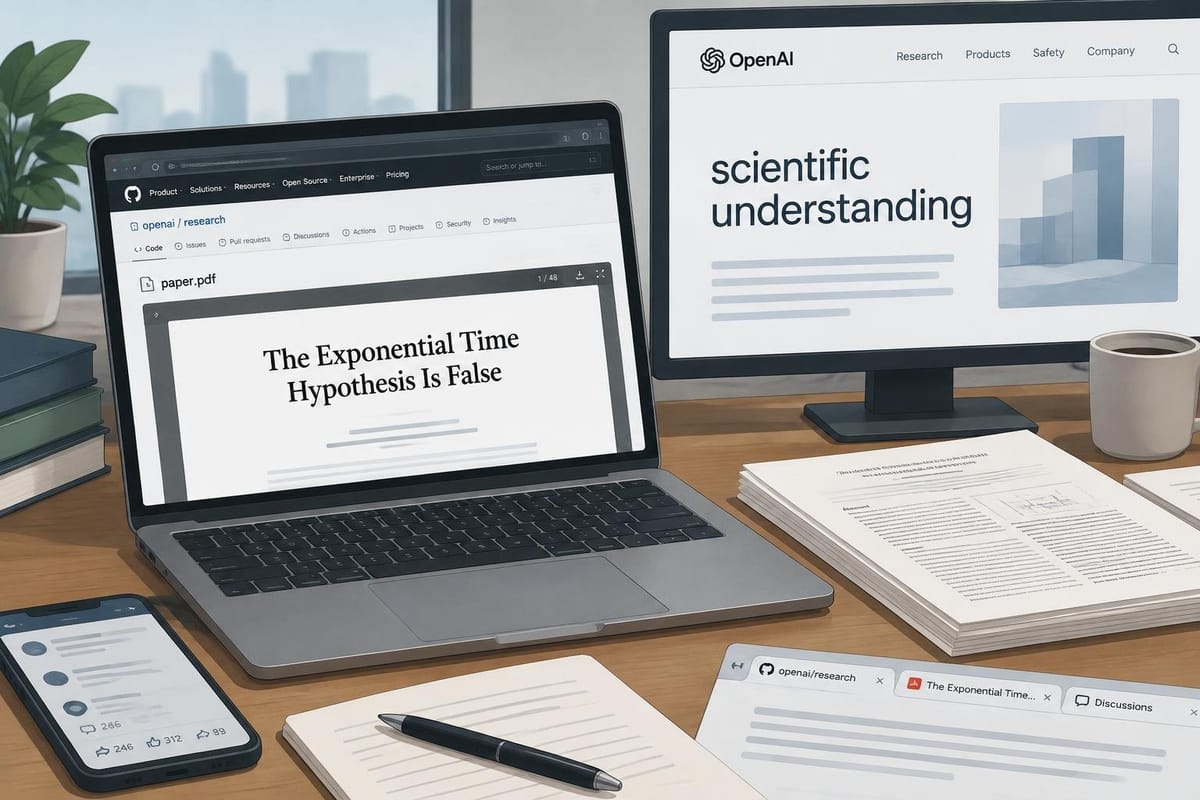
OpenAI’s latest science splash is real, but the strongest evidence is narrower than the noise around it. The company has posted a technical preprint on a complexity-theory question, paired it with a new post about scientific understanding with academic communities, and set off a heavy discussion spike. What is not yet clear from the captured material is the proof itself.
The clearest concrete item in the paper trail is a preprint in OpenAI’s math repository titled “The Exponential Time Hypothesis is False” dated Oct. 25, 2026. That is the clearest available sign that OpenAI has posted a technical preprint on a complexity-theory question. It does not by itself verify the theorem, the proof strategy, or the technical merits of the claim — the PDF was not fully retrievable in this session, so those details remain unconfirmed here.
The other anchor is OpenAI’s Oct. 26 post, “Building scientific understanding with academic communities.” That page also wasn’t fully readable in-session, but the framing is still important. At a high level, it signals that OpenAI wants this release read as more than a standalone paper drop: the company is linking the work to mathematics, computer science and physics, and positioning academic collaboration as part of the story.
That gives the release two layers:
- A technical artifact — a posted preprint on a foundational complexity-theory problem.
- A distribution frame — a public push to place the work inside a broader scientific-community narrative.
That second layer matters because it changes how the release lands. This is not just a model update, a benchmark claim or a product launch. It is an attempt to make scientific output itself part of OpenAI’s public identity. If the paper holds up under independent scrutiny, that is a meaningful expansion of what the company is trying to be. If it doesn’t, the gap between announcement language and underlying evidence becomes the story.
The discussion spike suggests the release landed hard with technical readers. Hacker News threads attached to the OpenAI materials drew hundreds of comments and strong attention, which is a useful signal that the topic reached beyond the usual AI product crowd. But attention is not verification. The thread volume tells you people noticed; it does not tell you whether the proof is sound, novel or even correctly framed.
That distinction is the key to reading this release correctly. The available evidence supports a narrow conclusion: OpenAI has put a technical preprint into the public record and wrapped it in a broader academic-collaboration message. The evidence does not support going further and declaring the theorem validated or the proof settled.
For readers, the practical question is simple: what would make this story real beyond the headline? At minimum, the underlying paper would need to show:
- a clearly stated claim,
- the assumptions it depends on,
- the method or proof outline,
- and enough detail for independent experts to check it.
Those are the missing pieces in this capture. Without them, the safest reading is also the simplest one: OpenAI has made a high-profile scientific announcement, but the claim still lives or dies on the unreadable paper itself.
Bottom line
The new thing here is not that OpenAI talked about science. It is that the company appears to have posted a technical preprint and framed it as part of a wider academic push. That is substantively different from a normal blog announcement. But the strongest available evidence stops short of proving the underlying theorem claim, so the story remains about the release, the framing and the attention — not the validity of the result.
Sources
- OpenAI preprint repository entry: https://github.com/openai/math/blob/main/preprints/The-Exponential-Time-Hypothesis-is-False-October-25-2026/paper.pdf
- OpenAI post: https://openai.com/index/building-scientific-understanding-with-academic-communities/
- Hacker News discussion on the paper: https://news.ycombinator.com/item?id=50251661
- Hacker News discussion on the OpenAI post: https://news.ycombinator.com/item?id=50251344

Comments ()