Nodecode’s persistent Lisp runtime turns one agent into a live program
How Nodecode’s SBCL-based, stateful coding agent works, what the launch demo shows, and what remains unproven.
Nodecode’s persistent Lisp runtime turns one agent into a live program
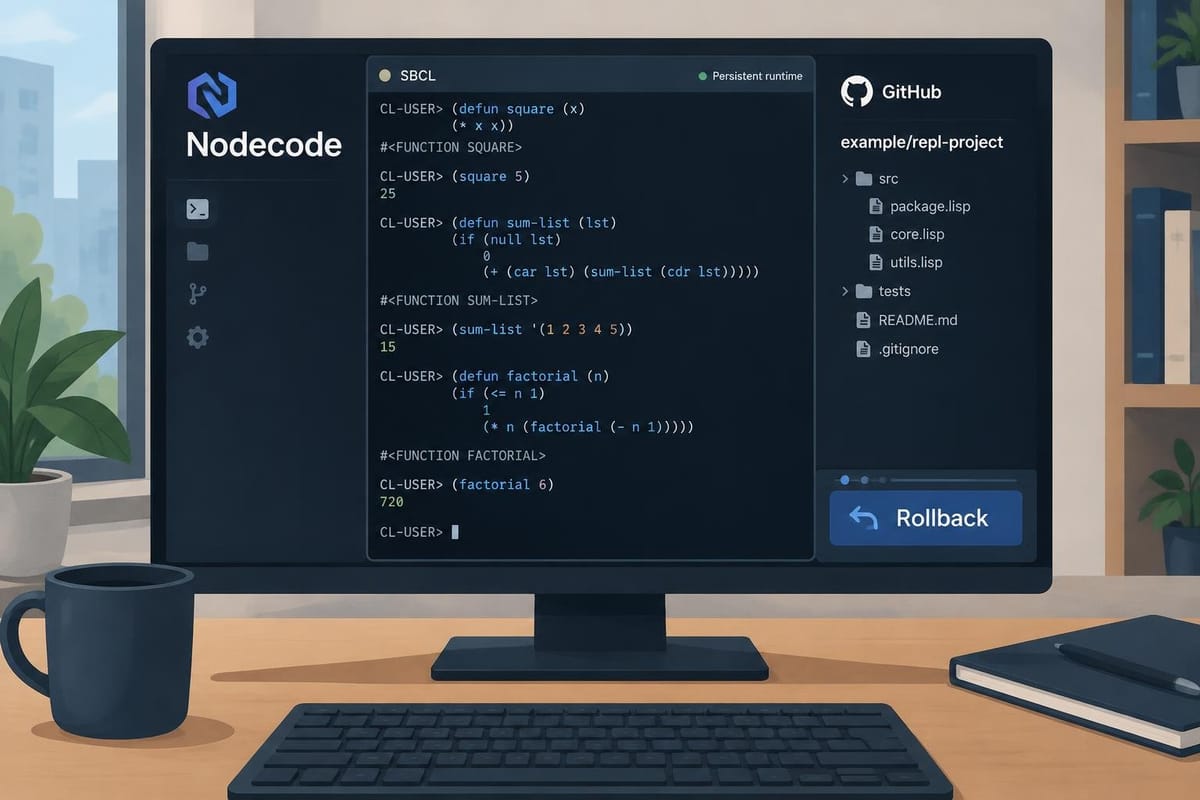
Nodecode is trying to make a coding agent behave less like a chat session and more like a running process. Its README describes a single SBCL/Common Lisp image that stays alive, accepts eval as the model’s one tool, and keeps the definitions it creates so they are still there on the next turn. That is the architectural bet: instead of rebuilding state for every step, the agent writes itself into a live runtime and keeps going. Source: https://github.com/nodecode-ai/nodecode/blob/main/README.md
The result is a workflow with a very different shape from a typical stateless assistant. In Nodecode’s model, the agent can define a helper once, reuse it later, and carry those changes forward unless the user explicitly rolls the session back. The project presents that not as a convenience feature but as the center of the product. Source: https://github.com/nodecode-ai/nodecode/blob/main/README.md
What the README says the system is
The repository’s README is unusually direct about the core design. It says Nodecode “runs as one process in SBCL, a Common Lisp system,” and that “shells attach to it.” It also says the model has “one tool”: it “evaluates Lisp in the running program and keeps what it defines.” The README reinforces that idea in several places: Nodecode is described as “a living agent,” one that “becomes yours and evolves over time.” Source: https://github.com/nodecode-ai/nodecode/blob/main/README.md
That framing matters because it places the runtime, not the prompt, at the center of the system. The agent is not just generating text about code. It is acting inside a live Lisp image where code can be added and retained. Source: https://github.com/nodecode-ai/nodecode/blob/main/README.md
The practical consequence is visible in the installation and first-run flow documented in the README. Users install with curl -fsSL https://nodecode.ai/install.sh | sh on Linux and macOS, or irm https://nodecode.ai/install.ps1 | iex in PowerShell on Windows, then run nodecode. On first launch, setup opens and asks the user to choose a provider, model, and reasoning effort. If another coding agent already exists on the machine, setup offers to import its keys, instructions, memory, skills, MCP servers, bots, and jobs. Source: https://github.com/nodecode-ai/nodecode/blob/main/README.md
That import flow is another clue to the product philosophy. Nodecode is not just a clean-room terminal agent; it is designed to absorb prior agent state and continue from there. Source: https://github.com/nodecode-ai/nodecode/blob/main/README.md
The persistent runtime is the product
The README’s most distinctive claim is that Nodecode does not treat code edits as disposable output. It says the system keeps working definitions in the running image, with “one file per definition, committed with git, loaded at every start.” In other words, the agent’s output is supposed to become part of the program’s own state, not a temporary scratchpad. Source: https://github.com/nodecode-ai/nodecode/blob/main/README.md
This is also how the project explains missing capabilities. Under “Rewrites itself in Lisp,” the README says the model’s one tool, eval, evaluates Lisp in the running Nodecode: “what it defines runs at once and is kept.” If the agent needs a new tool, “it writes one.” Source: https://github.com/nodecode-ai/nodecode/blob/main/README.md
That is the clearest technical distinction in the project. A conventional coding assistant may help generate a patch, but it still depends on a separate edit/apply/restart loop. Nodecode collapses more of that loop into the live process itself. The environment is mutable, and the agent is expected to evolve with it. Source: https://github.com/nodecode-ai/nodecode/blob/main/README.md
Live updates, generations, and rollback
The README also describes how that persistence is controlled. Under “Updates while it runs,” Nodecode says most releases go live in the running program “one changed definition at a time, with no restart.” It then names the recovery mechanism: nodecode generations lists saved generations, nodecode rollback N restores one, and --pristine runs the binary alone. Source: https://github.com/nodecode-ai/nodecode/blob/main/README.md
That combination is the story’s technical center of gravity. Persistence without rollback would be dangerous; rollback without persistence would be ordinary versioning. Nodecode ties them together. The runtime can keep accreting behavior during a session, but the project also claims you can step back to an earlier generation if the live image drifts into a bad state. Source: https://github.com/nodecode-ai/nodecode/blob/main/README.md
That is the architecture in miniature:
- keep definitions in the live SBCL image,
- load them at startup,
- update them incrementally while the program is running,
- and preserve generations so the user can reverse course.
The README does not present this as a sidecar workflow. It is the way the system is meant to operate. Source: https://github.com/nodecode-ai/nodecode/blob/main/README.md
What the demo visibly shows
The README includes a launch image and an explicit disclosure that the sequence is staged to repeat reliably. It says: “A take from the launch trailer: the shell and every evaluation are real, the model’s reply is scripted so the take repeats.” Source: https://github.com/nodecode-ai/nodecode/blob/main/README.md
Taken literally, that means the demo is a controlled illustration of the workflow rather than a free-running record of model behavior. The shell interaction and evaluation happen against a real system, while the reply is scripted so the take is reproducible. On that basis, the safest reading is narrow: the launch material shows the mechanics of the loop, not an independent measurement of how the product performs in the wild. Source: https://github.com/nodecode-ai/nodecode/blob/main/README.md
The example shown in the README has the system being asked to teach itself to read PDFs, defining read-pdf, keeping that definition, and then using it to read an invoice. The point of the example is not that PDF reading is novel. It is that the agent can add the capability to its own runtime and keep it. Source: https://github.com/nodecode-ai/nodecode/blob/main/README.md
The benchmark claim should stay inside the README
The README also includes a “Fewer tokens, same games won” section and a chart comparing token use across tasks, including ARC-AGI-3 and “all 25 public games.” Because that chart lives in the project’s own README, it should be treated as a project claim, not an independent benchmark result. Source: https://github.com/nodecode-ai/nodecode/blob/main/README.md
That distinction matters. The README is making a performance argument, but it is not, by itself, a neutral evaluation report. The architecture story is stronger than the benchmark story here. The former is documented in the codebase and setup flow; the latter is a product claim that still depends on how the tasks were run, what baselines were used, and how much scripting or selection shaped the outcome. Source: https://github.com/nodecode-ai/nodecode/blob/main/README.md
Why this architecture is unusual
The distinctive idea in Nodecode is not simply that it uses Lisp. It is that Lisp’s live-image culture becomes the operating model for an AI coding agent.
That changes the shape of the workflow in at least three ways:
- State is native, not external. The agent does not have to re-derive every helper from scratch each turn; it can keep definitions in the runtime.
- Change is incremental. The README says updates can land “one changed definition at a time,” which suggests a finer-grained evolution than a full restart or rebuild.
- Recovery is built in. Rollback generations give the user a way to retreat if the live image becomes messy.
This is why Nodecode reads less like a conventional AI assistant and more like an agent runtime with long-lived memory and mutable behavior. The practical pitch is that the agent can accumulate capability as it works, instead of treating every request as an isolated exchange. Source: https://github.com/nodecode-ai/nodecode/blob/main/README.md
What the evidence supports — and what it doesn’t
The available material supports a narrow but solid conclusion: Nodecode is built around a persistent SBCL/Common Lisp runtime, a single eval tool that writes into that runtime, and a generation-based rollback model. The README also shows a demo pattern in which the system’s shell interaction is real but the demo reply is scripted for repeatability. Source: https://github.com/nodecode-ai/nodecode/blob/main/README.md
What this material does not establish is that the stateful design is superior in practice across broad coding tasks. The repository makes the architecture legible; it does not independently prove that the approach beats more familiar agents on accuracy, speed, or human correction burden in everyday work.
That limitation is not a flaw in the story. It is the line between an architectural claim and a validated product claim. Nodecode clearly wants readers to see a different class of coding agent: one that is persistent, self-extending, and recoverable. The README makes that case plainly.
Why it matters
If the model works as described, Nodecode is aiming at a real friction point in AI development tools: the cost of reassembling context and rebuilding state. A live runtime can reduce that cost by making the agent’s own additions durable. A rollback mechanism can make that durability safer.
That combination is compelling because it shifts the agent from “generate something useful” to “grow into a useful system.” Whether that proves better than more conventional assistants will depend on independent use, not the README alone. But the repository already shows the shape of the bet: in Nodecode, the assistant is not just talking about code. It is becoming part of the codebase itself.
Source
- Nodecode README: https://github.com/nodecode-ai/nodecode/blob/main/README.md


Comments ()