IndiaAI’s new ‘offline’ models look more limited than the launch pitch suggests
What the Nov. 4 EKA-1 and Dhīr releases actually show about offline use, language coverage, hardware limits, and sovereignty.
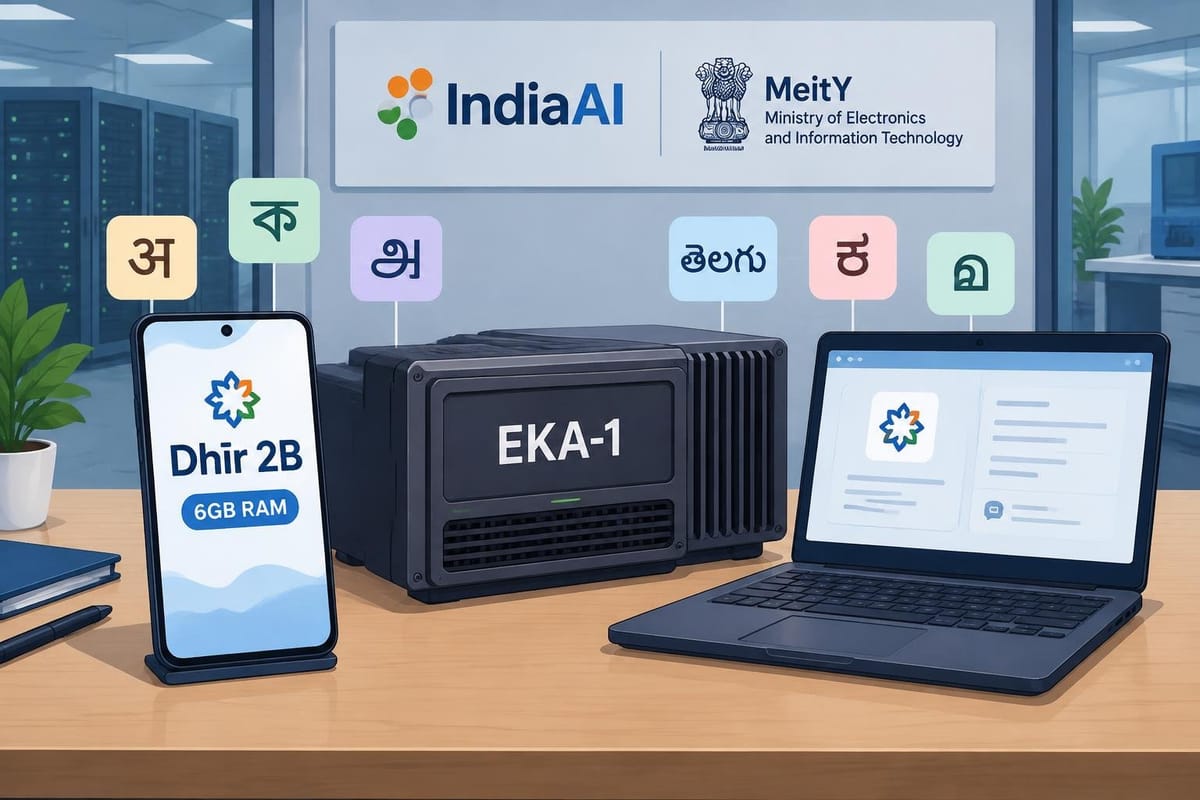
IndiaAI’s newest model releases are being marketed as a step toward “offline sovereign AI,” but the public artifacts currently available point to something narrower: limited on-device inference, some multilingual coverage, and deployment claims that still depend on the exact device and use case.
On Nov. 4, the IndiaAI Mission said Soket Labs had launched EKA-1 and ZenteiQ AiTech had launched Dhīr 2B and Dhīr 5B under the government-backed initiative. In The Hindu BusinessLine’s report, ZenteiQ said Dhīr 2B and Dhīr 5B are open-source models that can be deployed as secure, on-premises, multilingual assistants in English and 10 Indian languages, and that they can run on smartphones with at least 6GB of RAM. Soket said EKA-1 has 26.3 billion parameters, was trained on around 7.5 trillion tokens, and supports all 22 scheduled Indian languages plus English. BusinessLine also quoted the MeitY secretary describing the releases as strengthening India’s “technological and strategic autonomy.”
That is meaningful, but it is not the same as proving these systems are broadly usable offline in the ordinary sense many readers would assume — on a laptop, a disconnected edge box, or a general-purpose phone, with no cloud dependency and no operational caveats. The public reporting currently supports a narrower conclusion: some local inference is possible, and at least Dhīr is explicitly pitched for devices with a minimum RAM floor. It does not, from the available artifacts, establish that every advertised workload runs fully offline, that EKA-1 itself is mobile-deployable, or that the models are ready for a wide range of real-world Indian-language applications without additional infrastructure.
What the launch materials actually say
The most concrete public details in the available reporting come from BusinessLine’s Nov. 4 article. It says:
- Dhīr 2B and Dhīr 5B are open-source and can be deployed as secure, on-premises, multilingual assistants.
- The Dhīr models support English and 10 Indian languages.
- ZenteiQ says the models can run on smartphones with at least 6GB of RAM and do not depend on cloud connectivity.
- EKA-1 is a 26.3 billion-parameter open sparse hybrid language model trained on about 7.5 trillion tokens.
- EKA-1 covers all 22 scheduled Indian languages plus English.
BusinessLine’s framing is important because it gives the public-facing technical claim in relatively specific terms: offline-capable, on-device, on-premises, and multilingual. But the same report also shows how much remains conditional. The on-device claim is attached to Dhīr, not EKA-1. The smartphone claim has a memory floor. And the report does not describe the benchmark suite, inference settings, context length, quantization, latency, or whether the models were tested on a phone, a laptop, or an edge server.
The Hindu’s report adds one more detail: it said EKA-1 can be used without mobile data or Wi‑Fi because it can do “certain inferencing” on the local device, “say a smartphone.” That wording matters. “Certain inferencing” is not the same as saying the model runs all intended tasks offline. It suggests a partial capability, not an across-the-board guarantee.
What “offline” means here — and what it does not
In practice, “offline” can mean several different things:
- A fully disconnected laptop running local inference end to end
- An edge box or on-prem server that never calls a cloud API
- A smartphone that can answer limited requests locally
- A hybrid system that works offline for some tasks but falls back to cloud for others
The public material available for EKA-1 and Dhīr does not settle which of those applies across the board. The reports say Dhīr can run on smartphones with 6GB RAM and without cloud connectivity. They say EKA-1 can do some local-device inference. They do not show whether either model has been packaged with a documented offline app, quantized weights for common consumer hardware, or reproducible installation instructions for end users.
That distinction matters because “offline” can be used to mean anything from “not dependent on cloud inference” to “works on a midrange phone in airplane mode.” Those are very different engineering claims. Only the first is broadly suggested by the public coverage; the second remains unproven from the released artifacts.
Sovereign, but sovereign in what sense?
The launches are also being sold as “sovereign AI,” a term that can refer to at least four different things:
- Hosting sovereignty — the model can be run domestically or on-premises.
- Data sovereignty — training or inference data stay under local control.
- Language sovereignty — the model is specialized for Indian languages and local use cases.
- Governance sovereignty — the program is publicly backed or strategically managed.
The current public record supports parts of all four, but not equally.
- Hosting: Dhīr is explicitly described as on-premises deployable and cloud-independent in the BusinessLine report.
- Language: EKA-1 is said to support all 22 scheduled Indian languages, while Dhīr supports English and 10 Indian languages.
- Governance: Both were launched under the IndiaAI Mission with MeitY involvement.
- Data: The available reporting does not provide enough detail to verify training-data provenance, filtering, or whether any sensitive data remained onshore.
So “sovereign” is not empty branding here, but the strongest evidence is for domestic governance and local-language specialization, not for a fully verified sovereign data pipeline.
The missing details that would decide the offline question
The launch coverage does not yet answer the questions that matter most to operators:
- What exact model files were released?
- Are the weights downloadable in a standard format?
- Are there official inference scripts or a reference runtime?
- What hardware was used for the “6GB RAM” claim?
- What latency, throughput, or token limits were measured?
- Were the models tested in quantized form, and if so, at what precision?
- How much of EKA-1’s 26.3B parameter model is practical on a phone versus a server?
Without those details, the public artifacts show promise, not readiness. A model can be “offline-capable” in the narrow sense of local inference and still be impractical for many users because of memory, compute, or latency constraints. The hardware floor in the Dhīr description is especially telling: if a phone needs 6GB RAM just to run the model, that is already a limited slice of the market, not a universal offline product.
What is actually new
The substantive news is not that India now has a pair of language models with patriotic branding. It is that the IndiaAI Mission appears to be backing models with explicit deployment targets: offline operation, on-premises use, and Indian-language coverage. That is a step beyond generic model announcements.
But the public evidence also suggests caution. The releases, as currently documented, are not yet a full proof of offline sovereign AI for Indian-language workloads. They are a proof of intent, a partial proof of local-device inference, and a limited proof of language breadth. They are not yet a full proof of deployability across common hardware, nor a full proof that the models can be used offline for the range of tasks implied by the launch messaging.
For readers trying to judge whether these models are ready for use, the correct reading is narrower than the slogan: the artifacts support some offline and on-premises use, but the strongest public claims still outrun the detail available in the released materials.
Bottom line
If “offline sovereign AI” means “can never touch a cloud service,” the current public reports do not prove that. If it means “some models can perform some inference locally, with Indian-language support and government backing,” then the launch materials do support that — at least for the specific claims quoted by the companies and reported by BusinessLine and The Hindu.
The gap between those two readings is the story.
Comments ()