Google finds attacker AI automating patch-to-exploit workflow
GTIG found exploit_agent, an attacker framework set to diff patches and auto-run exploits; here is what it means for patch priority on exposed web software.
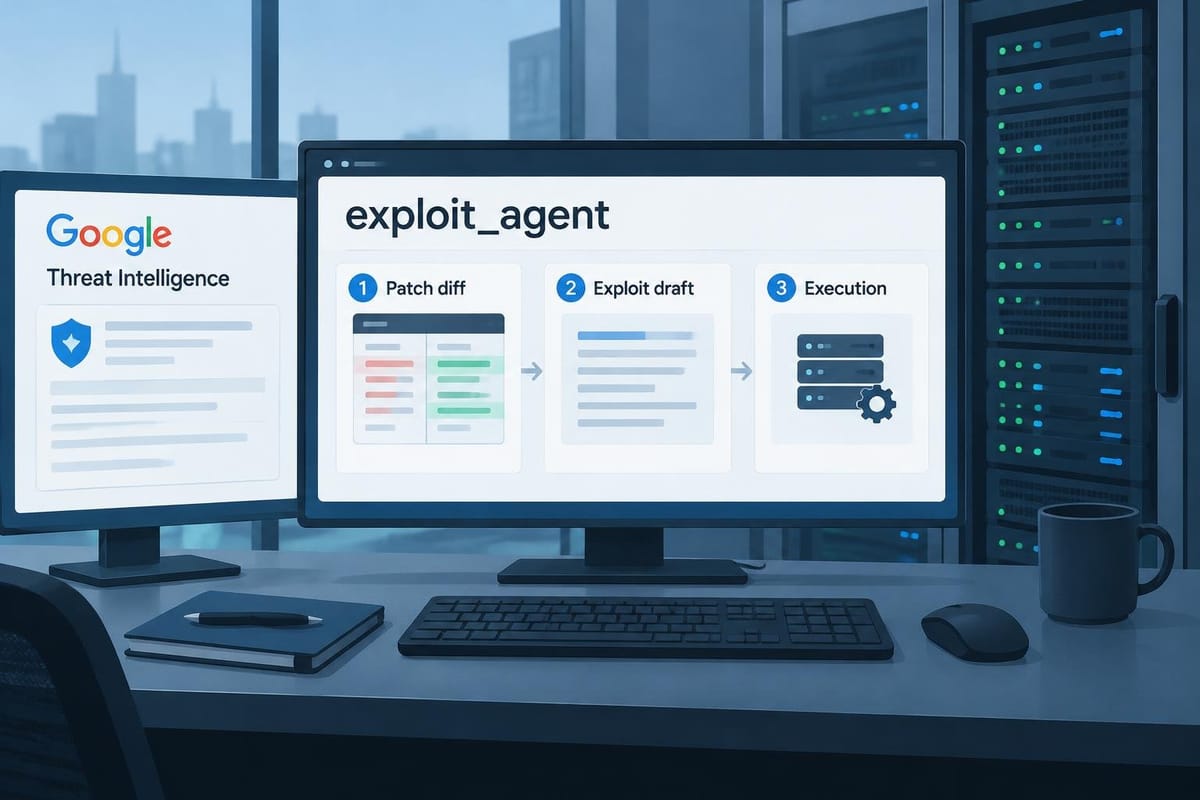
Google Threat Intelligence Group (GTIG) says it has, for the first time, identified attackers running an AI framework configured to turn software patches into exploits and execute them automatically, with no human in the loop. The framework, called exploit_agent, was found on an exposed staging server, according to GTIG's AI Threat Tracker, "Agentic Threat Activity Crosses a Significant Threshold", dated November 17, 2026.
This is observed attacker infrastructure, not a lab demonstration. For vulnerability-management leads, the consequence is that patch-release dates for popular, internet-facing web software are now a trigger an adversary can automate against. SiliconANGLE reported the findings on November 16; this article draws on the GTIG report itself and on separate incident reports from Huntress and GreyNoise.
What GTIG observed
GTIG describes a multi-agent vulnerability research and weaponization framework that integrates with several frontier and locally hosted LLMs. Per the report, it is set up to:
- run continuous differential analysis of popular web application software, comparing code before and after patch announcements;
- analyze the findings to identify potential vulnerabilities;
- draft exploits;
- execute them automatically, without human intervention.
The same server held data exfiltrated from victims and scripts for internal reconnaissance, brute-forcing, installing webshells, and removing webshells left by rival attackers. Victim telemetry suggests the operator targeted French websites in media, entertainment and education, per GTIG and SiliconANGLE. SiliconANGLE adds that a Russian-language comment in the configuration file tells the operator to enter keys "right here, not in the chat."
Someone had to build the framework, supply model access and credentials, and run the infrastructure. That is our inference; GTIG does not document every setup step. What GTIG calls autonomous is the loop from patch comparison to exploit execution.
Why n-days
GTIG argues attackers may find it more efficient to weaponize patched n-day flaws than to hunt zero-days, because the research scope is a finite set of material: code versions (including, in GTIG's general discussion, pre-release or preview channels), release notes and security research. That fits LLM agents well.
GTIG also cites volume data: overall disclosures and exploits nearly doubled between January and August 2026, while zero-day exploitation rose only from a 2025 average of 8 per month to 11 per month in 2026, spiking to 22 in August.
What the PaperCut cases show
The closest measured example of the speed involved is separate from exploit_agent. PaperCut NG and MF flaws CVE-2026-81578 and CVE-2026-82078, chained for pre-authentication remote code execution, were exploited in the wild before PaperCut's August 27 advisory, per Huntress. SiliconANGLE's account of GTIG's report says researchers and Huntress used LLMs to generate working exploits within a day of disclosure.
GreyNoise documented an AI-orchestrated campaign from August 31 through September 2 that used OpenAI's Codex harness with a DeepSeek model. Its timeline has the actor downloading the advisory and pre- and post-patch versions, diffing them, building and testing exploits in a lab, and then compromising at least 440 PaperCut instances across 395 organizations in 48 countries. GreyNoise says the actor reached domain admin at only 12 victim organizations, so success was uneven. GreyNoise's timing is the only measured success data we have; none of it applies to exploit_agent.
GTIG also reports open-source agentic pentest frameworks in live intrusions. It independently observed CAIRN and PentAGI in the wild, including CAIRN against a US aerospace target, and saw experimentation with CyberStrikeAI and HexStrike AI.
What to do with it
- Re-rank by exposure and software class. GTIG's description centers on popular web application software and internet-facing servers. Internet-facing web apps and management servers with public patch diffs belong at the front of the queue. The report does not claim every vendor's window shrinks.
- Shorten the clock for those assets. The PaperCut cases show that an exploit attempt can follow a public patch and advisory within hours to days. For PaperCut itself, Huntress says to remove public exposure of the Application Server and move to a maintenance release (26.0.5, 25.0.13 or 24.1.10), and, in its post published August 27, noted that 47% of roughly 2,500 installations it tracks were running v23 or older, with no patch available. That figure reflects Huntress's observation at that time, not a current count.
- Detect the noise. GTIG says unrestricted autonomous execution generates forensic traffic, recognizable identifiers and code-level traces, which raises detection odds. Google SecOps has deployed rulepacks for ARTEX, and Mandiant Consulting released a hardening guide for LLM-enabled offensive tooling.
- Expect rivals' webshells. Scripts that remove other attackers' webshells mean the absence of a foreign shell on a compromised host does not show the host is clean.
What is not known
The sections of the GTIG report we reviewed do not say which products or CVEs exploit_agent was used against, or report a success rate, so it is not established that its generated exploits worked against victims. GTIG also does not say it has seen this pipeline beyond that one operator.

Comments ()