Google's agentic data cloud: what changed in AlloyDB, Spanner and Iceberg
Which parts of Google's Agentic Data Cloud are GA or preview, from AlloyDB Express to Spanner Omni and cross-cloud Iceberg, and which claims are unverified.
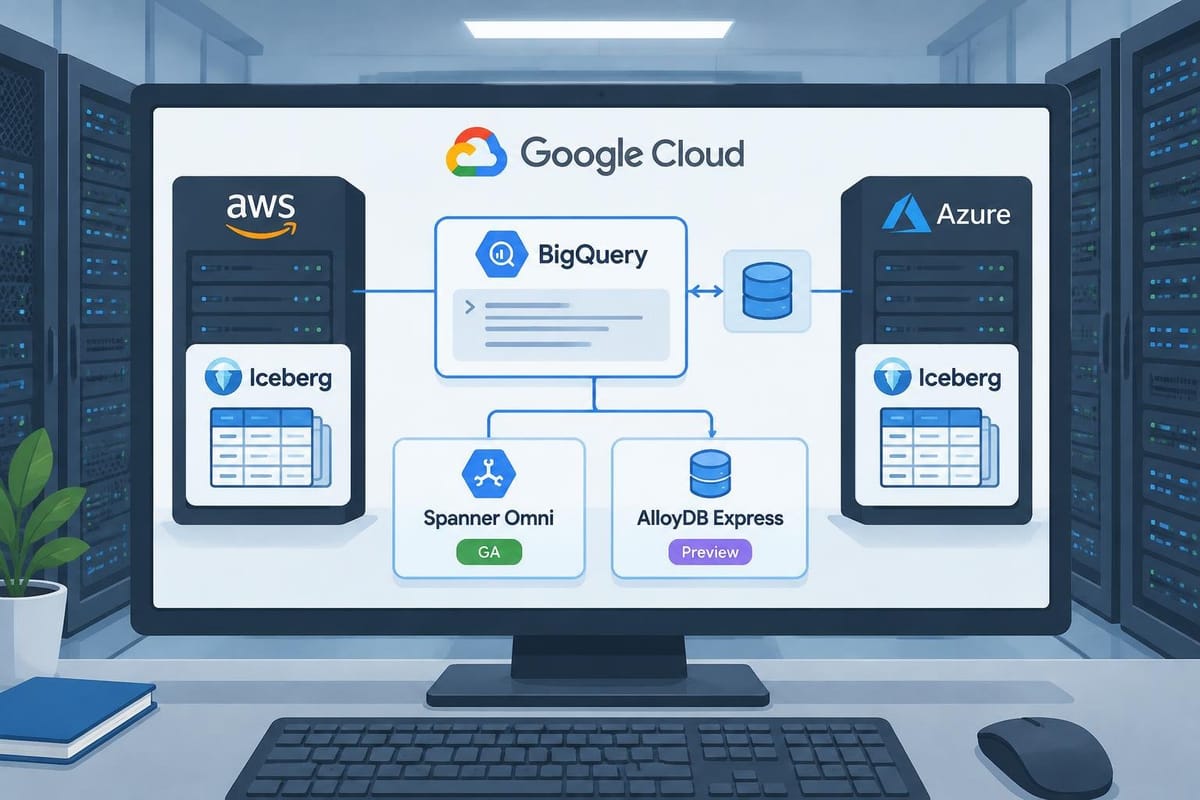
Google Cloud's "Agentic Data Cloud" announcement, published on its blog on November 5, 2026 by vice presidents Sirish Chandrasekaran and Raj Pai, puts the cross-cloud Apache Iceberg lakehouse, Spanner Omni, BigQuery Graph and Data Agent Kit in the generally available column. AlloyDB Express and "PostgreSQL for agents" in AlloyDB remain previews (Google Cloud blog). CloudNews, whose Spanish sister site RevistaCloud ran the same piece, dates the announcement November 4; the Google post carries November 5 (CloudNews, RevistaCloud). The two sites are one report, not independent confirmation.
The practical split: the shipping pieces mostly reduce data movement, while the pieces aimed at agent workloads at scale are still previews, and nearly every performance figure is Google's own.
Generally available
Cross-cloud Iceberg access. Google says its "borderless Lakehouse" lets BigQuery query Iceberg tables in AWS and Azure without "surprise variable egress fees." Its documentation is more measured. Queries can go over the public internet or a private Cross-Cloud Interconnect, and the benefit of the private route is described as "potentially lower egress charges" from AWS or Azure. Over the public internet, standard provider egress applies (Google docs). Caching of remote file blocks in the Google Cloud query region is optional: it must be enabled on the federated catalog or connection, and it is off by default. The docs also warn that cached copies sit at rest in the querying region, which matters for data residency, and that customer-managed encryption keys are not supported for the cache.
The catalog connects to Databricks Unity Catalog, AWS Glue and Snowflake Horizon through Iceberg REST. Google quotes Harish Ramesh of Delivery Hero's talabat saying federating Iceberg tables from Amazon S3 into BigQuery cut data-movement costs by about 40%. That is a customer quote supplied by Google, and the reviewed material does not show how it compares with other approaches.
Spanner Omni. Google's GA post is dated October 1; InfoQ and Compute Labs report the announcement on September 30, so the November post restates a launch rather than breaking one (Google Cloud blog, InfoQ, Compute Labs).
Terms matter here. The Developer Edition is free for non-production use with a 90-day license that excludes backups and worker nodes; the exception is a single server of 4 vCPUs or fewer, which does not expire and includes backup and restore. The Commercial Edition is a vCPU-based annual subscription, and Google publishes no price. Customers run the software themselves: Google states it provides no availability SLA, pointing to reference architectures instead, and excludes integrations such as BigQuery and Knowledge Catalog.
InfoQ reports that Omni swaps Colossus for a "Colossus-like abstraction layer" and TrueTime's atomic clocks for software time that still provides error-bounded synchronization. Google's explanation is that Spanner overlaps uncertainty waits with other work, so it tolerates weaker bounds. Nothing reviewed shows a consistency loss, but there is no independent measurement of the tail-latency cost either. Google's 2 million downloads figure is a download count, not production installs.
BigQuery Graph and Data Agent Kit are GA per Google: graph queries over relational tables without a separate graph database, and Google data tools exposed over MCP in VS Code, Claude Code and Antigravity.
Still preview
AlloyDB Express is a PostgreSQL-compatible AlloyDB edition with scale-to-zero, private connectivity and 1–2 vCPU instances, with storage capped at 20 GB. Google's launch post says instances are created in under two seconds; Google's documentation qualifies this as approximately two seconds for public DNS and up to 20 seconds for Private Service Connect endpoints. Google's launch post gives pricing: $0.115 per compute-unit hour billed by the second, $0.00 for compute paused after 15 idle minutes, $0.30 per GB-month for storage used, and a free tier of 50 compute-unit hours monthly (AlloyDB Express post). Google's documentation adds that the free tier includes 2 GB of storage and lasts for the first 12 months. Paused instances wake in seconds when a query arrives. An in-place upgrade to standard AlloyDB keeps data, schemas, users and connection strings, adding HA, replicas and DR. The documentation lists seven supported regions: asia-east1, asia-east2, asia-northeast1, asia-southeast1, australia-southeast1, europe-west2 and us-west1. The aim is dev, test and coding agents' throwaway databases.
PostgreSQL for agents targets production: thousands of agents querying live transactional data with workload isolation, sub-millisecond I/O and over 3 million queries per second. The post gives no dataset, hardware or workload, so the figure can't be compared with anything.
Direct Iceberg access in AlloyDB lets one PostgreSQL query join live tables with Iceberg tables in cloud storage, registered via the Lakehouse runtime catalog. Google claims up to 7x faster aggregations than "Amazon's comparable PostgreSQL-compatible service," naming neither product nor full method; its announcement says the test used a 1 TB dataset in Cloud Storage. Knowledge Catalog's default-on Gemini grounding is preview; semantic-model support is GA. Google's internal tests, it says, show agents nearly four times more accurate with up to 33% lower latency and up to 75% fewer tokens.
What "agent-ready" means concretely
The features reduce to four things: fast, cheap disposable databases; workload isolation for many concurrent sessions; federated Iceberg queries instead of copies; and a catalog that resolves business terms, picks tables and determines join paths before Gemini writes SQL under the user's permissions.
Lock-in
Iceberg is open and the catalog federates with rivals' catalogs, which eases format lock-in. Whether the interconnect and caching make multicloud queries cheaper depends on interconnect capacity, provider egress rates and cache hit rates; the reviewed material does not compare workloads or competitors' pricing.
Not yet established: the regions for the Cross-Cloud Interconnect, and the full configurations behind the 7x and 3 million QPS claims. Google's benchmark and customer claims remain vendor-supplied rather than independently verified.
Comments ()