Nvidia targets 2028 for Rubin HPC with over 50,000 CUDA cores
Nvidia’s Rubin HPC GPU targets 2028 with over 50,000 CUDA cores. Here is what scientific-computing buyers can compare now.
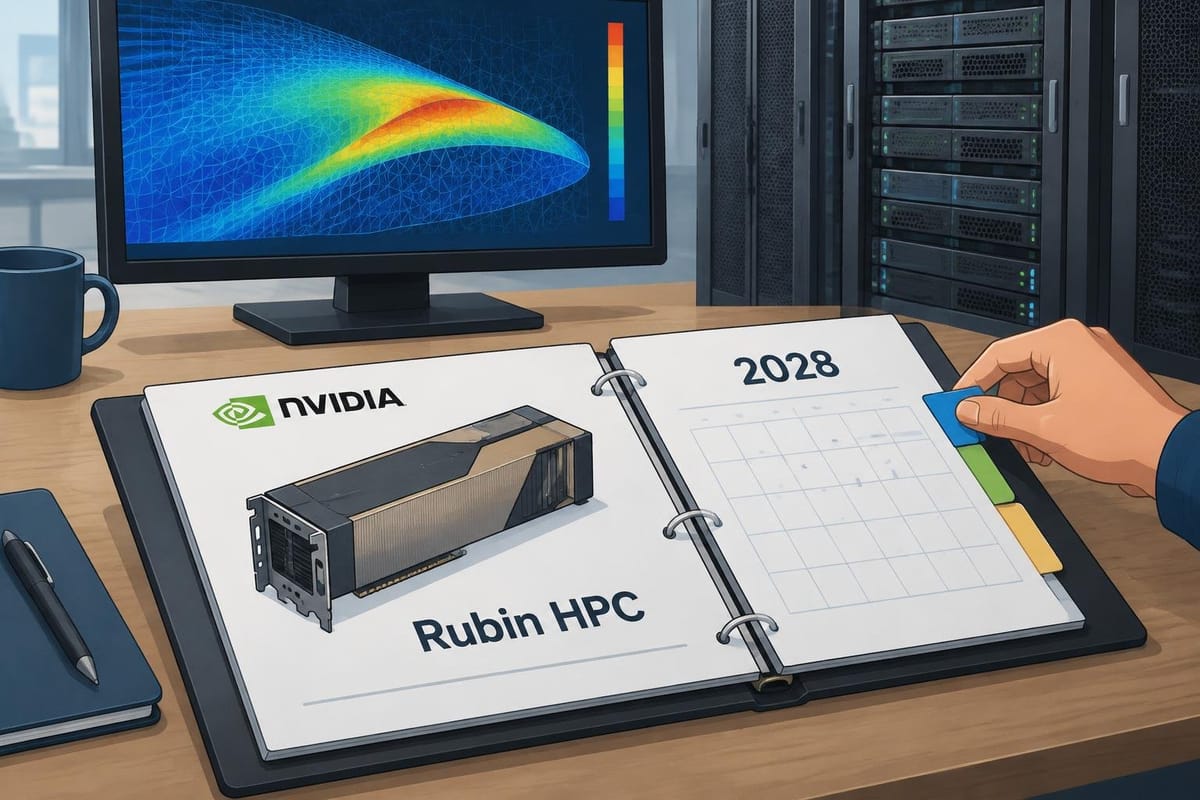
Tom’s Hardware reports that Nvidia announced Rubin HPC on November 16, a scientific-computing GPU with more than 50,000 CUDA cores that the company expects to be available in 2028.
For research teams planning a cluster purchase, Rubin HPC is a future option, not hardware they can deploy now. Teams with earlier procurement deadlines should size systems against currently available products and their own simulation workloads rather than treat the 2028 date as a delivery commitment.
Nvidia’s announcement at Supercomputing 2026 describes a GPU designed for simulations and data processing in science, engineering and analytics, including workflows in which AI agents propose candidates for simulations to evaluate. Nvidia also announced a sparse-data acceleration capability and seventh-generation NVLink for connections between GPUs. The company says the design is intended to keep computing cores supplied with data during operations such as sparse matrix calculations and sorting.
The announced core count is substantially higher than the 28,672 CUDA cores Tom’s Hardware reports for the current Rubin GPU. That does not establish a scientific-computing speedup: application performance also depends on arithmetic precision, memory throughput, communication and how well the workload uses the hardware.
Nvidia has not disclosed Rubin HPC’s FP64 throughput, HBM capacity or bandwidth, NVLink 7 bandwidth, price or power, and has not published application benchmarks for the chip. FP64 matters particularly for simulations that require double-precision arithmetic; memory and interconnect capacity matter when datasets and calculations span GPUs.
The existing Vera Rubin NVL72 system is a separate product Nvidia lists as available now. Nvidia specifies 288 GB of HBM4 and 19.2 TB/s of memory bandwidth per Rubin GPU in that system; those figures should not be used as Rubin HPC specifications.




Comments ()