Google confirms Gemini reviewers can see connected emails and files
Google's help pages confirm some Gemini Connected Apps data can be human reviewed; a GitHub repo's stronger retrieval claims remain unverified.
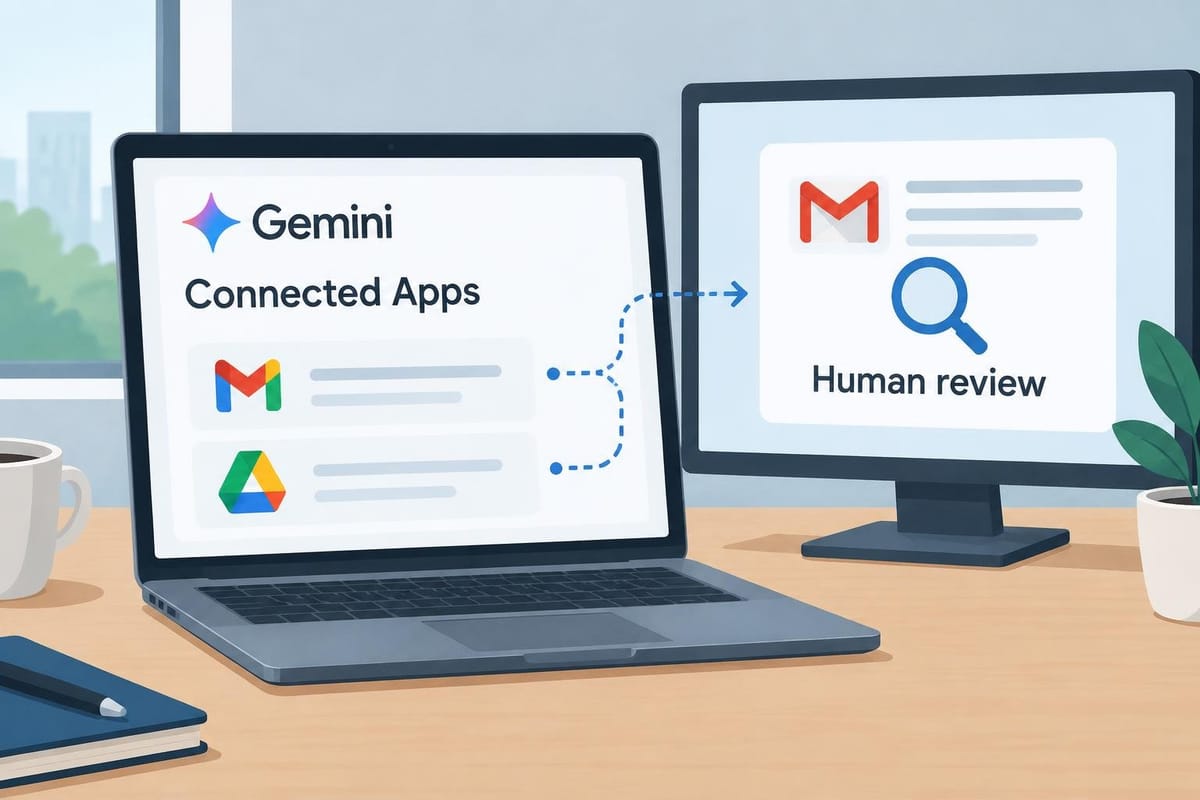
A pseudonymous GitHub repository published on 9 November alleges that consumer Gemini can pull personal Gmail and Drive content into chats that Google's human reviewers may read. Google's own help page partly supports the claim: it says a subset of connected-app data can be reviewed by people, and the repository's stronger claims about full files and contractors rest on the author's own testing, which is unverified.
The distinction matters for who is affected. The repository README was clarified on 10 November to apply only to personal Google accounts with Connected Apps turned on. It says Workspace Business, Enterprise and Education accounts fall under separate data-processing terms that exclude human review by default. A commenter on the Hacker News thread, which showed 148 comments when captured, made the same point, and Google's Workspace privacy hub says Workspace content is not human reviewed outside the customer's domain without permission.
The author's method is to mention a topic from an inbox, such as an internet bill, without tagging Gmail or Drive, then ask Gemini to print what its retrieval tool returned. The README says results range from no retrieval to summaries, quoted passages, or a full email with headers, because tool-calling is probabilistic. These are the author's reports of what Gemini returned. A model's account of its own tool output does not establish what was actually ingested, and the repository offers no direct evidence of a reviewer seeing any user's email. It does not show who later reads such sessions.
Google's Help Answer 16836988, quoted in the HN thread, says a subset of Connected Apps data processed by Gemini is reviewed by human reviewers, including trained service providers, and warns users not to connect apps with confidential information they would not want a reviewer to see. CyberInsider reports that Google added a note on 16 October 2026 to its 2023 Bard-extensions announcement saying such data can face human review "in limited circumstances". It also reports that the help page says a reviewed summary "may just be the email or file", and that Google says it removes some personal information and unlinks interactions from accounts, except in cases of abuse or harm. A summary of the help page reported by AI/TLDR adds that reviewers may see some Gmail inbox content itself only in some cases, such as when a user sends feedback or Google must address abuse.
So the disclosure exists. The general Connected Apps review pathway covers excerpts and summaries of connected content, with the stated Gmail-inbox exceptions for feedback and abuse or harm.
The user controls are narrower than they sound. Google's Gemini Apps Privacy Hub says disconnecting an app does not delete data already in Gemini activity, and that turning off Keep Activity does not end all human review: Google still uses chats to protect its services, including with human reviewers. Chats that were reviewed are kept for up to three years even if the user deletes their activity. Turning off Keep Activity also disables the Workspace connection.
No Google response to the repository was found in the material reviewed; this is not a statement that Google was asked. Not yet established: how often reviewers see whole items, and whether the repository's results are reproducible.

Comments ()