Claude Code’s email leak looks narrower than the panic, but still bad
A GitHub issue alleges Claude Code exposed users’ email addresses in User-Agent headers during web searches, with a partial privacy fix already mentioned.
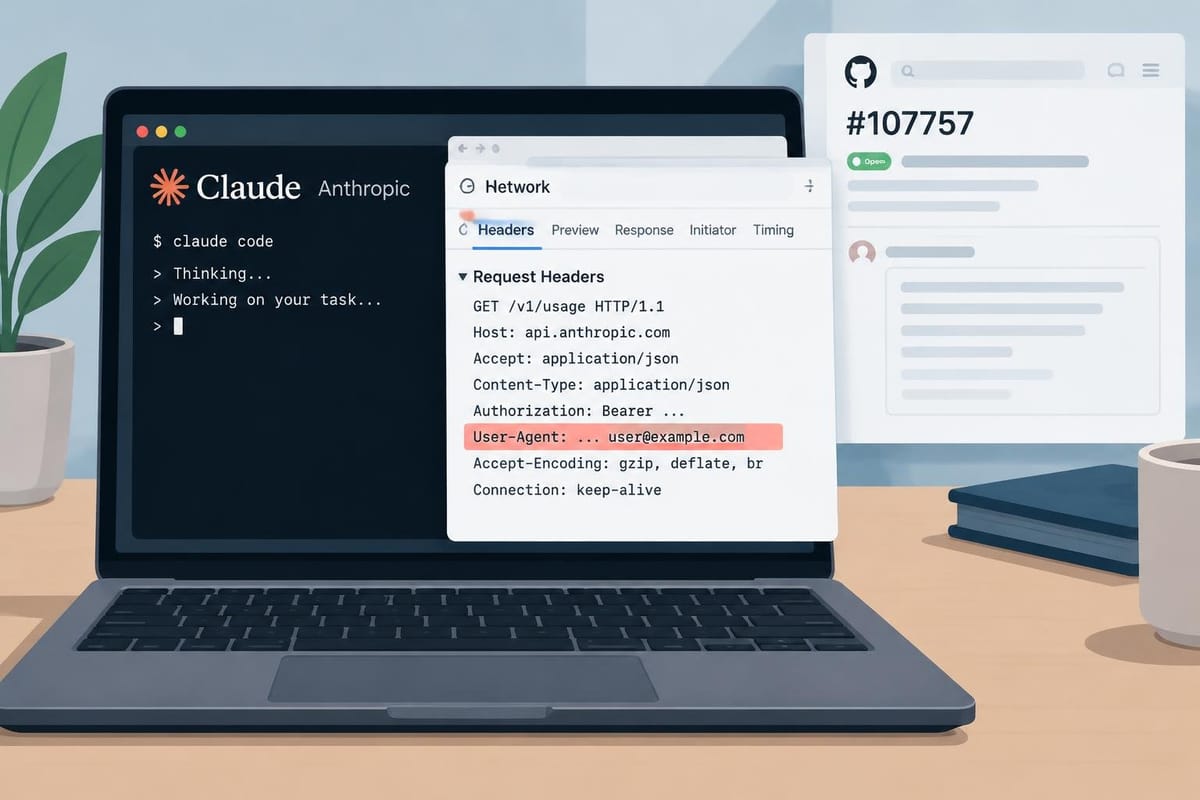
Claude Code’s privacy scare is real, but the blast radius is more specific than the most viral headlines suggest: the report is about the tool putting a signed-in user’s email address into outbound web requests, apparently in the User-Agent header, when its browser or web-search tools run. The original GitHub issue, opened Nov. 5, says the author was seeing “dozens of scam emails per day” after Claude Code “divulged my email to arbitrary 3rd parties in the User-Agent request header while conducting web searches without my permission.” The issue is filed against Claude Code 2.1.318 on macOS and is tagged area:security, area:tools, and platform:macos. GitHub issue #107757
That distinction matters because the early Hacker News thread quickly turned into a fight over whether this was a universal leak or a policy edge case. One of the most plausible explanations in the thread is that the problem appears when Claude Code hits sites that expect a contact address in the request header, especially public data services. A top comment says the SEC API will reject a default request unless an email is supplied in the User-Agent; the commenter demonstrated a 403 from a default curl request and a 200 when an email-bearing User-Agent was used. Another commenter said they had caught Claude sending a personal email on SEC data requests even though they had a separate work contact address. That suggests the behavior is not just “Claude randomly sprayed email everywhere,” but rather “the agent sometimes propagates account identity into requests where a service or the tool’s own logic asks for a header identifier.” HN thread
Still, “narrower” does not mean “benign.” If a coding assistant is allowed to forward the owner’s email into outbound requests without an explicit prompt and without clear user approval, that creates two problems at once: third-party sites can learn the account identifier, and the user may never realize where that identifier has gone. The GitHub reporter’s complaint is blunt on that point: they want the behavior removed from the harness entirely, not hidden behind an opt-in or opt-out setting. GitHub issue #107757
The key practical question for developers is whether the leak is limited to websites that already expect an identifying header, or whether Claude Code can also expose the email in other request paths. The public evidence so far points to a tool-use workflow, not a general account breach: the report describes the leak happening “while conducting web searches,” and the HN examples center on outbound HTTP requests to public APIs or websites. There is not yet evidence in the captured reporting of a wider compromise of Anthropic accounts, tokens, or repos. But the issue is still serious because the whole point of a coding agent is that it can take actions across websites on the user’s behalf. If it can silently add personal identifiers to those requests, then the privacy boundary depends on every target site behaving responsibly — a bad assumption on the open web. GitHub issue #107757
There is also evidence that Anthropic has already shipped at least one mitigation, though the fix appears partial. A commenter in the GitHub thread says a built-in privacy module, cc-plugin-privacy, is enabled by default and can be turned off through /plugins. Another later comment says version 2.1.319 still allowed a test command involving User-Agent: test <account email> to run, which implies the protection was not a complete blanket refusal in that case. A separate summary page likewise says Anthropic introduced cc-plugin-privacy in version 2.1.317 as a deterministic block for the behavior. Taken together, that suggests Anthropic is aware of the issue and has tried to constrain it, but not necessarily eliminate every path where email can still end up in a request. GitHub issue #107757
For developers using Claude Code, the immediate audit is simple and worth doing now:
# Check what version you are running--version
claude # Inspect whether the privacy plugin is present and enabled
/plugins# Watch outbound requests for headers that reveal identity
# (Use your normal proxy/logging setup; do not assume the tool is stripping them.)
What to look for:
- any
User-Agentvalues that include an account email or other persistent identifier; - requests to public APIs that require contact details in headers, especially data sources like the SEC;
- scripts or shell commands the agent writes itself, since the HN thread suggests the identifier can be injected even when the original typed command does not contain it;
- whether plugin-based privacy controls are enabled in the environment actually used by your team, not just documented somewhere else.
The biggest lesson here is not that Claude Code uniquely misbehaved. It is that agentic tooling still treats identity as a convenient default instead of a data-minimization problem. That works fine in a demo. It breaks down the moment a tool starts composing requests for the user across third-party sites, where the right answer is usually the least informative identifier possible — or no identifier at all unless the user explicitly asks for it. GitHub issue #107757
Anthropic has not, in the captured material, posted a detailed public response in the issue itself. That leaves an important gap: users can see the symptom, but they still need a clear explanation of which request flows are affected, what the default privacy plugin actually blocks, and whether the fix changes how Claude Code behaves on sites that request an email in the User-Agent header. Until that is spelled out, the safest assumption for teams is that Claude Code may expose account identity during outbound web requests and that anyone using it for browser-like work should verify header behavior before trusting it with sensitive accounts.


Comments ()