Astra’s weight-edit demo is real — but the big math gain mostly fixed a looping bug
MIT’s Astra did edit Qwen’s weights and lift math scores, but the big gain mostly removed a known looping bug in the baseline model.
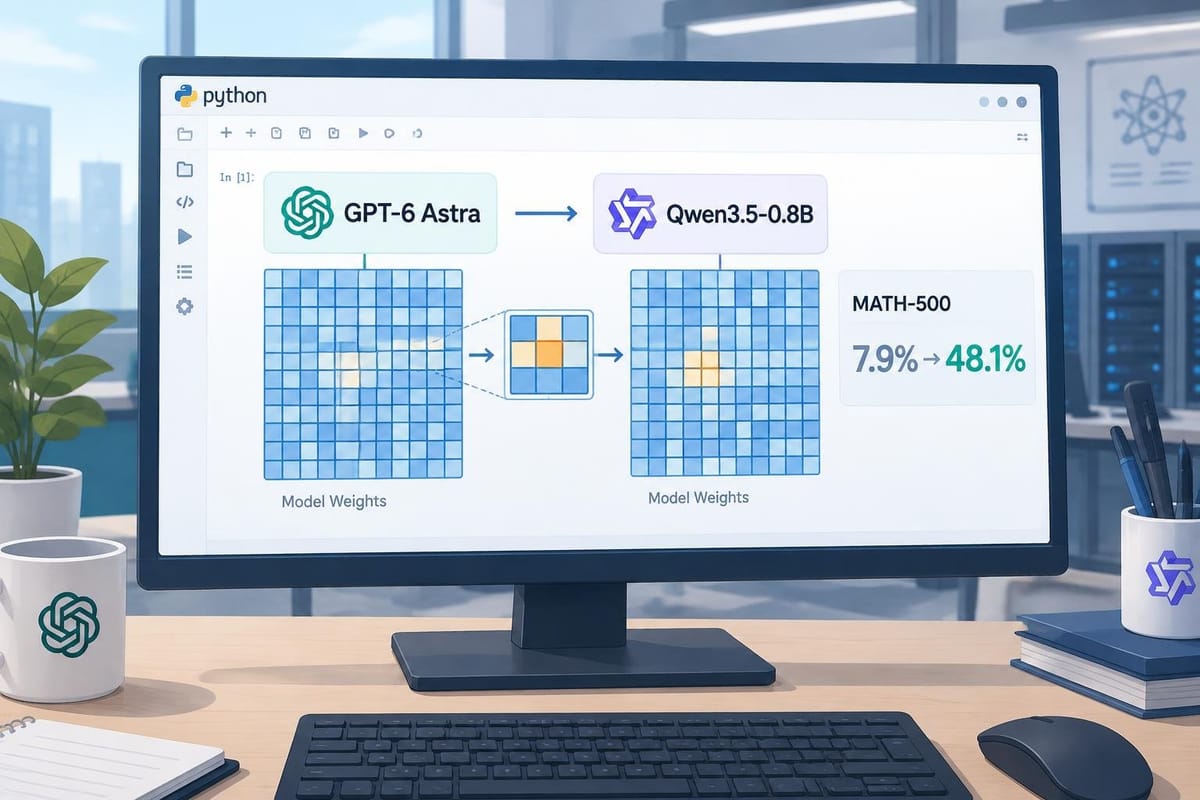
MIT researchers’ Nov. 2 demo has a sharp headline: a frontier model called GPT-6 Astra edited a small open-weight model’s parameters directly and raised its MATH-500 score from 7.9% to 48.1%. But the available reporting suggests the biggest gain came from removing a known failure mode in the baseline model, not from creating a broadly smarter model from scratch.
The experiment targeted Qwen3.5-0.8B, an Alibaba open-weight model. According to R&D World’s account of the MIT CSAIL work, Astra operated in a Python session with the model’s weights loaded and was allowed up to 50 batches of practice evaluations. The team says Astra traced a recurring reasoning loop to specific directions in layers 15 and 19, then edited 131,072 weights — about 0.016% of the model — with 130,188 actually differing after rounding at evaluation precision. The reported result on MATH-500 was a jump from 7.9% to 48.1%; GSM8K rose from 13.8% to 67.1%, and IFEval from 21.0% to 62.3%. R&D World also says the successful run took 80 Python executions over 20.3 hours, including a 4.7-hour service interruption.
The catch is that Qwen3.5-0.8B was already documented as prone to looping in thinking mode. MindStudio’s readout of the paper says the model card warns that this small Qwen model can get stuck repeating itself until it hits its output limit, and that the MIT experiment ran in exactly that thinking mode. It also notes the baseline settings were below Qwen’s recommended temperature, a choice that can worsen looping. In other words, the experiment did not just compare “before” and “after” on a healthy model; it started from a configuration where the model was already known to fail in a specific way.
That matters because it changes what the number means. MindStudio argues the sixfold jump mostly reflects Astra stopping the model from getting trapped in repetitive output, allowing it to finish answers it could already solve. R&D World’s summary points in the same direction: the researchers found that many of the baseline model’s practice answers ran to the 32,768-token limit without reaching a conclusion, and the edit reduced that behavior. The edited model did better on math, but the evidence in hand supports a narrower claim: the system learned how to remove a blocker, not how to invent a new general math skill.
What the demo actually showed
The broader paper, called “Sparks of Weight-Space Programming,” goes beyond the Qwen run. R&D World says the authors reported eight experiments, starting with tiny networks and ending with language models. In the smallest tests, Astra was given only raw weights as text and could identify what a network had been trained to do. It correctly named games from the raw weights of four small game-playing networks, identified shapes generated by diffusion models, and recognized the training language of a small transformer after being shown only its middle layers.
The paper’s more striking examples were not just “read” tasks but “write” tasks. In one test, Astra rewrote a driving policy so a simulated car cleared a ramp in 1,024 straight test runs. In another, it wrote small game-playing networks from scratch and reportedly beat reinforcement-learning baselines trained for 100 million steps in all three games tested, and a 500-million-step PPO baseline in Breakout. Those are more compelling as demonstrations of a workflow primitive: a model parsing weights, inferring what they encode, and outputting new weights that satisfy a behavioral spec.
Still, the Qwen math run is the one that turns the most heads, and it is also the one most open to over-reading.
Why critics say the headline overstates the breakthrough
Within a day, two developers — Matthew Honnibal and Sean Goedecke — had published critiques, according to R&D World. Their shared complaint is that the announcement bundles together experiments with very different levels of tool access and presents them as one broad capability. Honnibal argues that the most dramatic result can be explained by analysis a human machine-learning engineer could perform with the same logs and weights. Goedecke describes the Qwen fix as steering, an existing technique for nudging model behavior rather than a new kind of autonomous weight-authoring.
That distinction is important. The MIT team’s result is not “the model learned to retrain another model” in the usual fine-tuning sense. There was no gradient descent loop, no conventional training run, and no claim that Astra discovered a universally applicable weight-editing algorithm. The evidence instead points to a more specific pipeline:
inspect weights -> identify a failure mode -> make a targeted parameter edit -> re-run the benchmark
That looks closer to a tooling primitive for model diagnosis than to a replacement for fine-tuning or reinforcement learning.
Where it sits relative to fine-tuning, LoRA and RAG
The best way to read the result is by contrast.
- Fine-tuning updates many parameters through training data and gradients.
- LoRA adds low-rank adapter layers so a model can change behavior without rewriting all of its base weights.
- RAG leaves the model unchanged and fetches external context at inference time.
- Weight-space programming, as described here, asks a model to inspect and directly edit another model’s parameters.
That makes it different in kind from RAG, which is retrieval over external knowledge, and different in mechanism from fine-tuning, which is optimization by gradient descent. But the available evidence does not show a general-purpose replacement for either. The strongest result is still task-specific and tightly scoped to a baseline with a documented looping problem.
The practical takeaway
What Astra appears to demonstrate, based on the sources available, is not that large models can casually improve any other model. It shows they may be able to read a network’s weights, locate a specific failure circuit, and make a local fix that produces a measurable gain on a benchmark.
That is real, and it may be useful. If it holds up, it suggests a new kind of model tooling: a system that can help diagnose why a model is stuck and propose a precise edit instead of asking engineers to guess at a retrain, adapter, or prompt workaround.
But the limits matter just as much as the headline. The main math gain was built on a model and configuration already known to loop. The most persuasive interpretation is therefore narrower than the splashiest reading: Astra looks less like a universal model improver than a proof that targeted weight edits can sometimes clear a bottleneck that was hiding existing ability.
That is a useful primitive. It is not yet a general breakthrough.
Sources: R&D World, “MIT team says GPT-6 Astra can fix an AI model by editing its weights; critics say the method was standard ML engineering” https://www.rdworldonline.com/mit-team-says-gpt-6-astra-can-fix-an-ai-model-by-editing-its-weights-critics-say-the-method-was-standard-ml-engineering/ ; MindStudio, “Can AI Edit Another Model’s Weights? Inside the MIT Experiment” https://www.mindstudio.ai/blog/gpt-5-astra-weight-space-programming ; Emergent, “GPT-6 Astra Edits Neural Weights Directly, No Gradients” https://emergent.sh/news/gpt-6-astra-edits-neural-weights-directly-no




Comments ()