Zig's libc Rewrite Introduced a Quadratic Bug That Made SQLite 12,000× Slower on Linux
A quadratic bug in Zig's pure-Zig strspn rewrite caused SQLite's JSON tokenizer to run 12,000× slower for cargo-zigbuild cross-compiled Linux binaries.
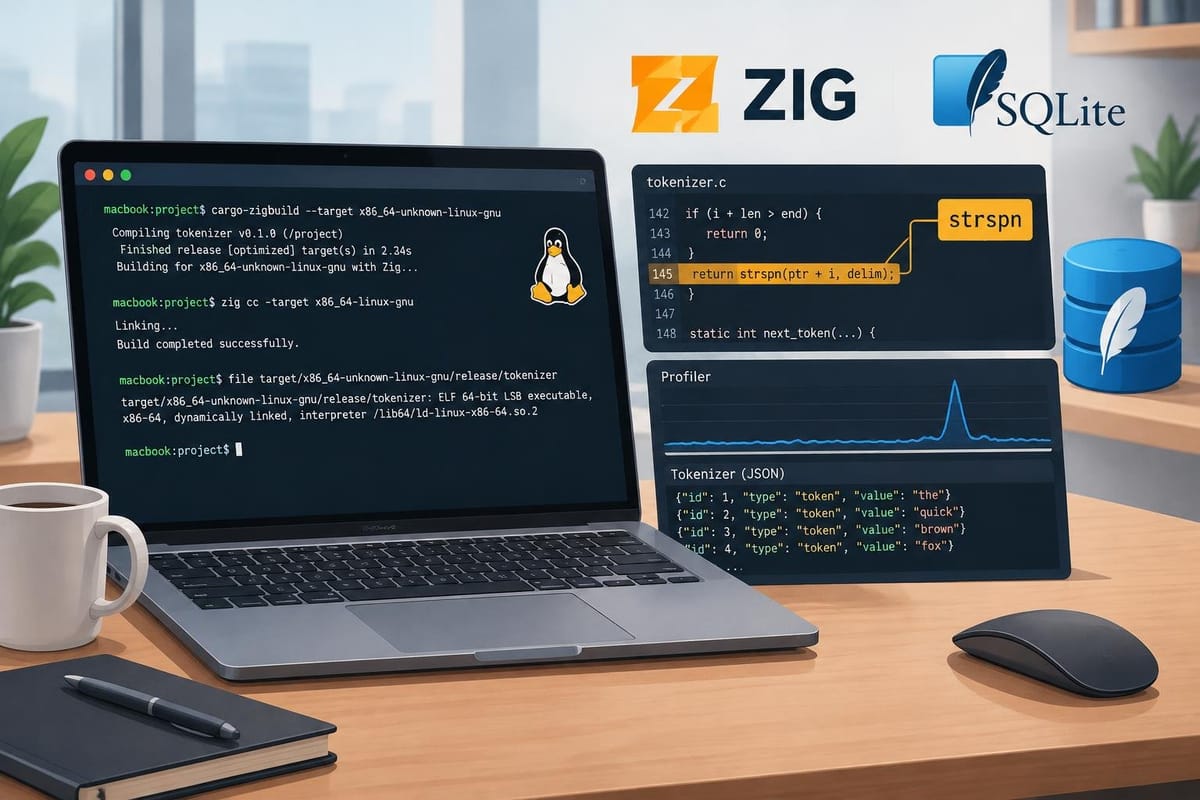
A Rust service processing chess game data was grinding through minutes of CPU time to insert roughly 40,000 JSON records into SQLite — a task that should have taken milliseconds. The culprit turned out to be not SQLite, not Rust, and not the application logic. It was a string-scanning function inside Zig's ongoing rewrite of its C standard library.
Developer Dennis Forbes documented the incident in detail on October 26, 2026. His headline figure — 12,000× slower — is real, reproducible on a 1.2MB JSON file, and grows quadratically as inputs get larger. But the conditions that produce it are specific enough that they merit careful unpacking before every Zig or cargo-zigbuild user starts auditing their pipelines.
What actually happened
Forbes's project is a Rust application, not a Zig one. The connection to Zig is cargo-zigbuild, a popular tool that uses zig cc as a cross-compilation driver so developers can build Linux binaries — ARM64 and x86-64 — from a Mac without containers or remote build machines. When zig cc compiles the C code inside the sqlx SQLite crate for Linux targets, it links against Zig's own libc implementation, libzigc.
Zig has been systematically replacing the musl libc functions it previously used with pure-Zig equivalents. The goal is to eliminate C dependencies entirely and enable fully static linking. That's the motivation. The problem is that one of those rewrites introduced a classic algorithmic error.
The function in question is strspn — a standard C routine that scans a string for characters belonging to a given set, returning the length of the matching prefix. SQLite's JSON tokenizer calls strspn (and related functions strcspn, strpbrk, and strstr) repeatedly as it walks through input character by character, skipping whitespace and finding token boundaries.
In Zig's pure-Zig implementation of strspn, the first operation is a call to measure the total length of the input string. That's a full O(n) scan. When strspn is called from inside a tokenizer loop — once per token, advancing a pointer forward each time — that length measurement is repeated from the original pointer, not from the current position. As the tokenizer advances through the file, every subsequent strspn call walks the already-consumed portion of the string all over again.
This is what Joel Spolsky called the "Shlemiel the Painter" problem in a 2001 essay: a painter who never moves his can of paint, spending more and more time walking back to retrieve it as he progresses down the street. The runtime complexity for tokenizing an n-character file becomes O(n²) instead of O(n).
Forbes estimates the slowdown at approximately 12,000× for a 1.2MB JSON file. Because the complexity is quadratic, the multiplier grows with file size — a 10MB file would fare dramatically worse.
Why it only appeared on Linux
This is one of the more instructive aspects of the incident. Forbes's Mac builds never showed the problem because zig cc wasn't involved there — SQLite was compiled with Apple's native toolchain and linked against system libc. Only the Linux cross-compilation path, which routes through libzigc, triggered the slow strspn.
This means that any developer using cargo-zigbuild or zig cc to cross-compile C code for Linux — without testing the Linux binary's performance on representative data — could be shipping this regression without knowing it. The bug is functionally invisible on small inputs; Forbes notes that his testing prior to the first large batch of games never surfaced it as a critical path.
The affected functions and fix status
Forbes identifies four string functions in Zig's libc rewrite that share the same pattern: strspn, strcspn, strpbrk, and strstr. All four are used in contexts where callers expect O(1)-overhead per call on a moving pointer — tokenizers being the canonical case.
Community discussion on Ziggit and Lobsters, beginning November 4, 2026, pointed to activity on the Zig tracker — specifically issue #37402 and pull request #37417 on Codeberg — as the relevant fix location. This review did not independently verify whether the PR has since landed in a Zig release, so users should check the Codeberg tracker and their exact installed Zig version before assuming the regression is resolved.
Forbes's own workaround was two-pronged: first, pre-stripping whitespace from JSON before passing it to SQLite (reducing the tokenizer's work and therefore the quadratic cost); second, moving Linux builds to Linux containers rather than relying on zig cc cross-compilation. He frames the second fix as the more complete one, since the problem could appear in other tokenizing contexts he hadn't audited.
Who is at risk
The risk profile is narrower than the 12,000× headline suggests, but not trivially narrow:
Directly affected: Any developer using cargo-zigbuild, zig cc, or libzigc to compile C code for Linux, where that C code calls strspn, strcspn, strpbrk, or strstr in a tight loop over large inputs. SQLite's JSON parser is one such caller; any other tokenizer or parser built on these functions in C is another.
Not directly affected: Pure Zig projects that don't call libc string functions through the C ABI; projects compiled natively on Linux with glibc or musl rather than through zig cc; Mac and Windows native builds.
Gray zone: Projects that use zig cc for cross-compilation and call into C libraries with parsers or tokenizers. The bug may be latent and only appear at production data volumes.
The Lobsters discussion thread noted that Zig's approach of mapping C strings into slices before processing them — rather than treating them as raw memory streams — naturally leads to this kind of overhead, because the slice constructor needs to know the length. That's a reasonable safety trade-off in isolation; it becomes a correctness-adjacent performance problem when the resulting functions are used in contexts that assume O(1) overhead per call.
The broader lesson for systems programmers
What makes this incident worth attention beyond its specifics is the combination of factors that made it hard to catch: the bug lived in a transitive dependency (Zig's libc, reached through cargo-zigbuild), it only manifested on a non-primary build target, and it was invisible at small data sizes.
Forbes draws the comparison to a Firefox string-concatenation regression he helped fix years ago, where the same quadratic pattern caused Firefox to lag in the Sunspider benchmark. The fix then was straightforward once found; the difficulty was that nobody was looking in the string library.
The practical test for affected projects is straightforward: run your Linux binary against data at the upper end of your expected input sizes, with CPU profiling active, and confirm that string scanning functions are not consuming disproportionate time. If you're using cargo-zigbuild, check the Codeberg PR tracker and your specific Zig version before concluding that the platform regression is behind you.
The 12,000× number is accurate for a specific workload — 1.2MB of JSON tokenized through SQLite's parser, compiled with an affected version of Zig's libzigc. It is not a general indictment of Zig's performance, nor of zig cc as a cross-compilation tool. It is a concrete, traceable algorithmic regression in four string functions, with a known location in the source tree and a fix under community review. Systems programmers who use Zig for cross-compilation should verify their versions and test at scale.


Comments ()