.NET 11 ships; its support ends alongside .NET 10 in 2028
.NET 11 ends support Nov 14, 2028, same as .NET 10 LTS. What to know about unions, Runtime Async preview, MAUI and upgrade checks.
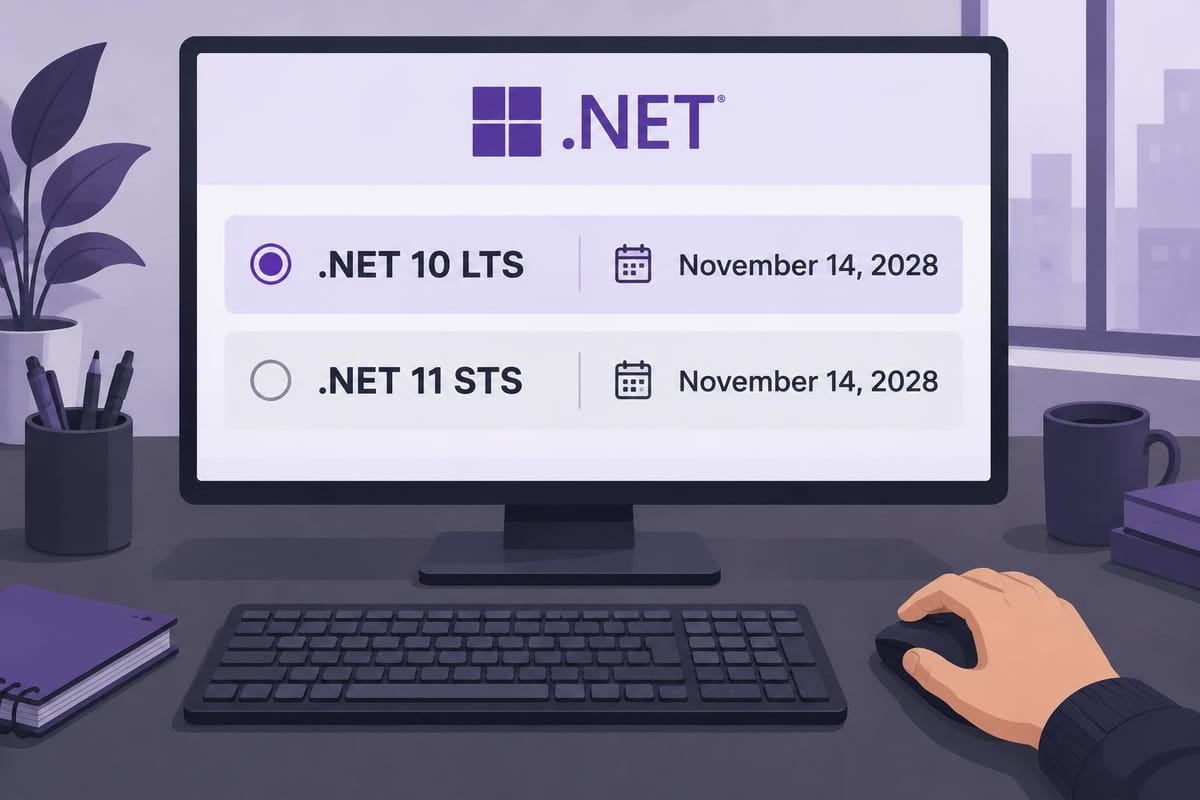
Microsoft released .NET 11 on November 10, 2026, as a Standard Term Support (STS) release supported through November 14, 2028, according to the dotnet/core release notes and Microsoft's support policy page. The Microsoft Learn overview says ".NET 11 is generally available." This is a GA release; the release notes list 11.0.0 dated 2026/11/10, after RC 3 on October 25.
The support dates make the upgrade choice simpler than the STS label suggests. The policy page lists .NET 11 (STS) and .NET 10 (LTS) with the same end-of-support date, November 14, 2028, so choosing .NET 10 today buys no longer remaining support window than .NET 11. The same page lists .NET 8 and .NET 9 as out of support as of November 10, 2026, their last patches (8.0.34 and 9.0.23) shipping that day. Teams on 8 or 9 need to migrate to keep receiving security and other fixes; their applications do not stop working. The choice is between .NET 10 and .NET 11, and it turns on features and risk tolerance, not calendar. Tech Times reached the same reading.
The policy also notes that STS and LTS releases share the same quality bar and servicing rules and differ only in length, and that supported systems must stay current on patch updates.
Three changes that matter
C# 15 union types. C# 15 is the default language version for net11.0. A union declares a closed set of case types, with implicit conversions into the union and exhaustiveness checking in switch expressions. Microsoft's example:
public union ProductLookup(Product, ProductNotFound);

string message = result switch
{
    Product p => $"Found {p.Name}",
    ProductNotFound m => $"No product with ID {m.Id}",
};
The feature was already described as stabilizing in the RC 1 post, so this is a previewed feature reaching GA. Tech Times notes these are object-based unions of existing types, not F#-style discriminated unions. System.Text.Json gained union support, which ASP.NET Core uses for JSON bodies.
Runtime Async (opt-in preview). The runtime, rather than compiler-generated state machines, handles async suspension. Microsoft's announcement states that Runtime Async remains a preview feature. What changed is narrower: projects targeting net11.0 no longer need <EnablePreviewFeatures>true</EnablePreviewFeatures>, and the runtime libraries themselves are compiled with runtime-async=on. Application projects still have to opt in per project; it is not on by default. NT Compatible reports the team wants it on by default in .NET 12. Tech Times cites a Microsoft example in which live stack frames for three nested async methods fall from 13 to 5; that is a vendor example, not an independent benchmark. Test async-heavy services under load before enabling it.
SDK startup and testing. The SDK enables a Native AOT CLI host and a warm MSBuild server by default, trimming startup for everyday commands. For Microsoft.Testing.Platform users, dotnet test gains run-level controls and result layouts, per the RC 1 notes; check CI scripts that pass VSTest-style options.
What needs checking before upgrading
Hardware. The Learn overview says minimum x86/x64 and Arm64 requirements now call for more modern instruction sets. Check build agents and older deployment targets.
Decimal conversions. A reader comment on the RC 1 post warns that double-to-decimal conversions no longer round away floating-point noise, citing a Microsoft Learn compatibility page on decimal and floating-point conversions. The commenter says this could change results in line-of-business code that casts doubles to decimal. We did not read that page, so treat it as an unverified warning. As a precaution, teams that initialize decimals from doubles rather than decimal literals may want to test those paths.
ASP.NET Core and EF Core. Microsoft's announcement lists asynchronous validation, OpenAPI 3.2, finalized SignalR authentication refresh APIs and experimental Blazor AI components. EF Core 11 requires .NET 11, so it cannot be adopted separately. Review the .NET 11 breaking changes hub, the What's new in ASP.NET Core notes and What's new in EF Core, and confirm your database provider supports EF Core 11. EF Core's SQL Server vector search is experimental. Scope note: this article did not go through those breaking-change lists line by line.
MAUI. .NET MAUI now defaults to CoreCLR, and per Microsoft Learn the optional Microsoft.Maui.Controls.Compatibility package is no longer built or shipped. Projects referencing it should migrate off it.
Who should upgrade now
Teams on .NET 8 or 9 are out of support and should move now. Landing on .NET 10 gives a more conservative baseline with the same end date as .NET 11. Teams that want union types, the SDK speedups or MAUI on CoreCLR can adopt .NET 11 with a test pass on hardware targets, test-runner flags and, as a precaution, decimal handling. Microsoft's "hundreds of performance improvements" claim is a vendor statement; no independent benchmarks were found yet.


Comments ()