Anthropic’s Opus 5.5 is cheaper — but the 40% claim depends on workload and token mix
Anthropic’s Opus 5.5 does cost less than Opus 5, but the 40% claim depends on token mix, cache use and benchmark setup.
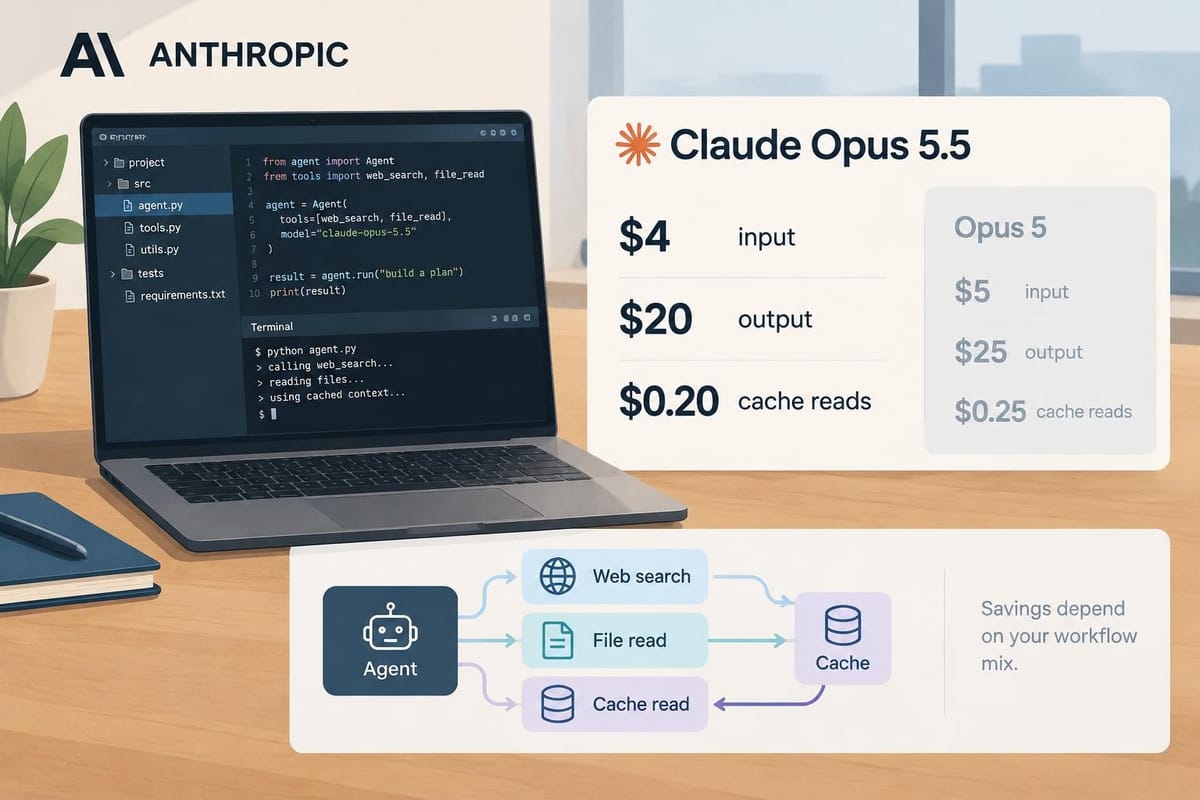
Anthropic’s Claude Opus 5.5 launch is a real price cut, but the headline “40% less” is narrower than it first sounds. The company says the new model costs $4 per million input tokens and $20 per million output tokens, down from Opus 5’s $5 and $25, while cache reads drop from $0.50 to $0.20 per million tokens and cache writes from $6.25 to $5. On Anthropic’s own pricing page, that translates to a lower bill on “typical workloads,” because the model is also described as using fewer tokens per task. The company frames the result as “about 40% less to run” for work billed by token, not a universal 40% price cut across every use case. Anthropic announcement Anthropic model page
That distinction matters for engineering teams routing coding agents. Anthropic is not claiming Opus 5.5 is simply cheaper in isolation; it is claiming a better efficiency profile in workflows where the model’s output length, tool use and cache behavior reduce total tokens consumed. The company says Opus 5.5 “costs less per token than Opus 5 and uses fewer tokens per task,” and that “work on the Claude Platform, in Claude Code, and in the Claude apps costs about 40% less for work billed by token than on Opus 5.” Anthropic model page
The benchmark language is similarly specific. Anthropic says Opus 5.5 “leads in agentic coding and knowledge work,” and that it performs at the level of Claude Fable 5.1 on most work. On its own materials, the company highlights Terminal-Bench 4.0, FrontierCode and CursorBench, all with different harnesses, effort settings and cost baselines. In one example, Anthropic says Opus 5.5 at default effort beats Opus 5 at max effort for about a fifth of the cost on Terminal-Bench 4.0, and beats GPT-5.6 Sol on CursorBench by 11 points for about a third of the cost per task. Those are useful comparisons, but they are not the same as “typical real-world coding-agent workflows” inside a production stack. Anthropic announcement
The fine print on Anthropic’s own benchmark tables shows why. The company says some results were generated with production safeguards enabled, and when safeguards intervened, other models were used to complete tasks, which could lower Opus 5.5’s score. It also notes that AutomationBench results from Zapier were run without fallback models, so safeguard interventions counted as failures. That means the headline ranking is tied to specific test rules, not a single apples-to-apples measurement across all coding agents. Anthropic announcement
For buyers, the practical question is not whether Opus 5.5 can top a benchmark chart. It is whether the cheaper token rate survives the realities of long-running agents: tool calls, retries, cache hits, latency, and how often a model needs to rework or verify its own output. Anthropic says Opus 5.5 is more than 30% faster than Opus 5 in output generation, and that fast mode can go up to 2.5x faster at a higher rate of $8 per million input tokens and $40 per million output tokens. It also raises five-hour usage limits on Pro, Max, Team and seat-based Enterprise plans. Those are concrete operational changes, but they also show the tradeoff: the cheapest path is not always the fastest path, and the fastest path is not the cheapest. Anthropic announcement Anthropic model page
Anthropic’s access terms are broad enough to matter for deployment planning. Opus 5.5 is available to Claude for Pro, Max, Ultra, Team and Enterprise users, and to developers on the Claude Platform, Amazon Web Services, Google Cloud and Microsoft Foundry. The company also says US-only inference is available at 1.1x pricing. For organizations with data residency or procurement constraints, that means the model is not just a benchmark release; it is already sitting inside the same commercial channels teams use to route work today. Anthropic model page
What Anthropic’s announcement does not prove is that every coding-agent workload gets 40% cheaper in the wild. The strongest evidence in the release is first-party: Anthropic’s own pricing tables, its own harnesses, and customer quotes that describe fewer steps, fewer tokens, and better task completion in specific internal or early-access evaluations. Those are useful signals, but they are still vendor-run tests. The closest defensible reading is that Opus 5.5 offers a real efficiency improvement — one that can be substantial in token-heavy agentic coding — while the size of the savings will depend on how often a team leans on cached context, how much the agent talks, and whether the workflow is measured by tokens, wall-clock time or successful completion. Anthropic announcement


Comments ()