Cloudflare’s new vuln-response playbook starts with triage, telemetry and fast patching
Cloudflare’s new posts show how Zero Wire triages critical vulns and how eMudhra patching adds fast blocking and source-code scanning.
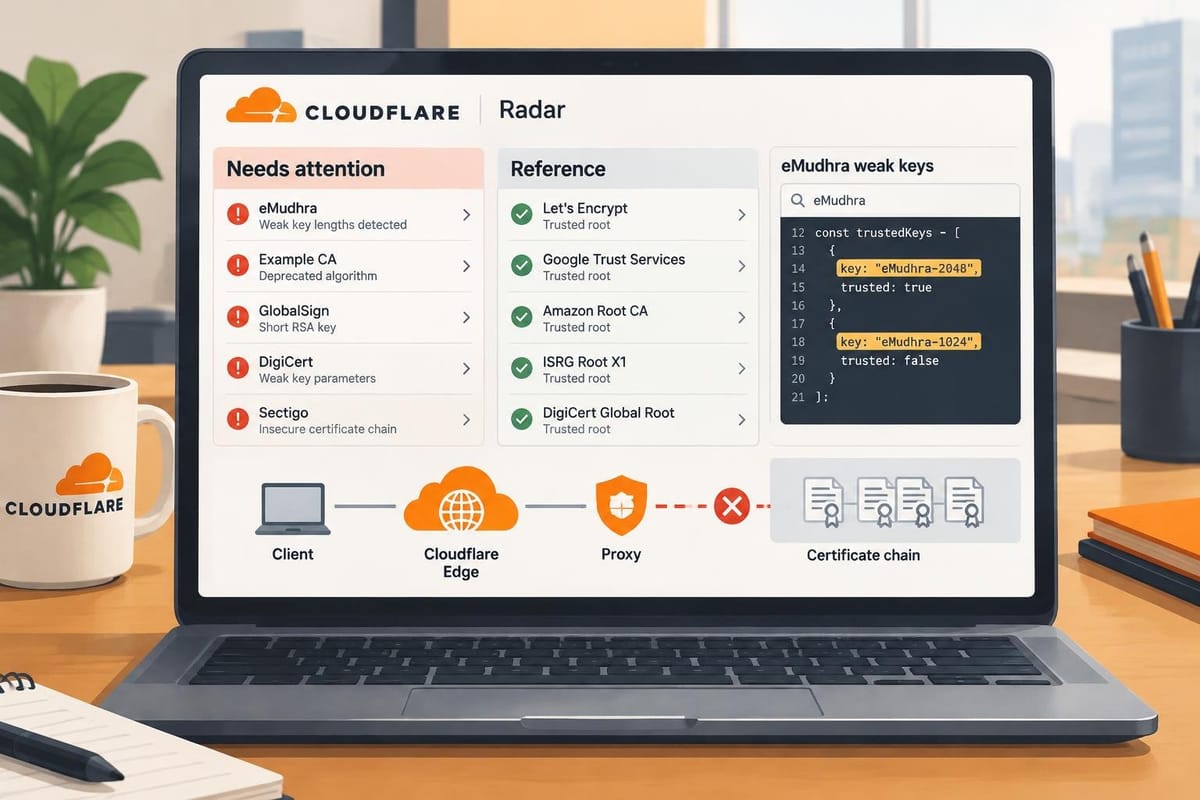
Cloudflare’s latest security posts show a shift from one-off vulnerability announcements to a more centralized response workflow: triage the issue in a public hub, pair it with live attack context, then patch the edge and audit the codebase for every place the weak trust anchor still reaches.
On Nov. 3, Cloudflare introduced Zero Wire, a hub on Cloudflare Radar for “investigating critical Internet vulnerabilities.” The company says the system groups issues into two operational buckets: “Needs attention” for problems that require active assessment or action, and “Reference” for briefings whose guidance has stabilized. Cloudflare is explicit that moving an item to “Reference” does not mean remediation is complete everywhere; it only means the briefing has settled, not that every affected system has been patched. That distinction matters for operators because it turns the hub into a triage tool, not a green-light signal for inventory cleanup. Cloudflare Zero Wire
The practical change is that vulnerability handling is no longer described as a single blog post or advisory. Zero Wire pairs plain-language summaries with attack telemetry and remediation guidance, so teams can see what needs immediate action, what is being watched, and what can wait for later review. Cloudflare’s own tagged description says the hub is meant to help teams “triage critical CVEs faster and decide how to protect your infrastructure.” Cloudflare Blog tag: Vulnerabilities
The companion Nov. 3 post on eMudhra shows how that playbook looks in practice. Cloudflare says it patched its own services “in hours” to reject vulnerable eMudhra keys and, at the same time, started AI-assisted analysis of its source code to find other systems that still trusted those weak keys. The company also says it prioritized patching critical services before public disclosure and reported no active exploitation on its own services. 4 real? Tracking exploitation and patching of eMudhra’s weak keys
That matters because the eMudhra issue is not a neat, isolated certificate problem. Cloudflare describes it as a weak-key exposure broad enough that “four, just four” could be enough to break into an unpatched connection using those certificates. In other words, the remediation problem is not just revoking one bad certificate or issuing one advisory; it is finding every system that still trusts the compromised chain and closing those paths quickly. Cloudflare’s post is notable for combining immediate mitigation, internal code scanning, and public exposure tracking in one workflow rather than treating them as separate jobs. 4 real? Tracking exploitation and patching of eMudhra’s weak keys
For operators, the clearest takeaway is that the response model is becoming more mechanical and more centralized:
- Classify fast. Put current, actionable vulnerabilities in a live queue instead of burying them in an archive.
- Link the advisory to telemetry. Pair the writeup with what is actually being seen in the wild.
- Patch the edge first. Cloudflare’s wording makes clear that critical services were updated before wider disclosure.
- Search for inherited trust. The eMudhra post shows why remediation has to include code and configuration paths that trust the vulnerable material, not just the obvious front door.
- Use automation to reduce blind spots. Cloudflare’s use of AI-assisted source-code analysis is a concrete sign that scale, not just urgency, is driving the workflow.
The other lesson is about the life cycle of vulnerability information. Zero Wire’s “Reference” state keeps older issues available after the urgent phase passes, but Cloudflare warns that older vulnerabilities can still matter if an organization has not finished remediation. That is an operationally useful model for infrastructure teams that struggle to keep old CVEs visible after the headlines move on. Cloudflare Zero Wire
Cloudflare has not turned this into a full incident-response framework, and it is not claiming to have solved the industry’s patch backlog. But the two Nov. 3 posts do show a concrete shift: critical vulnerability response is being organized around prioritized queues, live attack evidence, fast edge-side blocking and automated code search for remaining trust dependencies. That is the part other operators can borrow now, even if they do not run Cloudflare-scale infrastructure.
What teams can borrow now
The posts point to a workflow that infrastructure teams can adopt without waiting for a new product:
- maintain a short-lived “needs attention” queue for exploitable issues rather than relying on a static advisory list;
- attach current telemetry or exposure evidence to each item so patching priority is evidence-based;
- patch externally facing and customer-impacting services first;
- run code and configuration searches for any component that still trusts a compromised key, certificate, or library;
- keep an archived reference layer so older issues stay visible after emergency status expires.
That is a narrower, more operationally useful story than “Cloudflare launched a new hub.” The real change is that the company is describing vulnerability management as a repeatable response system: prioritize, observe, patch, search, and only then downgrade the urgency.
Sources
- Cloudflare, “Introducing Zero Wire, a hub for investigating critical Internet vulnerabilities” — https://blog.cloudflare.com/zero-wire
- Cloudflare, “4 real? Tracking exploitation and patching of eMudhra’s weak keys” — https://blog.cloudflare.com/emudhra-patching
- Cloudflare blog tag page with Zero Wire summary — https://blog.cloudflare.com/tag/vulnerabilities/


Comments ()